Embedded Hardware Security Module (Root of Trust) - Automotive Grade ISO 26262 ASIL-B
The RT-64x Embedded Hardware Security Module (Root of Trust) family are fully programmable, ISO 26262 ASIL-B hardware security co…
Overview
The RT-64x Embedded Hardware Security Module (Root of Trust) family are fully programmable, ISO 26262 ASIL-B hardware security cores offering security by design for automotive applications. They protect against a wide range of failures such as permanent, transient and latent faults and hardware and software attacks with state-of-the-art anti-tamper and security techniques.
As the connected nature of automobiles evolves, device architects face a growing array of emerging security threats. Whether V2X, ADAS, infotainment, or other application, one constant in automotive design is the need for an embedded hardware security module-based security implementation. The Rambus RT-640 is the ideal security co-processor for automotive uses. Built on a custom 32-bit RISC-V siloed and layered secure co-processor, along with dedicated secure memories, the RT-640 features a number of high-capability cryptographic accelerators like AES (all modes), HMAC-SHA-2 (all modes), RSA up to 4096 bits, ECC up to 521 bits, a NIST-compliant Random Bit Generator, and Fast DMA capability.
The RT-640 is certified by TÜV-SGS as ISO-26262 ASIL-B satisfying the ASIL-B Single Point Fault Metric (SPFM ≥ 90 % of faults detected) and Latent Fault Metric (LFM ≥ 60 % of faults detected). The development process for Rambus Root of Trust products is also certified to ISO-26262. To support customers, the RT-640 package comes with the proper ASIL documentation, such as the ASIL-B Failure Modes Effects and Diagnostic Analysis (FMEDA and Safety manuals).
The RT-641 is ASIL-B compliant and builds on the RT-640 with Chinese cipher algorithms SM2, SM3 and SM4, offering security by design for automotive applications that require Chinese crypto-based security support.
If higher SPFM and LFM rates are required, the RT-7xx ASIL-D configuration satisfies the ASIL-D Single Point Fault Metric (SPFM ≥ 99 % of faults detected) and Latent Fault Metric (LFM ≥ 90 % of faults detected). To support customers, the RT-7xx package comes with the proper ASIL documentation, such as the ASIL-D Failure Modes Effects and Diagnostic Analysis (FMEDA), Dependent Failure Analysis (DFA) and Safety manuals.
Satisfying use cases such as secure boot, EVITA and SHE+ HSM and AutoSAR functionality, as well as protection of propriety algorithms, the Rambus RT-64x Root of Trust family is ideally suited for automotive applications where security is imperative.
How the Root of Trust Works
The Root of Trust RT-640 is an independent hardware security core designed for integration into automotive semiconductor devices, offering secure execution of user applications, tamper detection and protection, and secure storage and handling of keys and security assets. The RT-640 implements hardware and software safety mechanisms to exceed ASIL-B safety integrity levels. It offers chipmakers a siloed approach to security; while located on the same silicon as the main processor, the secure processing core is physically separated. A layered security approach enforces access to crypto modules, memory ranges, I/O pins, and other resources, and assures critical keys are available through hardware only with no access by software. While based on a custom processor, the Rambus Root of Trust supports all common main processor architectures, including ARM, RISC-V, x86 and others.
The Root of Trust supports multi-tenant deployments by offering true multiple root of trust capabilities. Each individual Secure Application can be assigned its own unique keys, meaning permissions and access levels are set completely independent of others. Secure Applications are siloed from each other, ensuring the best approach to security. OEMs can determine access levels and permissions for each and all processes operating within the secure processor.
Secure Applications
Included with the RT-64x Hardware Root of Trust cores are a series of standard secure applications (“containers”) to speed development, including secure boot, identity management, HSM reference, and others. Dedicated EVITA-Full and EVITA-Medium Secure Applications can be offered on request. A container development kit (CSDK) is also included to allow the development of custom containers for specific use cases.
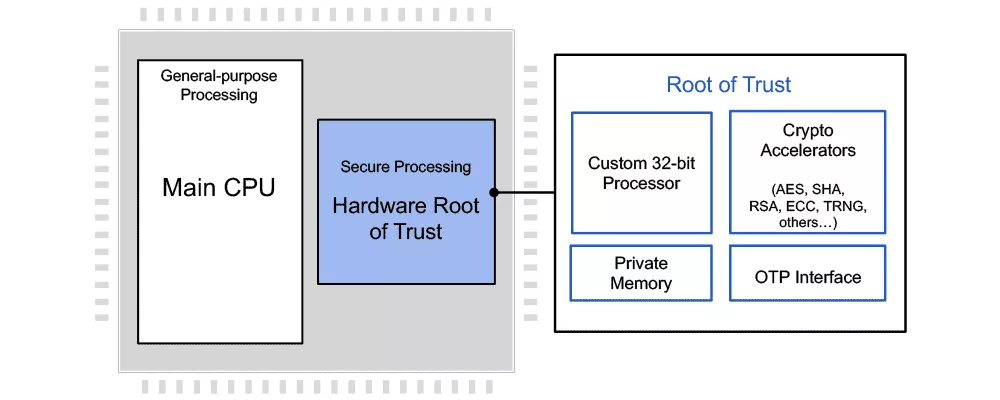
Key features
- Superior Security
- Hardware Root of Trust cores employing a custom RISC-V secure processor
- RT-640: ASIL-B Certified
- RT-641: ASIL-B Compliant with Chinese SM2, SM3 and SM4 algorithm support
- RT-7xx: ASIL-D Ready
- Hardware and software safety mechanisms to exceed ASIL-B/ASIL-D safety integrity levels
- Secure in-core processing and industry-leading anti-tamper protections
- Multi-layered security model provides protection of all components in the core
- NIST CAVP and CMVP compliant for FIPS 140-2 validation
- Enhanced Flexibility
- 3rd-party applications run securely within trusted boundary, each with its own assigned security permissions
- Complete development environment allows OEMs and users to easily develop secure applications (”containers”); standard use case application containers provided
- Support for secure provisioning of keys and firmware at manufacturing or in the field
- Support for multiple roots of trust within a single secure core
- Security Models
- Hierarchical privilege
- Secure key management policy
- Hardware-enforced isolation/access control/protection
- Error management policy
- Cryptographic Accelerators
- Includes AES, HMAC, RSA, ECC, RBG (configuration-dependent)
- Security Modules
- Canary logic for protection against glitching and overclocking
- Secure key derivation and key transport
- Life cycle management
- Secure test and debug
- Feature management
Block Diagram
Applications
- Linux Secure Boot: Implements secure boot for Linux OS, secured by the Root of Trust co-processor
- Linux Secure FOTA: Implements secure Firmware Over the Air (FOTA) updates for Linux OS
- Secure Boot: Uses the Root of Trust co-processor to assist in the secure boot process of ASICs and FPGAs
- Secure Data Storage: Uses the Root of Trust co-processor to protect user credentials or biometric templates
- Open SSL Hardening: Hardens the OpenSSL crypto operations via the Root of Trust secure co-processor
- Reference HSM: Implements a basic HSM supporting AES, HMAC, SHA256, ECDSA, X.509 certificates and secure storage
- Unique ID Generator: Creates a Root of Trust unique ID and stores it in the Root of Trust NVM (Non Volatile Memory)
What’s Included?
- Complete Documentation
- Hardware integration guide
- Hardware and software reference manuals
- Programming guides
- ASIL-B/ASIL-D FMEDA and Safety Manual
- Tools and Scripts
- Verilog for synthesis and simulation
- All scripts and support files needed for standard EDA tool flows integration deliverables
- Integration Deliverables
- Complete verification test bench and comprehensive set of test vectors
- Container-authoring software
- Boot loader and firmware, including secure RTOS and security monitor
- HLOS APIs for accessing capabilities
- Complete development environment, including compiler, assembler, debugger, simulator, reference code
Files
Note: some files may require an NDA depending on provider policy.
Specifications
Identity
Provider
Learn more about Root Of Trust IP core
Rambus CryptoManager Root of Trust Solutions Tailor Security Capabilities to Specific Customer Needs with New Three-Tier Architecture
Why Anti-tamper Sensors Matter: Agile Analog and Rambus Deliver Comprehensive Security Solution
Side-Channel Attacks On Post-Quantum Cryptography
Cryptography Does Not Equal Security
Root of Trust: A Security Essential for Cyber Defense
Frequently asked questions about Root of Trust IP cores
What is Embedded Hardware Security Module (Root of Trust) - Automotive Grade ISO 26262 ASIL-B?
Embedded Hardware Security Module (Root of Trust) - Automotive Grade ISO 26262 ASIL-B is a Root Of Trust IP core from Rambus, Inc. listed on Semi IP Hub.
How should engineers evaluate this Root Of Trust?
Engineers should review the overview, key features, supported foundries and nodes, maturity, deliverables, and provider information before shortlisting this Root Of Trust IP.
Can this semiconductor IP be compared with similar products?
Yes. Buyers can compare this product with similar semiconductor IP cores or IP families based on category, provider, process options, and structured technical specifications.