Display Port 2.0 Verification IP
Display port 2.0 is the serial communication protocol developed by Video Electronics Standards Association(VESA) to support the v…
Overview
Display port 2.0 is the serial communication protocol developed by Video Electronics Standards Association(VESA) to support the video,audio and other data between a source device and sink device. Display port 2.0 VIP can be used to verify transmitter or Receiver device following the Display port basic protocol as defined in Display port 2.0.
Display Port 2.0 Verification IP is supported natively in SystemVerilog, VMM, RVM, AVM, OVM, UVM, Verilog, SystemC, VERA, Specman E and non-standard verification env
Display Port 2.0 Verification IP comes with optional Smart Visual Protocol Debugger (Smart ViPDebug), which is GUI based debugger to speed up debugging.
Key features
- Full Display port 2.0 source device and sink device functionality.
- Supports backward compatibility with previous versions upto DPv1.4a
- Supports multi lanes upto 4 lanes.
- Supports control symbols for framing.
- Supports serial & parallel bit ordering.
- Supports Interlaced & non-interlaced video stream.
- Supports main link, Aux link and Hot plug functionality.
- Supports Fast link training.
- Supports Full link training.
- Supports skip the link training.
- Supports Spread Spectrum clocking (SSC).
- Supports I2C over AUX CH to access EDID, Display ID.
- Supports Symbol Stuffing and Transfer Unit.
- Supports 3D stereo.
- Supports ANSI8B10B encoding / decoding.
- Supports 128b/132b channel coding
- Supports Serialization and de-serialization.
- Supports RGB, YCBCR444, YCBCR422, YCBCR420 and Y-only RAW color format.
- Supports Main Stream Attribute (MSA) packets.
- Supports following Secondary packets,
- Audio timestamp
- Audio stream
- Extension
- Audio copy management
- ISRC
- VSC
- Camera SDP 8 to 15
- Info frame formats
- VSC extension VESA
- VSC extension CEA/CTA
- Picture Parameter Set (PPS).
- Adaptive-Sync SDP
- Supports Split SDP for both SST and MST mode.
- Supports packing of all audio formats supported by IEC 60958-1, IEC 60958-3, IEC 60958-4, IEC 61937-1, IEC 61937-3, CEA 861-F/CTA-861, CEA-861.2/CTA-861.2, CEA-861.3/CTA-861.3,CEA 861-G
- Supports both 128b132b channel encoding and 8b10b channel encoding training pattern sequence(128b132b_TPS1,128b132b_TPS2,TPS1,TPS2,TPS3 and TPS4).
- Supports interlane skew insertion in source mode.
- Supports deskew in sink device mode.
- Supports scrambler as in Display port 2.0 specification.
- Supports for dynamic Scrambler enable and disable
- Supports Multi Stream Transport (MST) operation.
- Supports Advanced Link Power Management to reduce wake latency
- Supports GTC-based video timing synchronization
- Supports Display Stream Compression (DSC) up to version1.2a.
- Supports Cyclic Redundancy Checks for Display Stream Compression
- Supports Forward Error Correction (FEC).
- Supports 8bit and 16bit RAW interfaces.
- Supports 10bit, 20bit and 40bit parallel interfaces.
- Supports High-bandwidth Digital Content Protection System version1.3 (HDCP v1.3)
- Supports High-bandwidth Digital Content Protection System version2.2 (HDCP v2.2)
- Supports for HDCP2.2 with full authentication.
- Supports for HDCP2.2 with bypass the authentication.
- Supports High-bandwidth Digital Content Protection System version2.3 (HDCP v2.3)
- Detects and reports the following errors,
- Invalid control character
- Invalid data character
- Invalid 10bit code
- Sync errors
- Scrambler errors
- Single and multi bit ECC errors
- Invalid packing injection and detection
- Supports LT-tunable Phy Repeater(LTTPR).
- Supports Horizontal Blanking Expansion
- Supports jitter insertion for Main link Clock and Aux Channel Clock
- Supports RBR, HBR, HBR2, HBR3, UHBR10, UHBR20, UHBR13.5
- Supports Panel Replay
- Monitors, detects and notifies the test bench of significant events such as transactions, warnings, timing and protocol violations.
- Status counters for various events on bus.
- Callbacks in node transmitter, receiver and monitor for user processing of data.
- Display port 2.0 Verification IP comes with complete testsuite to test every feature of Display port version 2.0 specification.
- Functional coverage for complete Display port 2.0 features.
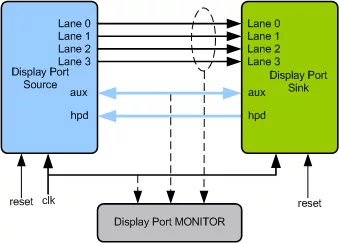
Block Diagram
Benefits
- Faster testbench development and more complete verification of Display port 2.0 designs.
- Easy to use command interface simplifies testbench control and configuration of receiver and transmitter.
- Simplifies results analysis.
- Runs in every major simulation environment.
What’s Included?
- Complete regression suite containing all the Display port testcases.
- Examples showing how to connect various components, and usage of Transmitter, Receiver and Monitor.
- Detailed documentation of all class, task and function's used in verification env.
- Documentation contains User's Guide and Release notes.
Files
Note: some files may require an NDA depending on provider policy.
Specifications
Identity
Provider
Learn more about Displayport IP core
VESA Adaptive-Sync V2 Operation in DisplayPort VIP
Understanding LTTPR: Enabling High-Speed DisplayPort Interconnects in Complex System Designs
DisplayPort 2025: Navigating the Next Wave of Display Innovation
Audio Transport in DisplayPort VIP
DisplayPort 2.1 vs DisplayPort 1.4: A Detailed Comparison of Key Features
Frequently asked questions about DisplayPort IP cores
What is Display Port 2.0 Verification IP?
Display Port 2.0 Verification IP is a Displayport IP core from SmartDV Technologies listed on Semi IP Hub.
How should engineers evaluate this Displayport?
Engineers should review the overview, key features, supported foundries and nodes, maturity, deliverables, and provider information before shortlisting this Displayport IP.
Can this semiconductor IP be compared with similar products?
Yes. Buyers can compare this product with similar semiconductor IP cores or IP families based on category, provider, process options, and structured technical specifications.