Vendor: Global UniChip Corp. (GUC) Category: Single-Protocol PHY

TSMC CLN3FFP HBM4 PHY

IGAHBMZ03A is a High Bandwidth Memory 4 Physical Layer (HBM4 PHY) that is compliant with JEDEC HBM4 DRAM Specification JESD270-4.

Overview

IGAHBMZ03A is a High Bandwidth Memory 4 Physical  Layer (HBM4 PHY) that is compliant with JEDEC HBM4 DRAM Specification JESD270-4. Fabricated in the TSMC 3 nm Advanced process node (N3P), it supports the data rate up to 12 Gbps per data pin in the DDR PHY Interface (DFI)-like 1:4 clock frequency ratio (HBM4 controller clock: WDQS = 1:4). The signal and power integrity is analyzed by the GUC design flow to meet all signal and power requirements.

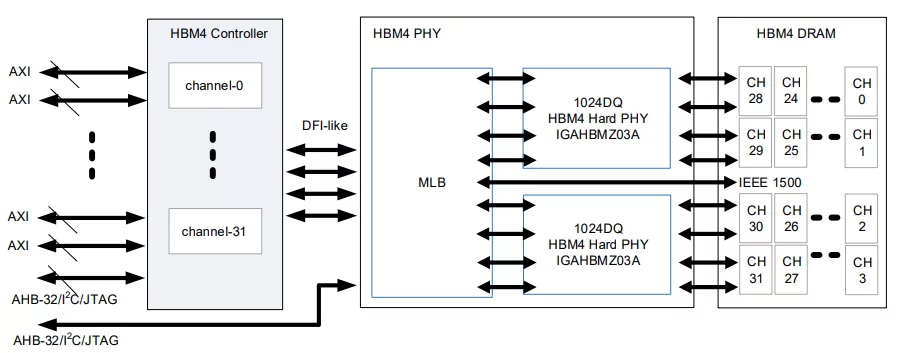
GUC HBM4 PHY includes a hard PHY and a Register Transfer Level (RTL) soft module. The hard PHY, IGAHBMZ03A, includes Command Address (CA) modules, data modules, IO pads, a Phase-Locked Loop (PLL), and Delay-Locked Loops (DLLs). The RTL soft module, also called Miscellaneous Logic Block (MLB), included to work with the hard PHY for functions, such as the training logic, the register controller interface, the Built-In Self-Test (BIST) logic, and the IEEE 1500 function logic.

Key features

  • HBM4 data rate: up to 12 Gbps
  • DFI-like 1:4 clock frequency ratio  (HBM4 controller clock: WDQS = 1:4)
  • Only Burst Length 8
  • AWORD/DWORD bus parity
  • Programmable parity latency
  • HBM4 Data Bus Inversion (DBI)
  • 64DQ ECC/SEV per channel
  • HBM4 Hard PHY delivered as a hard macro including IO, PLL, and DLL
  • Internal Loopback and WRITE/READ BIST
  • HBM4 loopback test, including MISR and LFSR modes
  • IEEE 1500 Instruction
  • HBM4 lane repairs with redundant pins for row/column/data
  • HBM4 Duty Cycle Adjuster (DCA) and Duty Cycle Monitor (DCM) training.
  • HBM4 AWORD write eye/VREF/perbit training training
  • HBM4 WDQSK2CK training
  • HBM4 DWORD write/read eye/VREF/perbit training
  • Broken lane detect and repair
  • DLL compensation to overcome VT  variation
  • HBM4 DWORD write eye retrain to  overcome Device VT variation

Technology

  • Process: TSMC 3 nm 0.75 V/1.2 V CMOS LOGIC FinFET Advanced Process 
  • Special layer & device:  SVT, LVT, LVTLL, ULVT, ULVTLL and ELVT
  • Metal scheme: 1P17M  (1Xa_h_1Xb_v_1Xc_h_1Xd_v_1Ya_h_1Yb_v_4Y_hvhv_4Yy2Z)

Block Diagram

Applications

  • For applications with high performance & high bandwidth memory, such as AI/ HPC.

Files

Note: some files may require an NDA depending on provider policy.

Specifications

Identity

Part Number
IGAHBMZ03A
Vendor
Global UniChip Corp. (GUC)

Provider

Global UniChip Corp. (GUC)
HQ: Taiwan
Global Unichip Corp. (GUC), a dedicated full service SoC (System On Chip) Design Foundry based in Taiwan, was founded in 1998. GUC provides total solutions from silicon-proven IPs to complex time-to-market SoC turnkey services. GUC is committed to providing the most advanced and the best price-performance silicon solutions through close partnership with TSMC, GUC major shareholder, and other key packaging and testing power houses. With state of the art EDA tools, advanced methodologies, and experienced technical team, GUC ensures the highest quality and lowest risks to achieve first silicon success. GUC has established a global customer base throughout Greater China, Japan, Korea, North America, and Europe. Its track-record in complex SoC designs has brought benefits to customers in time to revenue at the lowest risk.

Learn more about Single-Protocol PHY IP core

UFS Goes Mainstream

UniversalFlash Storage (UFS) was created for mobile applications and computer systems requiring high performance and low power consumption. These systems typically use embedded Flash based on the JEDEC standard eMMC. UFS was defined by JEDEC as the evolutionary replacement for eMMC offering significantly higher memory bandwidth. The standard builds on existing standards such as the SCSI command set, the MIPI Alliance M-PHY and UniPro as well as eMMC form factors to simplify adoption and development.

Design IP Faster: Introducing the C~ High-Level Language

In this paper, we introduce a new high-level, dataflow programming language called C~ (“C flow”) that further increases productivity by raising the level of abstraction from behavioral descriptions, while overcoming the limitations of C for hardware design. We present the syntax and semantics of this language, and the framework that provides hardware and software code generation. This paper illustrates the benefits of using C~ for hardware design of a IEEE 802.3 MAC, synthesized for FPGA and for 90nm CMOS technology.

Universal Flash Storage: Mobilize Your Data

Universal Flash Storage (UFS) was created for mobile applications and computer systems requiring high performance and low power consumption. These systems typically use embedded Flash based on the JEDEC standard eMMC. UFS was defined by JEDEC as the evolutionary replacement for eMMC offering significantly higher memory bandwidth. The standard builds on existing standards such as the SCSI command set, the MIPI Alliance M-PHY and UniProSM as well as eMMC form factors to simplify adoption and development.

Can MIPI and MDDI Co-Exist?

Since MIPI and MDDI standards both target interfaces to cameras and displays on mobile devices, are two separate standards really needed?

Frequently asked questions about Single-Protocol PHY IP

What is TSMC CLN3FFP HBM4 PHY?

TSMC CLN3FFP HBM4 PHY is a Single-Protocol PHY IP core from Global UniChip Corp. (GUC) listed on Semi IP Hub.

How should engineers evaluate this Single-Protocol PHY?

Engineers should review the overview, key features, supported foundries and nodes, maturity, deliverables, and provider information before shortlisting this Single-Protocol PHY IP.

Can this semiconductor IP be compared with similar products?

Yes. Buyers can compare this product with similar semiconductor IP cores or IP families based on category, provider, process options, and structured technical specifications.

×
Semiconductor IP