NVIDIA GPU Confidential Computing Demystified
By Zhongshu Gu 1, Enriquillo Valdez 1, Salman Ahmed 1, Julian James Stephen 1, Michael Le 1, Hani Jamjoom 1, Shixuan Zhao 2 and Zhiqiang Lin 2
1 IBM Research
2 Ohio State University
Abstract
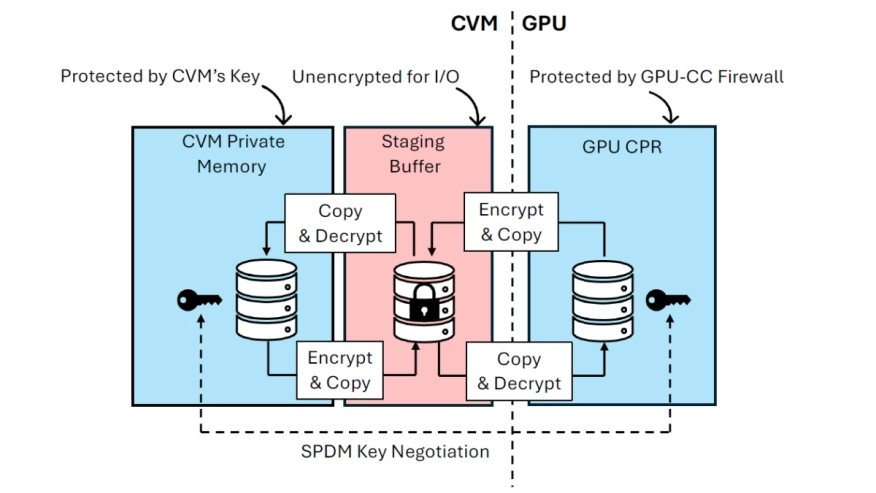
GPU Confidential Computing (GPU-CC) was introduced as part of the NVIDIA Hopper Architecture, extending the trust boundary beyond traditional CPU-based confidential computing. This innovation enables GPUs to securely process AI workloads, providing a robust and efficient solution for handling sensitive data. For end users, transitioning to GPU-CC mode is seamless, requiring no modifications to existing AI applications. However, this ease of adoption contrasts sharply with the complexity of the underlying proprietary systems. The lack of transparency presents significant challenges for security researchers seeking a deeper understanding of GPU-CC's architecture and operational mechanisms.
The challenges of analyzing the NVIDIA GPU-CC system arise from a scarcity of detailed specifications, the proprietary nature of the ecosystem, and the complexity of product design. In this paper, we aim to demystify the implementation of NVIDIA GPU-CC system by piecing together the fragmented and incomplete information disclosed from various sources. Our investigation begins with a high-level discussion of the threat model and security principles before delving into the low-level details of each system component. We instrument the GPU kernel module -- the only open-source component of the system -- and conduct a series of experiments to identify the security weaknesses and potential exploits. For certain components that are out of reach through experiments, we propose well-reasoned speculations about their inner working mechanisms. We have responsibly reported all security findings presented in this paper to the NVIDIA PSIRT Team.
To read the full article, click here
Related Semiconductor IP
- E-Series GPU IP
- Arm's most performance and efficient GPU till date, offering unparalled mobile gaming and ML performance
- Highest performance automotive GPU IP, with revolutionary functional safety technology
- High performance GPU for cloud gaming with DirectX support
- Arm’s latest flagship GPU is based on the new 5th Gen GPU architecture, bringing the next generation of visual computing to mobile
Related Articles
- Analyzing Modern NVIDIA GPU cores
- ACE: Confidential Computing for Embedded RISC-V Systems
- Reconfiguring Design -> Adaptive computing makes efficient use of silicon
- Reconfiguring Design -> Reconfigurable computing aims at signal processing
Latest Articles
- RISC-V Functional Safety for Autonomous Automotive Systems: An Analytical Framework and Research Roadmap for ML-Assisted Certification
- Emulation-based System-on-Chip Security Verification: Challenges and Opportunities
- A 129FPS Full HD Real-Time Accelerator for 3D Gaussian Splatting
- SkipOPU: An FPGA-based Overlay Processor for Large Language Models with Dynamically Allocated Computation
- TensorPool: A 3D-Stacked 8.4TFLOPS/4.3W Many-Core Domain-Specific Processor for AI-Native Radio Access Networks