SoK: From Silicon to Netlist and Beyond Two Decades of Hardware Reverse Engineering Research
By Zehra Karadağ 1,2, Simon Klix 2, René Walendy 2, Felix Hahn 2, Kolja Dorschel 2, Julian Speith 2, Christof Paar 2, Steffen Becker 1,2
1 Ruhr University Bochum
2 Max Planck Institute for Security and Privacy
Abstract
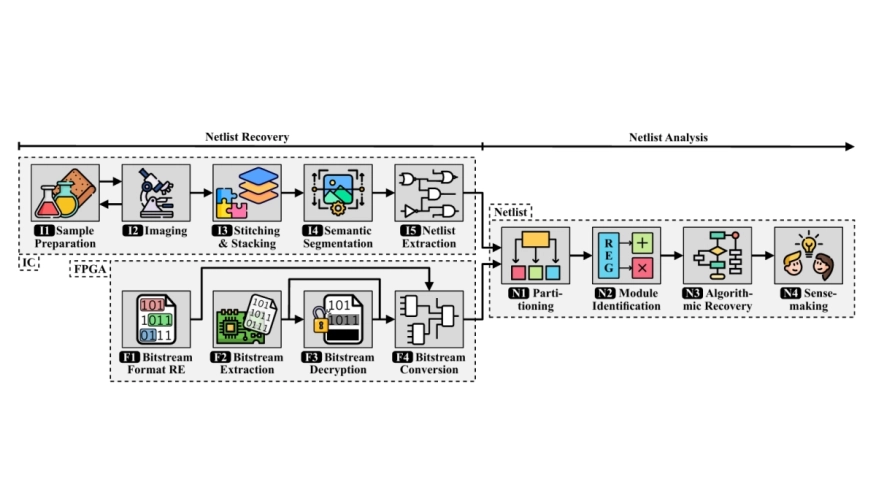
As hardware serves as the root of trust in modern computing systems, Hardware Reverse Engineering (HRE) is foundational for security assurance. In practice, HRE enables critical security applications, including design verification, supply-chain assurance, and vulnerability discovery. Over the past two decades, academic research on Integrated Circuit (IC), Field-Programmable Gate Array (FPGA), and netlist reverse engineering has steadily grown. However, knowledge remains fragmented across domains and communities, which complicates assessing the state of the art and hampers identifying shared research challenges. In this paper, we present a systematization of knowledge based on an in-depth analysis of 187 peer-reviewed publications. Using this corpus, we characterize technical methods across the HRE workflow and identify technical and organizational challenges that impede research progress. We analyze all 30 artifacts from our corpus using established artifact evaluation practices. Key results could be reproduced for only seven publications (4%). Based on our findings, we derive stakeholder-centric recommendations for academia, industry, and government to enable more coordinated and reproducible HRE research. These recommendations target three cross-cutting opportunities: (i) improving reproducibility and reuse via artifact-centric practices, (ii) enabling rigorous comparability through standardized benchmarks and evaluation metrics, and (iii) improving legal clarity for public HRE research.
To read the full article, click here
Related Semiconductor IP
- UCIe D2D Adapter & PHY Integrated IP
- Low Dropout (LDO) Regulator
- 16-Bit xSPI PSRAM PHY
- MIPI CSI-2 CSE2 Security Module
- ASIL B Compliant MIPI CSI-2 CSE2 Security Module
Related Articles
- The Growing Imperative Of Hardware Security Assurance In IP And SoC Design
- Larger IC makers won't shift to foundries, concludes research firm
- Introduction to XML for engineering applications
- Reverse Disaggregation - How Silicon IP Will Change the Semiconductor Supply Chain
Latest Articles
- RISC-V Functional Safety for Autonomous Automotive Systems: An Analytical Framework and Research Roadmap for ML-Assisted Certification
- Emulation-based System-on-Chip Security Verification: Challenges and Opportunities
- A 129FPS Full HD Real-Time Accelerator for 3D Gaussian Splatting
- SkipOPU: An FPGA-based Overlay Processor for Large Language Models with Dynamically Allocated Computation
- TensorPool: A 3D-Stacked 8.4TFLOPS/4.3W Many-Core Domain-Specific Processor for AI-Native Radio Access Networks