SoC-e Announces New Release of Managed Ethernet Switch (MES) IP Core Supporting DLR for Ethernet/IP
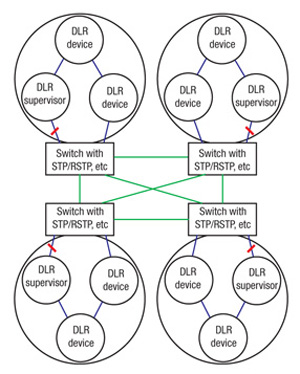
January 24, 2018 -- Device Level Ring (DLR) is a Layer-2 protocol that provides media redundancy in a ring topology. The DLR protocol is intended primarily for implementation in Ethernet/IP end-devices that have two Ethernet ports and embedded switch technology. The DLR protocol provides fast network fault detection and reconfiguration in order to support the most demanding control applications.
A DLR network includes at least one node configured to be a Ring Supervisor, and any number of Beacon Based Nodes. It is assumed that all the ring nodes have at least two Ethernet ports and incorporate embedded switch technology.
The new realease of SoC-e’s MES IP Core (Managed Ethernet Switch) fully supports DLR protocol. The IP Core allows to implement a DLR end-device, with embedded switching capabilities and supports multiple Ethernet interfaces. The following network node configurations can be implemented with the MES IP Core:
- Ring Supervisor Node
- Beacon Based Node
Related Semiconductor IP
- 10M/100M/1G Managed Ethernet Switch IP Core
- 10M/100M/1G/10G Managed/Unmanaged (TSN) Ethernet Switch IP Core
- 10M/100M/1G Managed Redundant Switch IP Core
- 10M/100M/1G Multiport TSN Ethernet Switch IP Core
- Configuration-over-Ethernet (COE) IP Core
Related News
- SoC-e's Managed Ethernet Switch now supports up-to 32 ports
- CAST Introduces MAC-SEC-MG IP Core for Secure 10G+ Ethernet SoC Designs
- SOC-E and SafeCore Devices to unveil a new TSN End Point IP Core: AeroTSN-EP
- CAST Introduces 100 Gbps TCP/IP Hardware Stack IP Core for High-Performance ASIC and FPGA Designs
Latest News
- GF unveils roadmap to deliver the world’s most advanced FD-SOI platform for Physical AI
- GlobalFoundries marks Dresden expansion milestone, announces next-generation platform for Physical AI
- TSMC September 2026 Revenue Report
- Lattice Collaborates with Arm to Advance Secure, Adaptable AI Data Center Infrastructure
- ZLG Selects CAST CAN XL and TSN IP for Next-Generation Vehicle-Network Development and Test Tools