Imec unlocks fourfold UWB range extension using world-first narrowband receiver chip compliant with IEEE 802.15.4ab standard
Building on this, imec further demonstrates the first full transceiver architecture compliant with IEEE 802.15.4ab, delivering up to a 32x improvement in ranging performance through combined receiver, transmitter, and IEEE 802.15.4ab standard innovations
LEUVEN (Belgium), JUNE 9, 2026 — At the IEEE MTT-S RF Integrated Circuits (IMS/RFIC) Symposium this week, imec – a world-leading research and innovation hub in advanced semiconductor technologies – unveils the first narrowband receiver chip that complies with, and validates, the narrowband assistance (NBA) mechanism defined in the upcoming IEEE 802.15.4ab UWB standard. Imec’s implementation supports a fourfold increase in ranging distance, and marks a key step toward reliable, scalable, and energy-efficient UWB deployments in dense wireless and interference-rich environments.
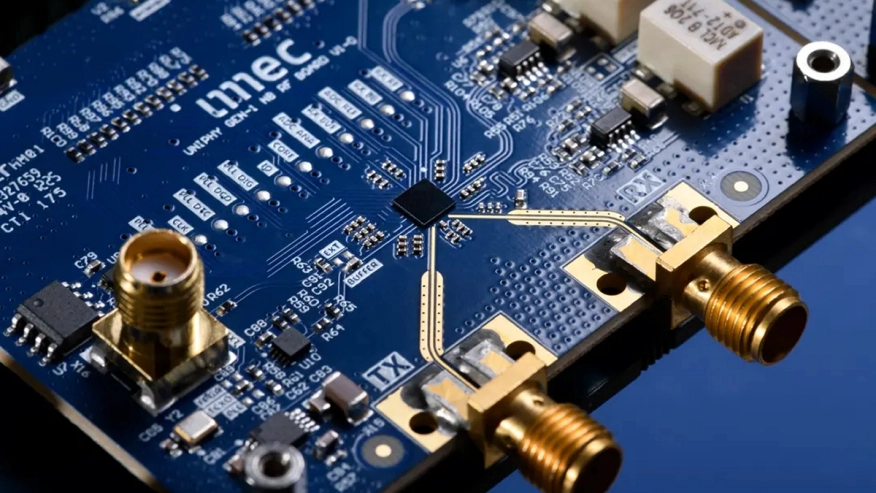 Impulse-radio ultrawideband (IR‑UWB) technology is gaining strong momentum, driven by its integration into smartphones, wearables, automotive platforms, and IoT devices. Yet, limitations in range, scalability, and robustness – particularly in dense wireless, interference-rich environments – continue to constrain its full potential.
The IEEE 802.15.4ab UWB standard, expected to be published later this year, marks an important step toward overcoming these limitations. A key concept introduced in this standard is narrowband assistance (NBA). It allows combining narrowband signaling (in the 5–6GHz frequency range) for device discovery, synchronization, and coordination with UWB’s precise ranging and localization. Leveraging the narrowband link, the system can operate more efficiently, better support multi-user scalability, and maintain reliable communication at lower signal levels and over longer distances.
The NBA mechanism, however, introduces stringent dynamic-range and blocker-tolerance requirements: to enable the required link budget, the narrowband receiver must exhibit a very low noise figure, allowing it to detect weak signals. At the same time, it must maintain robust operation in the presence of strong Wi-Fi interferers operating in overlapping or adjacent frequency bands.
The world’s first narrowband receiver to comply with the IEEE 802.15.4ab standard
In a world-first, imec has developed and validated a narrowband receiver that enables the NBA mechanism defined in the upcoming IEEE 802.15.4ab standard. Implemented in a 22nm CMOS process, imec’s design features a novel second-order transimpedance amplifier (TIA) with precisely controlled filtering. It suppresses strong out-of-band interferers – such as nearby Wi-Fi signals – early in the signal chain, while preserving the desired signal and maintaining a low noise figure.
Complementing this, the architecture integrates a high dynamic-range clip detector that continuously monitors the receiver’s operating conditions. When strong interference is detected, the system dynamically switches to a more robust mode, activating additional filtering and gain control to prevent distortion. In low-interference conditions, the receiver remains in a low-power mode, ensuring energy-efficient operation.
“These innovations deliver a step-change in receiver performance,” said Anoop Bhat, senior researcher at imec. “Our low-power design – consuming less than 6mW – achieves a 9dB improvement in dynamic range over state-of-the-art implementations, maintains a low noise figure of 3.2dB, and tolerates Wi-Fi blockers around –32dBm. By preserving sensitivity to weak signals under strong interference, the RX enables reliable narrowband-assisted UWB, supporting a fourfold increase in ranging distance.”
“Building on this, we also demonstrated the first full transceiver architecture compliant with IEEE 802.15.4ab – delivering up to a 32x improvement in ranging performance through combined receiver, transmitter, and IEEE 802.15.4ab standard innovations.”
From robotics, and AR glasses to shaping tomorrow’s low-power wireless systems
Imec’s work paves the way for a new class of applications that require secure, precise, and low-latency relative positioning and synchronization in dense wireless environments. Potential use cases of narrowband-assisted UWB include robot-to-robot coordination, or AR glasses interacting with their surroundings.
“As a next step, we are exploring how this NBA architecture can be extended to other low-power wireless systems, including future evolutions of Bluetooth – such as Bluetooth Higher Bands,” added Mitra Gilasgar, portfolio manager low-power wireless at imec. “In parallel, we engage with industry partners to accelerate the IP transfer and integration of this technology into commercial platforms.”
These results will be presented during the technical session on “mm-Wave FMCW Radars & UWB Transceivers” at the IEEE MTT-S RF Integrated Circuits (IMS/RFIC) Symposium (Tue 9 Jun, 08:00 - 09:40).
Explore UWB IP:
- Low Power Ultra-wideband (UWB) IP
- Silicon solutions & Protocols and Software applications for Ultra Wideband Technologies
About imec
Imec is a world-leading research and innovation hub in advanced semiconductor technologies. Leveraging its state-of-the-art R&D infrastructure and the expertise of over 6,500 employees, imec drives innovation in semiconductor and system scaling, artificial intelligence, silicon photonics, connectivity, and sensing.
Imec’s advanced research powers breakthroughs across a wide range of industries, including computing, health, automotive, industry, consumer electronics, aerospace and security. Through IC-Link, imec delivers customized solutions, from concept to full-scale manufacturing, to meet the most advanced design and production needs. Through imec.ventures, imec creates, co‑creates new ventures, and supports existing semiconductor deep‑tech companies to scale-up.
Imec collaborates with global leaders across the semiconductor value chain, as well as with technology companies, start-ups, academia, and research institutions in Flanders and worldwide. Headquartered in Leuven, Belgium, imec has research facilities in Belgium, across Europe, the USA and the GCC region, and representation on three continents. In 2025, imec reported revenues of €1.2 billion.
For more information, visit www.imec-int.com
Related Semiconductor IP
- Low Power Ultra-wideband (UWB) IP
- Silicon solutions & Protocols and Software applications for Ultra Wideband Technologies
- 1Gbit/s LDPC Decoder and Encoder (WiMedia UWB)
- 3 to 10GHz Low Noise Amplifier for UWB Application
- Multi-protocol wireless plaform integrating 802.11ax (Wi-Fi 6), Bluetooth 5.4 Dual Mode, 802.15.4 (for Thread, Zigbee and Matter)
Related News
- Imec pioneers unique, low-power UWB receiver chip: 10x more resilient against Wi-Fi and (beyond) 5G interference
- IMEC realizes world's first digital UWB transmitter IC for IEEE 802.15.4a
- Imec implements multi-mode digital TV receiver on reconfigurable processor with record area efficiency
- Imec Showcases World's First Sub-5mW, IEEE 802.15.4z Ultra-Wideband Transmitter Chip
Latest News
- GF unveils roadmap to deliver the world’s most advanced FD-SOI platform for Physical AI
- GlobalFoundries marks Dresden expansion milestone, announces next-generation platform for Physical AI
- TSMC September 2026 Revenue Report
- Lattice Collaborates with Arm to Advance Secure, Adaptable AI Data Center Infrastructure
- ZLG Selects CAST CAN XL and TSN IP for Next-Generation Vehicle-Network Development and Test Tools