Liquid Design Systems Represents DCT in Japan, Distributing High-definition Embedded Software to Connect Smartphone/tablet PCs with Large Screens
No Image Degradation and Very Low Latency Mirroring Solution Which Works on Wi-Fi
November 19, 2012 -- Liquid Design Systems, Inc. (“Liquid Design”), a leading provider of semiconductors and IPs in Japan, announced today that it is starting distribution of Dream Chip Technologies GmbH (“DCT”) product, “XBounds”, which is an embedded software solution which works on Wi-Fi to connect smartphones, tablet PCs, and portable game appliances to large screens such as TVs and projectors in HD and with hardly any latency.
DCT, with the assistance from the German government, was established in 1991 as an affiliate of SiCan, which specializes in video CODEC technology. After its acquisition by Silicon Image in the U.S. in 2006, DCT became an independent company by the MBO(management buy out) in 2010 and DCT’s expertise is in image IPs. XBounds was originally developed by ex-Nokia and Infineon engineers (β version announced in March 2012) and it has been available from Liquid Design in Japan from April 2012.
Differentiated technology than conventional mirroring:
Currently HDMI and MHL cables are used in order to connect smartphones with TV monitors. However, in order to enhance the usability, wireless connection standards utilizing wireless LAN are being deployed (wireless HD image transmission) and the method called mirroring which is to compress, transmit, decompress and display images has become widely available.
XBounds is different from any conventional mirroring technology which is to simply compress images on the handset side, transmit, and decompress them and display them on the display side. XBounds approach is to send only the packet information, video/audio, and OpenGL (graphic processing programming interface) commands from smartphones (with Android, Linux, and Windows mobile) and mirror the transmitted images by re-rendering in GPU, utilizing a small dedicated device which is connected to the HDMI terminal on the TV side (a dongle: see Fig. 2) or utilizing a smartphone handset instead of the dongle. Therefore, the data to be transmitted can be kept small (e.g. 50kbyte/sec for Angry Birds) and therefore if smartphones are used both on transmission and receiving sides, their batteries can support more than 2 hours of image transmission.
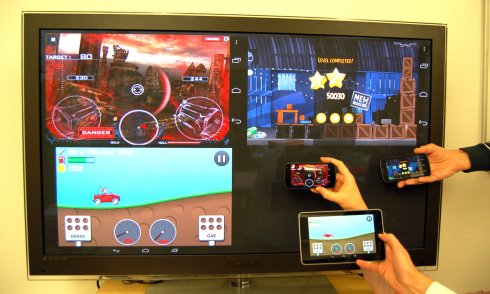
The characteristics of this technology is that there is hardly any latency on the receiving side (less than 10ms) and no image quality degradation. For example, the images transmitted from smartphones can be displayed in HD on larger than 100-inch monitor without feeling any delay. Games can be played almost in real-time and XBounds supports split-screen (up to four split screens). As shown in Fig. 1, multiple users can play mobile games with each other on a large screen in a synchronous manner, utilizing XBounds.
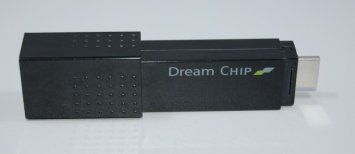
(Fig. 2 Dongle: prototype)
Low NRE (development cost) and Easy Deployment
For XBounds deployment, there is no need to develop dedicated chips and incorporate them into products. The technology utilizes GPUs which are already included in smartphones and tablet PCs so that the XBounds software IP can be only incorporated into the smartphones and tablets and high-performance mirroring becomes available. Therefore, as long as the OS information of newly-launched smartphones, tablet PCs, and portable game devices is available, XBounds solution can be deployed within about 1 month into such new products. Also, smartphones which are already available in the market for the past few years (e.g. with 200MHz CPUs) could benefit from high-quality mirroring as well.
Product Specification (xBounds 2.0, November 2012 version):
- Full GUI mirroring
- Application mirroring (e.g. pdf viewer, open office etc.)
- Game/Sound XBounds
- Device to device XBounds
- Video/Audio streaming
- Multi device mirroring
- Open GL|ES 1.0 to 2.0 translation
- Support for multiple I/O interface such as Wi-Fi, Wi-Fi Direct, HDMI, USB, Bluetooth, TCP/UDP IP and various standards such as OpenGL|ES, DLNA, UPnP, and HDCP
Price and availability:
XBounds is available in a form of IP core and either users or Liquid Design can incorporate the solution into user products. IP licensing agreement will be necessary in order to deploy XBounds. Please contact Liquid Design for further information.
Related Semiconductor IP
- UCIe D2D Adapter & PHY Integrated IP
- Low Dropout (LDO) Regulator
- 16-Bit xSPI PSRAM PHY
- MIPI CSI-2 CSE2 Security Module
- ASIL B Compliant MIPI CSI-2 CSE2 Security Module
Related News
- proteanTecs and Dream Chip Technologies Announce Collaboration to Advance Functional Safety in Automotive and HPC Markets
- Synopsys and GlobalFoundries Establish Pilot Program to Bring Chip Design and Manufacturing to University Classrooms
- SmartSoC Solutions Partners with Cortus to Advance Chip Design and Manufacturing for SIM Cards, Smart Cards, Banking Cards, and E-Passports in India
- Sofics joins GlobalFoundries’ GlobalSolutions Ecosystem to Enhance Chip Robustness, Performance and Design Efficiency
Latest News
- Arasan Announces immediate availability of its UFS 5.0 Host controller IP
- Bolt Graphics Completes Tape-Out of Test Chip for Its High-Performance Zeus GPU, A Major Milestone in Reducing Computing Costs By 17x
- NEO Semiconductor Demonstrates 3D X-DRAM Proof-of-Concept, Secures Strategic Investment to Advance AI Memory
- M31 Collaborates with TSMC to Achieve Tapeout of eUSB2V2 on N2P Process, Advancing Design IP Ecosystem
- Menta’s eFPGA Technology Adopted by AIST for Cryptography and Hardware Security Programs