What is Video Processor and Deinterlacer with Line-Doubled Output?
Video Processor and Deinterlacer with Line-Doubled Output is a Video Processing IP core from Crucial IP Inc. listed on Semi IP Hub.
The VPC-1 is a high quality motion adaptive deinterlacer and video processor with line-doubled output.
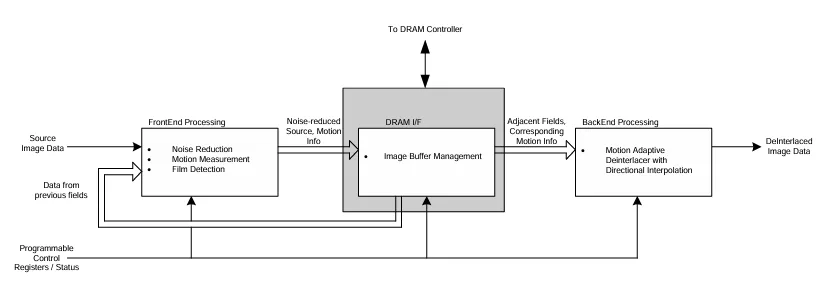
The VPC-1 is a high quality motion adaptive deinterlacer and video processor with line-doubled output. Additional functions include motion adaptive noise reduction, low angle directional interpolation and film cadence detection (supports multiple cadences including 3:2, 2:2 and others). When combined with Crucial IP’s VSC-1 scaler core, the VPC-1 can be used to provide complete up/down/cross conversion. Years of experience in developing video processing algorithms have contributed to the outstanding performance of the VPC-1 amongst motion adaptive class solutions. The full feature set, robust performance and extremely efficient implementation make the VPC-1 ideal for both consumer electronic and broadcast applications.
The VPC-1 is available with complete Verilog source code, Verilog test bench and bit-accurate C models as part of the license. Integration and programming guidelines are also included backed up by expert technical support.
A VPC-1 reference design is available for standard development kits from Xilinx and Altera for demonstration and evaluation purposes. The design includes a built-in user interface with embedded OSD to simplify access to key features of the IP. In addition to simplifying the evaluation of the VPC-1 IP core, the design also serves as a template for customer application development.
Note: some files may require an NDA depending on provider policy.

Video Processor and Deinterlacer with Line-Doubled Output is a Video Processing IP core from Crucial IP Inc. listed on Semi IP Hub.
Engineers should review the overview, key features, supported foundries and nodes, maturity, deliverables, and provider information before shortlisting this Video Processing IP.
Yes. Buyers can compare this product with similar semiconductor IP cores or IP families based on category, provider, process options, and structured technical specifications.