Vendor:
VinChip Systems Inc.
Category:
USB
USB 2.0 Device Controller
The USB 2.0 soft core facilitates data transmission up to 480 Mbps and is ideally suited for high-speed devices like CD-Rom drive…
Overview
The USB 2.0 soft core facilitates data transmission up to 480 Mbps and is ideally suited for high-speed devices like CD-Rom drives, Video camera etc.
PIE (Parallel Interface Engine)
PIE acts as a bridge between the control, non-control endpoints and the transceiver. Its gets the 16-bit raw data from the transceiver and splits and segregates the PID, CRC, data payload bits and delivers to the appropriate endpoints . It checks all the basic USB protocol needs viz. PID, CRC, time-out etc., during reception and packetizes the data-payload with proper PID and CRC bits, during transmission. It also handles the high-speed detection handshake protocol, suspend and resume signaling etc.
Control Endpoint
This block handles all the 3-stages (setup, data and status) of control transfers. It checks validity of device requests using a LUT. Descriptor information of the device is stored in a ROM housed inside the control endpoint. Address decoder also resides in this block. .
Non-Control Endpoint
Non-Control endpoints include endpoints supporting interrupt, bulk and isochronous data transfers. Each endpoint has an endpoint controller and a FIFO. The endpoint controller manages the USB transaction protocol, data-handling of the FIFO, and maintains integrity of the data. The FIFO residing in the endpoint is the data storage area. Up to 30 high-speed endpoints with different transfer types could be configured based on the need.
TEST-MODE
This block handles the test-mode operation of the device-controller. It supports the following test modes: Test_SE0_NAK, Test_J, Test_k and Test_Packet. A ROM housed inside the test-mode logic stores the test-packet to be transmitted for Testmode Test Packet command.
Application Interface
Application interface block provides a seamless interface to popular processor buses. Variants are available to support VCI. Supports DMA transfer type.
Key features
- USB 2.0 compliant
- Technology and Process independent
- Supports both UTMI and Philips transceivers
- Remote Wakeup Feature Support
- Control,Bulk, Interrupt and Isochronous transfer support
- Endpoint FIFOs are internal to the device
- Parametrizable endpoint features for number, transfer type, direction of transfer, maximum packet size
- Dual port RAM used for FIFO implementation
- Supports all standard requests
- Vendor specific request supported
- Utility for wiring endpoints and generating descriptors
- AHB interface support
Block Diagram
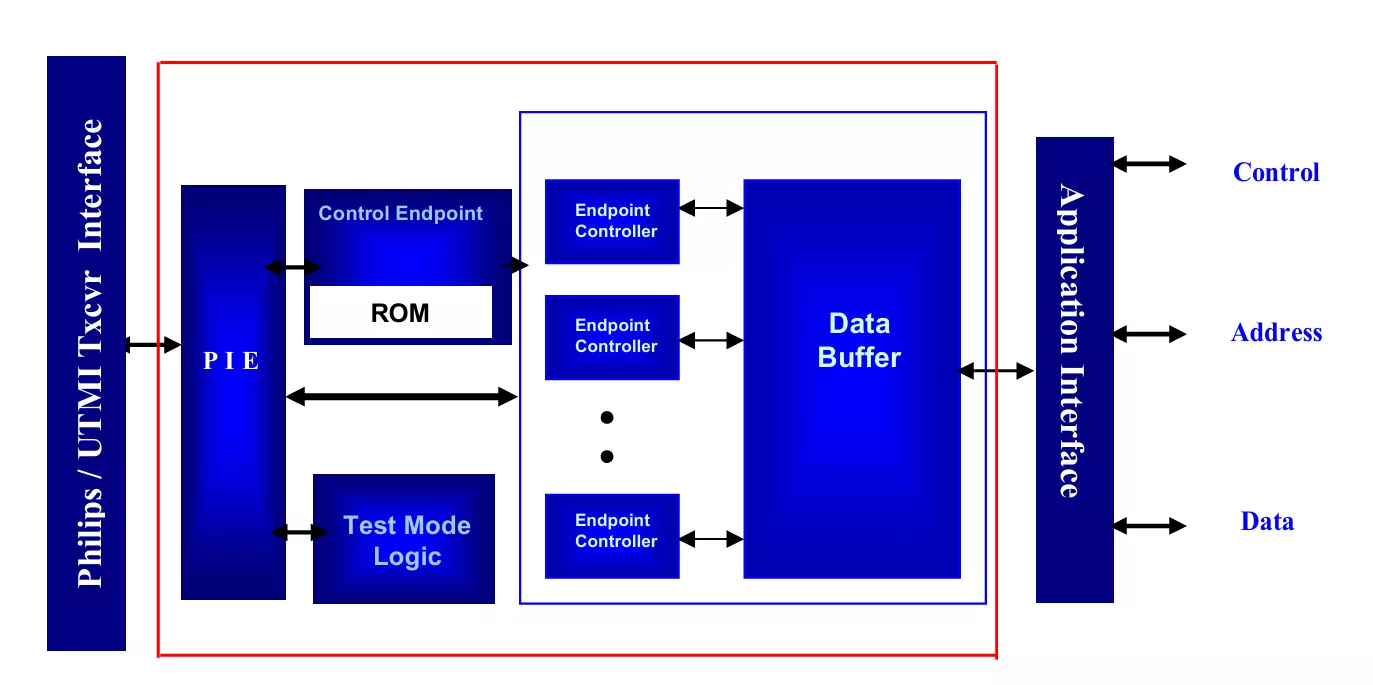
VUSB2D block diagram
What’s Included?
- VHDL/Verilog source code
- Synthesis and Test Scripts
- Test bench
- Documentation
- Behavioural models
- Software drivers
- Evaluation board
Specifications
Identity
Part Number
VUSB2D
Vendor
VinChip Systems Inc.
Type
Silicon IP
Files
Note: some files may require an NDA depending on provider policy.
Provider

HQ:
USA
Learn more about USB IP core
Exploring USB Applications and the Impact of USB IP
Understanding USB IP and Its Role in SOC Integration
What Designers Need to Know About USB Low-Power States
In addition to performance and interoperability, achieving low power has been one of the requirements for industry standards specifications. Some of the key specifications like Universal Serial Bus (USB), PCI Express (PCIe), and MIPI have defined power saving features for burst traffic. This whitepaper explains how Synopsys USB IP offers low power using various low power states that go beyond the basic features.
New USB 80Gbps Specification Boosts Data Rate, Enables Four Protocols on One Bus
Gervais Fong, Synopsys
New USB Device Class Specification Broadens Use Cases for I3C and I3C Basic
Sharmion Kerley, MIPI Alliance
Frequently asked questions about USB IP cores
What is USB 2.0 Device Controller?
USB 2.0 Device Controller is a USB IP core from VinChip Systems Inc. listed on Semi IP Hub.
How should engineers evaluate this USB?
Engineers should review the overview, key features, supported foundries and nodes, maturity, deliverables, and provider information before shortlisting this USB IP.
Can this semiconductor IP be compared with similar products?
Yes. Buyers can compare this product with similar semiconductor IP cores or IP families based on category, provider, process options, and structured technical specifications.