Vendor: PUFsecurity Category: IPsec / TLS

TLS 1.3 Compliant Crypto Coprocessor

PUFcc7 is the latest revision of the vendor’s high-security Crypto Coprocessor.

Overview

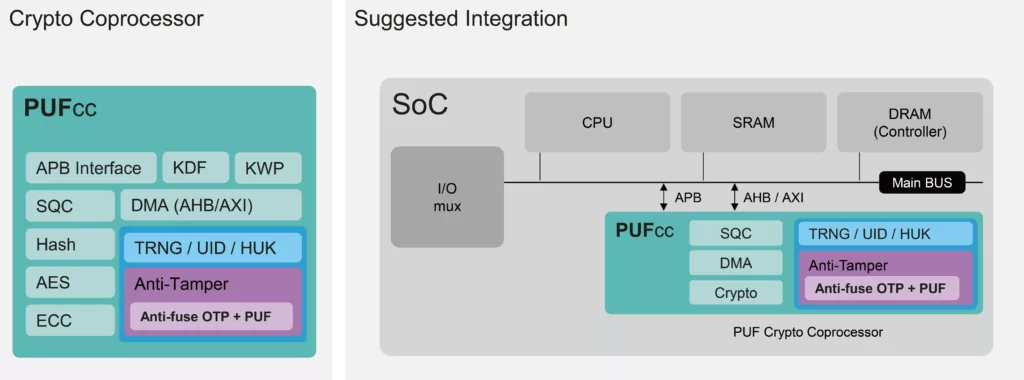
PUFcc7 is the latest revision of the vendor’s high-security Crypto Coprocessor. Compared to traditional security SoC designs in which each crypto component must be integrated separately, PUFcc7 is a much easier solution. As a result, PUFcc7 quickly improves the security level for any system as well as off loading the security functions away from the processor core and operating system.

The security boundary for PUFcc is robust, based on physical separation of hardware, with less vulnerability than a software-only barrier. The on-board PUF is a well-protected source of static entropy, suitable to base an SoC’s key management procedures, including key generation and derivation. In addition, PUFcc7’s standard crypto engines offer the flexibility to perform a wide variety of secure operations, such as key exchange, secure boot, TLS 1.3 handshaking and messaging, authentication (MAC), or key wrapping (again taking advantage of the natural randomness inherent to the PUF) for the secure export of wrapped keys to external memory.

Key features

  • NIST CAVP certified and OSCCA standard compliant crypto engine suite
  • Includes private/public key ciphers, message authentication code, hashes, and key derivation
  • Key wrapping function for the secure export of keys
  • Public-key coprocessor for digital signatures and key agreements over elliptic/Edward curves
  • Four 256-bit PUF fingerprints with self-health checking, suitable for direct use as unique identification (UID) or as a root key (seed)
  • Mass production OTP (8Kb standard) with hardware encryption and user-configurable partitions
  • Comprehensive anti-tamper designs implemented through physical and RTL methods
  • Silicon-proven and NIST-compliant deterministic random bit generator
  • APB control interface with secure/non-secure access privilege
  • AXI/AHB interface with direct memory access
  • Process Availability
    • Scalable down to 3nm, with continuous development
    • Available worldwide, at most foundries
  • Security Features
    • Riscure certified
    • Resistant to physical attacks, including decapsulation, microscope imaging, probing, reverse engineering, etc.
  • Controller/Interface
    • Standard APB Control Interface
    • Secure OTP Wrapper (Factory test, user, RMA debug, Read/Write, Read-Only, and Non-accessible modes)
    • AXI/AHB interface for direct memory access for various SoC designs
  • PUF-based Storage
    • Standard 8Kb OTP w/flexible partitioning
    • Dummy insertion read based on RNG entropy to prevent side channel analysis
    • Scrambler based on PUF value securely stores keys, unique to each PUFcc7
    • Stored values cannot be changed/deleted
    • Autoload function for automatic data readout after system power on
  • NIST SP800-90C Compliant TRNG
    • Ultra-fast initial time/stabilization (<100us)
    • High-speed throughput (> 160 Mbits/sec)
    • Ultra-low power consumption (< 0.38 pJ/bit)
    • Compliant with NIST SP800-22 and NIST SP800-90B with IID/restart test NIST SP800-90A DRBG for >1Gbps random number generation available as optional accessory
  • PUF-based Unique ID
    • Provides ideal minimum entropy (1)
    • Unpredictable randomness and uniqueness with near-perfect 50% Hamming Weight and Distance
    • On-demand keys for on-chip secret and off-chip ID or key generation/seeding
    • Optimal reliability with lifetime zero Bit Error-Rate (BER)
    • Robust functionality over wide operating range (Temp: -40~175°C)
  • Interface Extensions for More Functionality
    • Authenticated pairing with auxiliary PUFsecurity modules
    • Memory Built-In Self Repair/Test Data Register/Secure Debug access through external Test Access Port
  • Key Derivation Function (KDF)
    • Key/Password/Hash-based
    • KDF_HASH
    • RFC4306/2246/4346
  • Key Wrapping (KWP)
    • NIST SP800-38F key wrapping engine
  • Public Key Cryptography (PKC)
    • NIST approved Elliptic/Edwards Curves
    • ECDSA/ECDH/RSA
    • EDdSA/X25519/X448
    • SM2
  • Message Authentication Code Engine (MAC)
    • CMAC/HMAC/KMAC
    • POLY1305
  • Private Key Cryptography
    • NIST SP800-SP38A/B/C/D/E compliant
    • AES128/192/256
    • ChaCha20
    • SM4
    • ECB/CFB/OFB/CBC/CTR/CCM/GCM/XTS modes supported
  • Secure Hash Functions
    • MD5/SHA1
    • SHA2
    • SHA3/SHAKE128/256
    • SM3
  • Software
    • Software stack including firmware, API, and Mbed-TLS driver
  • Comprehensive Anti-Tamper Designs
    • Against Invasive Attack
      • Intrinsic physical security
      • Data scrambling and shuffling
      • Immune to voltage contrast attack
    • Against Semi-Invasive Attack
      • Metal shielding
      • Security-oriented IP layout
      • Simulation circuit protection
      • Interface protection
      • Output data FI detection
    • Against Non-Invasive Attack
      • Pin protection for address/data/mode IOs
      • Access control and Zeroization
      • Unified power design
      • Power floating detection
      • Built-in secure repair
      • Post-masking for UID and Key Storage to prevent malicious access

Block Diagram

What’s Included?

  • Datasheet
  • Release Notes
  • Integration Guidelines
  • Timing .lib file
  • LEF
  • Phantom GDS
  • Simulation Environment and PUF-based hard-macro behavior model
  • RTL: with Synthesis Script
  • Application note (memory-mapped register/FW/API)
  • FW/API Reference code
  • Hard Macro Release Note
  • Testing Methodology
  • Test Bench

Specifications

Identity

Part Number
PUFcc7
Vendor
PUFsecurity
Type
Silicon IP

Videos

PUFcc - The Only Crypto Coprocessor Combines Hardware Root of Trust and Full-set Crypto Engine
https://www.youtube.com/watch?v=PsQtw-d2tJI

Files

Note: some files may require an NDA depending on provider policy.

Provider

HQ: Taiwan

Learn more about IPsec / TLS IP core

Embracing a More Secure Era with TLS 1.3

TLS 1.3 offers attractive speed and security improvement benefits that are hard to ignore. The handshake phase was sped up by removing one or more roundtrips (back and forth messaging between client and server) in TLS 1.3 – with “or more” meaning that for certain cases, roundtrips can be entirely eliminated (0-RTT).

TPM 2.0-Ready: Top Security with PUFcc

The rising security threats endangering our connected world, from the chip to the cloud, are among the biggest challenges facing us today. Microsoft recently addressed some of these concerns by mandating the inclusion of TPM 2.0 (Trusted Platform Module) in all devices running its latest Windows 11 operating system. I

Standardized PUF-based Solution for Device eID

In this column, after a background introduction, we will first discuss IEEE 802.1AR standard on secure device identity. Next, we’ll assert PUF is an enabling solution for the device eID. Third, we will discuss PUF related international standards. Fourth, we will present a short tutorial on PUFiot. Fifth, we will assert that PUFiot is an ideal Device eID with wide applications. Finally, we will draw a conclusion on the future trend of Device eID development.

Frequently asked questions about IPsec / TLS IP cores

What is TLS 1.3 Compliant Crypto Coprocessor?

TLS 1.3 Compliant Crypto Coprocessor is a IPsec / TLS IP core from PUFsecurity listed on Semi IP Hub.

How should engineers evaluate this IPsec / TLS?

Engineers should review the overview, key features, supported foundries and nodes, maturity, deliverables, and provider information before shortlisting this IPsec / TLS IP.

Can this semiconductor IP be compared with similar products?

Yes. Buyers can compare this product with similar semiconductor IP cores or IP families based on category, provider, process options, and structured technical specifications.

×
Semiconductor IP