Vendor: CSEM Category: Temperature Sensor

Ultra-low power high dynamic range image sensor

Based on a time-domain pixel-level A/D conversion, its patented pixel architecture enables the capture of high dynamic range imag…

Overview

Based on a time-domain pixel-level A/D conversion, its patented pixel architecture enables the capture of high dynamic range images while consuming less than 1 mW for VGA resolution at 10 fps, a fraction of the power consumption of traditional image sensors.

Logarithmic data representation enables a 120 dB dynamic range coverage with 10-bit data words facilitating the analysis of visual scenes in real-world applications which naturally contain vastly changing environmental conditions.

Its in-pixel data memory relaxes data readout timing constraints thus enabling it to be used with microcontrollers with very limited data memory space. Moreover, its very low bill of material facilitates the integration in any system. This state-of-art image sensor makes autonomous vision systems powered by energy harvesting a reality.

On-chip memory

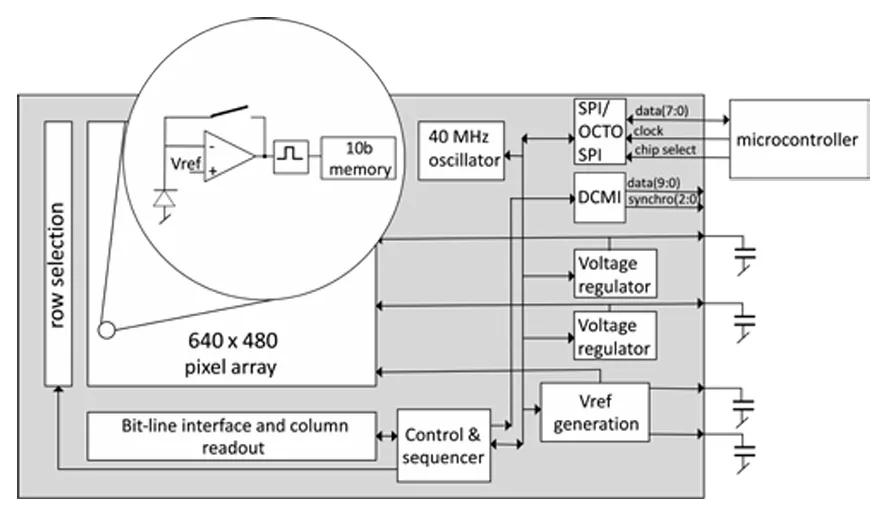
Each pixel incorporates a 10-bit static memory that serves two purposes:

  • Together with an in-pixel comparator, it enables high dynamic range through continuous comparison of the voltage resulting from photocurrent integration with a reference level.
  • As the digitized image is memorized on-chip, it can then be read out at a pace defined by the external device reading the image. This enables for example the use of microcontrollers with very limited memory, not able to store a whole frame.

Sub-sampling

A sub-sampled image can be read out to reduce the total amount of data transmitted for example for activity monitoring. As the whole image is still memorized on-chip, it can still be read out at full resolution or just a region of interest in case the analysis of the sub-sampled image led to the detection of activity.

Dual operation mode

In addition to its logarithmic high dynamic range mode, the ERGO640 can also be operated in linear mode like a standard imager to yield better image quality in low light conditions.

Ease of integration

The only external components needed are a few 1 μF capacitors. All pads are placed on a single side of the ERGO640 chip to enable a small footprint. Sensor control and data read out can be done through a standard 4-wire SPI if very limited communication interfaces are available, through an Octo-SPI bus, or combining a standard SPI for control and a 10-bit DCMI bus for data readout. The ERGO640 chip can be operated with a single 3.3 V supply, dual 3.3 V and 1.8 V supplies, or even single 1.8 V supply.

Key features

  • Resolution: VGA (640 x 480)
  • Backside illuminated sensor
  • Pixel size: 6.3 μm x 6.3 μm
  • Fill factor: 83 %
  • Dynamic range: 120 dB intra-scene
  • 10-bit data with logarithmic encoding
  • On-chip frame memory
  • Sub-sampling by 1/2, 1/4 and 1/8 for low power activity  monitoring
  • Region-of-interest readout
  • Power consumption at 10 fps: 0.9 mW
  • Supply voltage: 1.8 V and 3.3 V
  • Active area: 4.03 mm x 3.02 mm
  • Chip size: 4.4 mm x 4.9 mm
  • SPI/OCTO-SPI interface for control 
  • Parallel interface (DCMI) or SPI/OCTO-SPI for data  readout

Block Diagram

Applications

  • Activity tracking
  • IoT and wearable
  • Code reading
  • Biometry
  • Retrofit meter reading
  • Smart toys
  • Animal monitoring 

Specifications

Identity

Part Number
Ultra-low power high dynamic range image sensor
Vendor
CSEM
Type
Silicon IP

Files

Note: some files may require an NDA depending on provider policy.

Provider

HQ: Switzerland

Learn more about Temperature Sensor IP core

Power Management for Internet of Things (IoT) System on a Chip (SoC) Development

There are many factors that must be considered when developing a custom System on a Chip (SoC) for Internet of Things (IoT) applications. Chief among these are the power management circuits on the die. Vidatronic offers this white paper to discuss these considerations and all of the various circuit blocks that can be found in this application. Vidatronic IP solutions are discussed and the benefits they bring to IoT SoC designers.

Smart Transit Solution

Surveillance and security has become increasingly important during modern days for government/law enforcement, public or private transit authorities and for the fleet management. To monitor or investigate accidental damage, theft, harassment or left packages, producing/collecting evidences and analyze the occurrence of situation is challenge. This white paper describes how smart transit solution can generate evidences and help in analyze the situation of an incident. Smart transit solution improves profitability by enabling batter safety, security and service.

Design and Development of a Neuromorphic Silicon Suite: PVT Sensing, Stochastic LIF Inference, On-Chip STDP Learning, and Crossbar Programming

The authors present four interface-compatible digital IP blocks implemented as standard-cell CMOS on the SkyWater 130 nm process: a process, voltage and temperature (PVT) sensor built from five selectable ring oscillators that also provides a jitter-based true-random-number generator and a frequency-bounds health monitor; a stochastic leaky integrate-and-fire (LIF) neuron with a configurable LFSR, a programmable activation table, and a refractory period; an on-chip spike-timing-dependent plasticity (STDP) controller with a programmable curve and reward-modulated, eligibility-trace, and anti-Hebbian modes; and a memristive-crossbar controller supporting forming, set, reset, read, and automated current-voltage sweep with current-compliance limiting and half-select biasing.

Context Based Clock Gating Technique For Low Power Designs of IoT Applications - A DesignWare IP Case Study

This paper discusses about the intelligent low power techniques such as context based clock gating and how they are useful for IoT applications. It also describes how it improves the overall power efficiency of the system. The power statistics shared shows how the overall idle power and functional power consumption is significantly reduced. Further we discuss about how it can be combined with few other low power techniques to reduce the overall power

Frequently asked questions about Temperature Sensor IP cores

What is Ultra-low power high dynamic range image sensor?

Ultra-low power high dynamic range image sensor is a Temperature Sensor IP core from CSEM listed on Semi IP Hub.

How should engineers evaluate this Temperature Sensor?

Engineers should review the overview, key features, supported foundries and nodes, maturity, deliverables, and provider information before shortlisting this Temperature Sensor IP.

Can this semiconductor IP be compared with similar products?

Yes. Buyers can compare this product with similar semiconductor IP cores or IP families based on category, provider, process options, and structured technical specifications.

×
Semiconductor IP