Overview
XIP7131C is a compact 1 Intellectual Property (IP) core for TLS 1.3 client-side functionality. Transport Layer Security (TLS) is a cryptographic protocol, which provides communication security in computer networks and is used for securing a multitude of different applications ranging from casual Internet browsing to critical infrastructure communications. TLS 1.3 was published as RFC 8446 in August 2018, and it is the most recent version of the TLS standard and includes major modifications and security improvements compared to the earlier TLS versions.
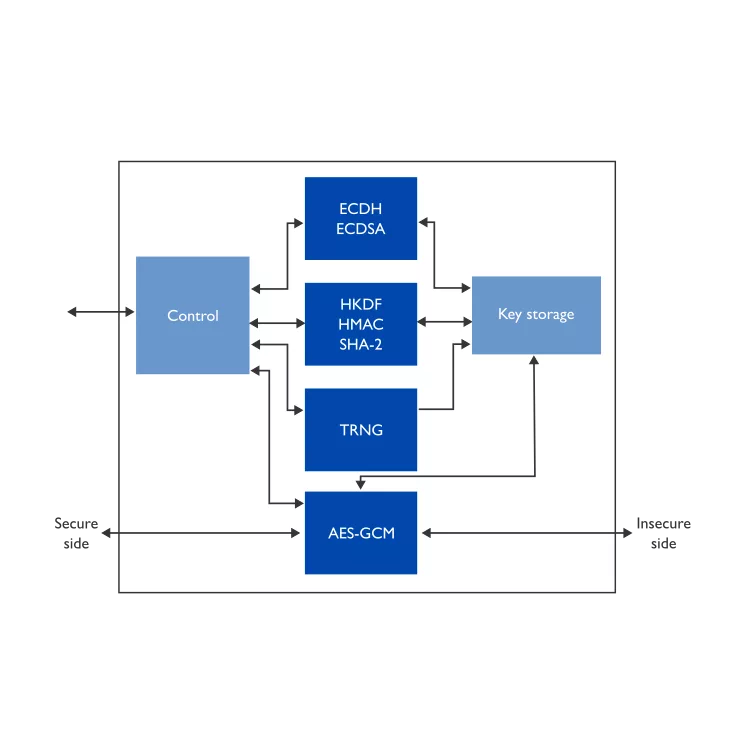
XIP7131C provides a hardware-based security solution level required for mission-critical applications. XIP7131C is optimized for low-area footprint, and it is ideally suited for high-volume FPGA applications, for example industrial automation, energy distribution, and secure edge computing. While the IP core itself has been optimized for low FPGA resource usage, it is capable of encrypting and decrypting bulk transmission speeds in excess of 1 Gbps after the secure connection has been established. XIP7131C supports the TLS 1.3 handshakes for session establishment and the TLS 1.3 record protocol for bulk communication. The IP core implements all cryptographic computations and key management activities required for secure TLS connections with a server. Critical cryptographical computations and key management are both isolated inside the FPGA from the rest of the system, offering a very high level of protection from different types of attacks. All computations are performed in constant time, thus nullifying timing-based side-channel attacks and protecting also against various other types of side-channel attacks. Due to the need to optimize the resource requirements, the supported cryptographic algorithms were carefully selected. XIP7131C supports X25519, Ed25519, SHA-2, HMAC, HKDF, and AES-GCM with 128-bit keys. Internally, XIP7131C includesa True Random Number Generator (TRNG) for generating truly random numbers needed in the TLS protocol, for example, ephemeral [1] keys. The TLS 1.3 IP Core is available for all Intel ® FPGAs.
The functionality of XIP7131C complies with the TLS 1.3 protocol definition in RFC 8446, and it implements at hardware level the required functionality for TLS 1.3 client side operation. The TLS 1.3 client (the FPGA-based XIP7131C IP core) opens a TLS connection with a server by running the client side of the TLS 1.3 handshake protocol. First XIP7131C generates a ClientHello message including the client’s ephemeral X25519 public share and sends it to the server. The server responds with a ServerHello message which includes the server’s ephemeral X25519 public share, the server’s certificate, a signature over the exchanged messages. After XIP7131C has received the ServerHello message it computes the shared session secret from the received public share and its own private share, verifies the certificate and the digital signature, and derives the required keys from the shared session secret for securing the bulk communications.
Learn more about IPsec / TLS IP core
Xiphera announces the launch of nQrux® Root of Trust, the latest addition to its nQrux® product family. Designed for ASIC and SoC implementations, the new IP provides a hardware-based foundation of trust for secure hardware systems.
Trust is the foundation of any secure computing system, but that trust has to start somewhere. This article explores the role of a Hardware Root of Trust, why that starting point must be built into hardware, and why it matters more than ever as device lifecycles grow longer, the EU Cyber Resilience Act introduces new security requirements, and the transition to quantum-resistant cryptography moves forward.
Xiphera has achieved ISO/IEC 27001:2022 certification, the internationally recognised standard for information security management, following an independent audit conducted by Into Certification Oy, an accredited certification body and subsidiary of Into Security Oy.
Japan is a focus market for Xiphera’s cryptographic hardware security solutions, and we are pleased to welcome Yasuhiro Okumura as our new Country Manager for Japan. His appointment strengthens our local presence and supports our continued growth in the region.
The project will develop a high-speed security IP core for optical satellite links, enabling secure data transfer at speeds of up to 100 Gbit/s. The technology is intended to support future satellite constellations and space systems that require both high-performance communications and strong cybersecurity.
The integration of Xiphera’s digital cryptographic cores and Agile Analog’s agileSecure anti-tamper sensor IP creates a unified defense solution for the next generation of semiconductor security. This is particularly important as the industry transitions to Post-Quantum Cryptography (PQC).