Overview
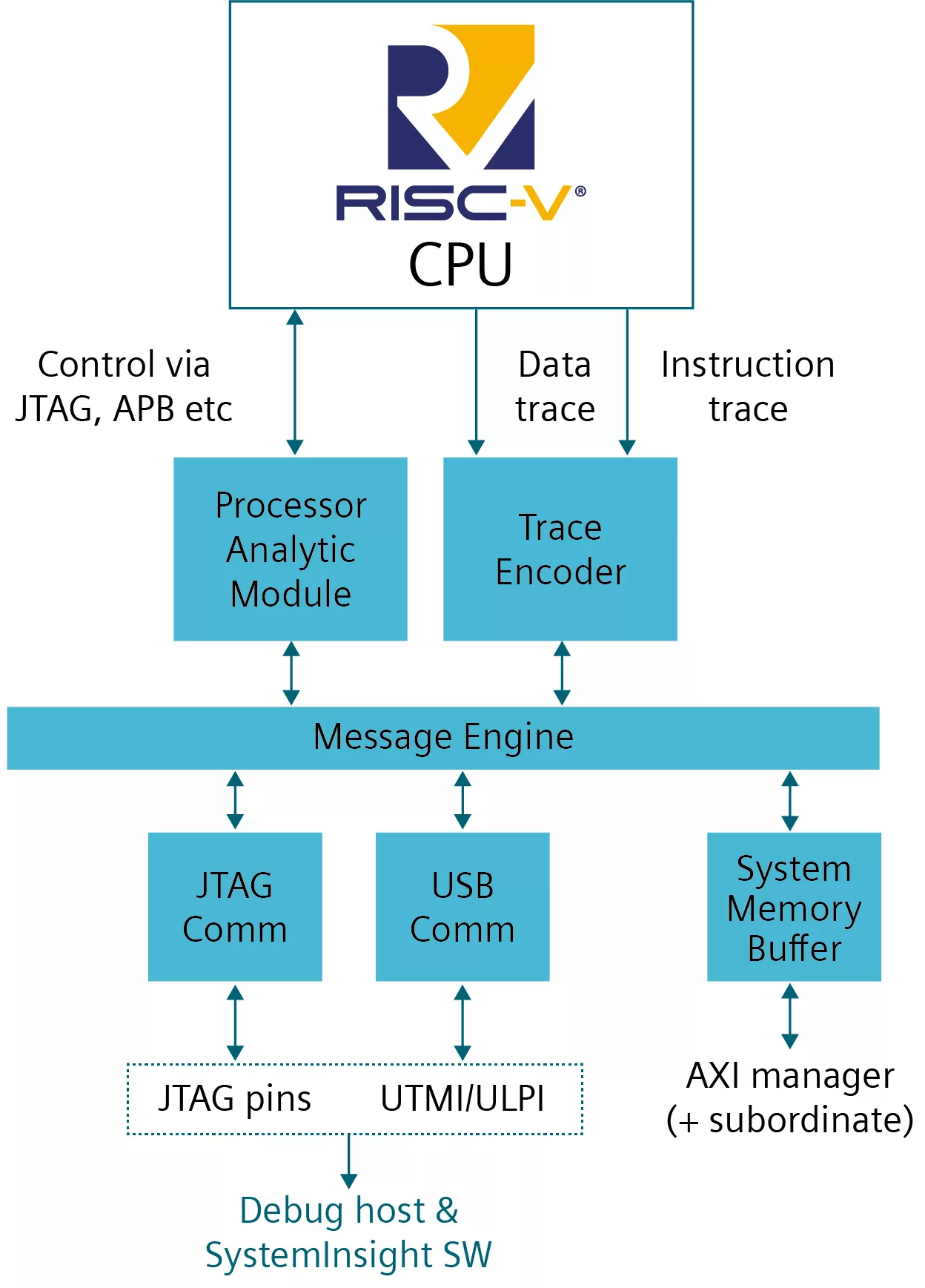
The Tessent Enhanced Trace Encoder is the market-leading trace solution for RISC-V. It is a fully-featured solution that provides a mechanism to monitor the program execution of a CPU in real time. It encodes program execution (instruction trace) and optionally, the data from load and store instructions (data trace), outputting trace in a highly compressed format.
The Tessent Enhanced Trace Encoder is designed to meet the official RISC-V Efficient Trace (E-trace) specification produced by the Debug and Trace Working Group. This group was led by representatives from Siemens who donated the trace algorithm to the RISC-V International community.
In addition to providing all the mandatory and optional features defined in the E-trace specification, the Tessent Enhanced Trace Encoder is cycle accurate, which means the developer gets insights into each and every instruction.
All Tessent Embedded Analytics monitors (IPs), can be accessed via a dedicated, secure communication infrastructure. Non-intrusive debug and monitoring using an off-chip host or debugger is facilitated through USB 2, USB 3, JTAG, or Aurora interfaces. Embedded software can drive the system via an AXI interface to create a self-contained on-chip monitoring system.
Learn more about CPU IP core
Nuclei System Technology today announces a strategic collaboration with Siemens Digital Industries Software. The companies are working on full Tessent™ Enhanced Trace Encoder solution support for Nuclei's RISC-V processor cores.
Understanding program behaviour in complex systems is not easy. Understanding the behaviour of complete systems is even more challenging. Get non-intrusive, full-speed and system-level visibility with E-Trace.
To debug and profile a RISC-V processor that comprises tens or hundreds of cores and processes billions of instructions each second can be challenging. Is the software running as expected? Does the verification team see the same behavior as the firmware engineers or application developers?