Vendor: Thesys-Intechna Category: Analog Front End

SPDT Analog Switch

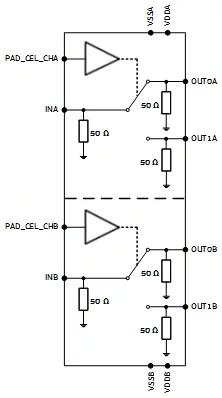
The TI-RF-Switch is a broad-band dual SPDT analog switch containing two single-pole double-throw switches.

Overview

The TI-RF-Switch is a broad-band dual SPDT analog switch containing two single-pole double-throw switches. Used CMOS XH035 technology provides high isolation and low insertion loss at frequencies up to 1 GHz. The analog switch includes an integrated control logic scheme, which eliminates the necessity of applying of external control circuitry. Logic control inputs of the device are compatible with CMOS and LVTTL logic levels.

Key features

  • Voltage transmission coefficient: 0.95/0.94/0.93 at 0.1/0.5/1 GHz input
  • Switching time: 9 ns
  • Isolation: 64/47/41 dB at 0.1/0.5/1 GHz input
  • Video feedthrough: 5.5 mV
  • Operating temperature range: -60 °C to +125 °C
  • Supply voltage: 2.3 V to 3.5 V

Block Diagram

Benefits

  • Two totally independent SPDT switches in a chip
  • Inputs and outputs isolated by metallization layers
  • High frequency signal inputs separated by ground supplies up to the chip level
  • 50 ? terminated shunt legs
  • Good VSWR in each output regardless of the switch mode

Applications

  • Wireless communications
  • Radio frequency signals switching

What’s Included?

  • Datasheet
  • GDSII database
  • Customer support

Specifications

Identity

Part Number
TI-RF-Switch
Vendor
Thesys-Intechna
Type
Silicon IP

Files

Note: some files may require an NDA depending on provider policy.

Provider

HQ: Russia

Learn more about Analog Front End IP core

How to specify and integrate successfully a measurement analog front-end including its power computation engine in an energy metering IC

Based on the system specification of a typical smart meter, this article demonstrates the importance of carefully selecting the power metering IP solution so that its specification matches the standard requirements and copes with the application challenges. This article then pinpoints thoroughly the various issues that must be taken into account for the selection of the Silicon IP and helps identify the possible trade-offs between the performance of the Mixed-signal Front-end (MFE) and that of the Power and energy Computation Engine (PCE).

Modeling and Verification of Mixed Signal IP using SystemVerilog in Virtuoso and NCsim

In this paper we present a methodology to model and verify a mixed-signal IP using SystemVerilog in Virtuoso and NCsim. We take our 12.5Gbps transmitter (TX) design as an example to explain the method we propose. This TX is designed to operate at programmable data rates from 1.25Gbps – 12.5Gbps and to support requirements of multiple serial protocols like USB, PCIe, and SATA. Interaction between AFE and Digital is key towards proper implementation of features like Feed Forward Equalization (FFE), programmable output swing and power management states.

Is there a "one-size fits all" SOC PLL?

Like most types of circuits, there is no such thing as a "one size fits all" PLL. This article will explore the trade-offs in PLL performance and design and look for a solution to most SOC PLL needs.

Frequently asked questions about Analog Front End IP cores

What is SPDT Analog Switch?

SPDT Analog Switch is a Analog Front End IP core from Thesys-Intechna listed on Semi IP Hub.

How should engineers evaluate this Analog Front End?

Engineers should review the overview, key features, supported foundries and nodes, maturity, deliverables, and provider information before shortlisting this Analog Front End IP.

Can this semiconductor IP be compared with similar products?

Yes. Buyers can compare this product with similar semiconductor IP cores or IP families based on category, provider, process options, and structured technical specifications.

×
Semiconductor IP