Overview
Many digital systems use filters to remove noise, provide spectral shaping, or perform signal detection. Two types of common filters that provide these functions are Infinite Impulse Response (IIR) and Finite Impulse Response (FIR) filters. IIR filters are used in systems that can tolerate phase distortion. FIR filters have an inherently stable structure, and are used in systems that require linear phase. This benefit makes FIR filters attractive enough that they are designed into a large number of systems. However, for a given frequency response specification, FIR filters are of higher order than IIR, making them computationally expensive.
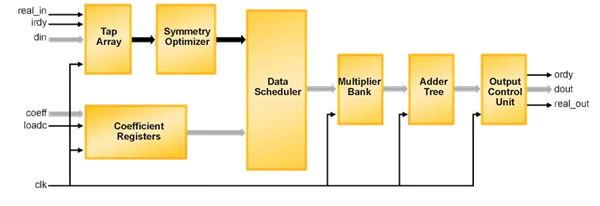
The Lattice Serial FIR filter uses serial arithmetic elements to achieve a compact size. Due to the serial nature of the arithmetic, the data rate is slower than the clock rate and dependant on the data width. The effective throughput is defined as:
Data rate = (f/(ofw +1)
where ofw is the Output Full Width and f is the clock frequency.
Learn more about Filters Transforms IP core
Extending Lattice's post-quantum cryptography leadership from silicon to a complete platform security stack, Lattice Sentry now delivers CNSA 2.0-aligned, NIST-compliant protection across AI data centers, and critical infrastructure, giving system designers a validated, production-ready path to quantum-resistant security.
Combining Arm® AGI CPU server platforms with Lattice FPGAs and AMI firmware creates a solution that provides advanced security, manageability, connectivity, and flexibility for next-generation AI data center infrastructure.
Lattice Prompt pairs with AI agentic tools developers already use, combining them with Lattice design tools, knowledge base, and documentation to turn natural language inputs into validated responses, dramatically accelerating FPGA development while optimizing design performance and capability.
First announced on May 4, 2026, the acquisition creates the industry's most complete secure management and control platform.
The acquisition brings together Lattice’s industry-leading low power FPGAs with AMI’s industry‑leading platform firmware and infrastructure manageability solutions for cloud and AI to create a complete portfolio of secure management and control solutions.
The collaboration demonstrates a real-time AI sensor fusion architecture that integrates TI mmWave radar and camera sensors using NVIDIA Holoscan Sensor Bridge running on Lattice’s low power FPGA. The FPGA acts as a companion chip delivering synchronized sensor data directly into GPU-accessible memory to enable low-latency and robust perception for robotics and industrial edge AI applications.