Overview
3GPP compliant coding and modulation for Physical Shared Channels
The Physical Uplink Shared Channel (PUSCH) is used to for uplink data which is shared from the user to the gNB on time and frequency. This channel contains, uplink user data and higher layer control messages. The PUSCH channel needs to be designed with flexibility in mind to support various modulation and coding schemes dependant upon SNR. To support channel estimation and demodulation contains a DMRS reference signal.
As part of the supported standard, AccelerComm have multiplexed uplink control information (UCI) as part of the PUSCH replacing the need for PUCCH transmission but this does require the inclusion of a polar decoder into the channel.
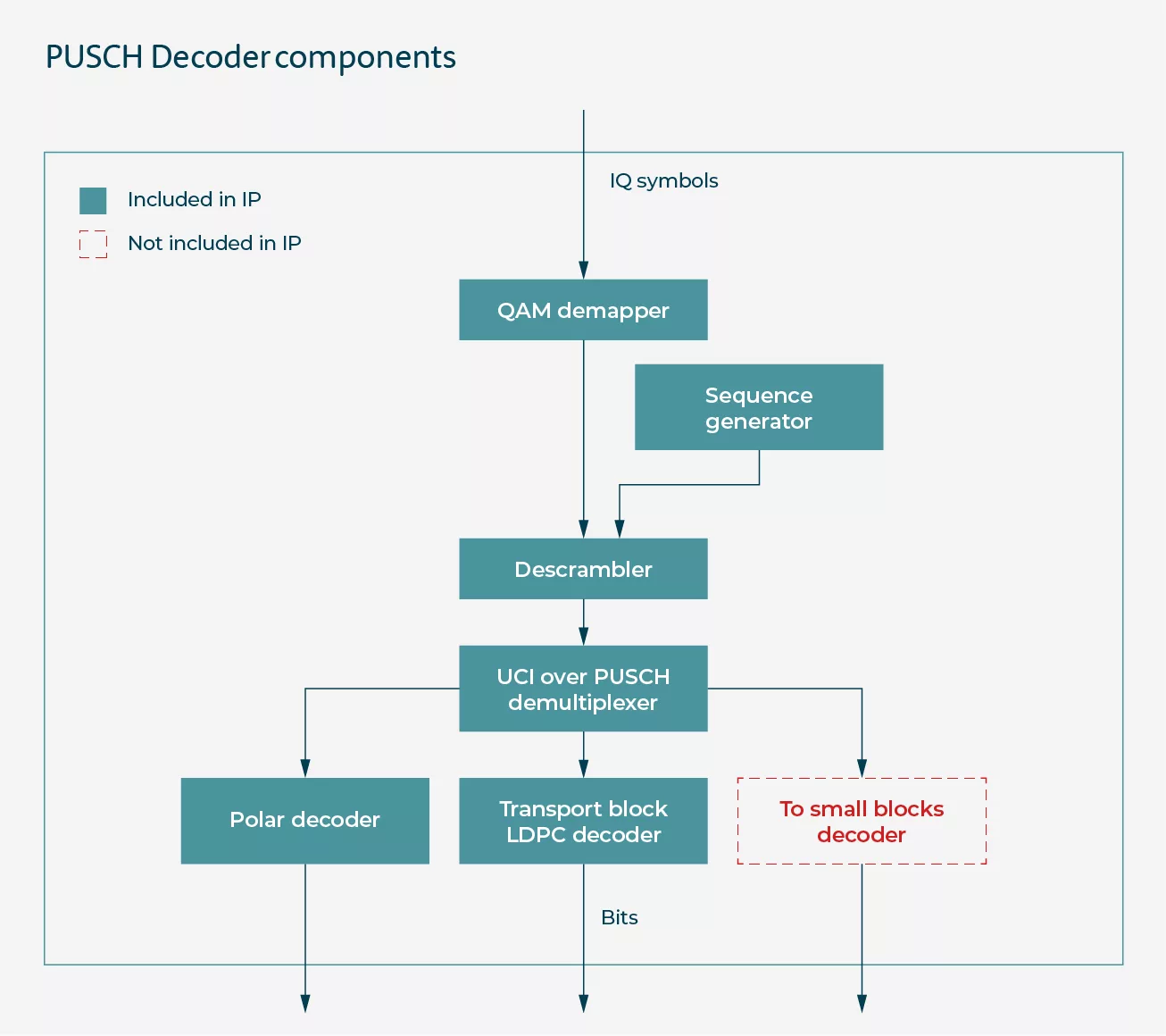
AccelerComm’s PUSCH Decoder, provides Forward Error Correction (FEC) decoding capabilities along with the complete Quadrature Amplitude Modulation (QAM) demodulation functionality for uplink data processing in a gNB/base station.
* They are implemented as per the latest 3GPP specifications and are compliant with TS 38.211 and 38.212.
* The new QAM demodulator functionality complements the existing high performance AccelerComm LDPC and Polar decoder solutions.
* Like all AccelerComm IP the LDPC, Polar decoder and demodulator is configurable to several different parallelisms to optimise the Size, Weight and Power (SWaP) of each integration.
* Functions supported in the PUSCH Decoder IP are transport block CRC, desegmentation, code block CRC, LDPC decoding, Polar decoding, HARQ buffer, rate matching, deinterleaving, deconcatenation, demultiplexing, descrambling, demodulation
Learn more about Channel Coding IP core
AccelerComm will support development of one of Europe’s first regenerative 5G satellite base stations for Low Earth Orbit networks
Across the two successive engagements, AccelerComm supported Eclipse in defining the physical-layer architecture for its next-generation spacecraft, spanning both its direct-to-device and broadband payload families.
Airbus UpNext SpaceRAN aims to demonstrate how 5G technology can be extended beyond terrestrial networks, delivering interoperable, standardized, and globally available connectivity for commercial, defense, and governmental applications. As part of a consortium of industry partners assembled by Airbus, AccelerComm is supplying a critical 5G physical layer (PHY) solution that enables communications signal processing on-board software-defined satellites.
This project will tighten the integration of the two companies' technologies so that they can be offered as a complete package to satellite manufacturer and operator customers.
The capital will be used to further develop and accelerate deployments of the company’s 5G satellite communications products and technology that enable Direct-to-Device (D2D) communications between phone handsets and space-based satellite networks.
One question we get asked by most of our customers when they are designing our technology into their systems is what is the processing throughput? It turns out that the answer to this question is a little more complex than you might think. It’s tempting to simply state the peak throughput of the component in question, but that can sometimes be quite misleading.