Vendor: Qbit labs Category: Filters Transforms

OFDM - Orthogonal Frequency Division Multiplexing
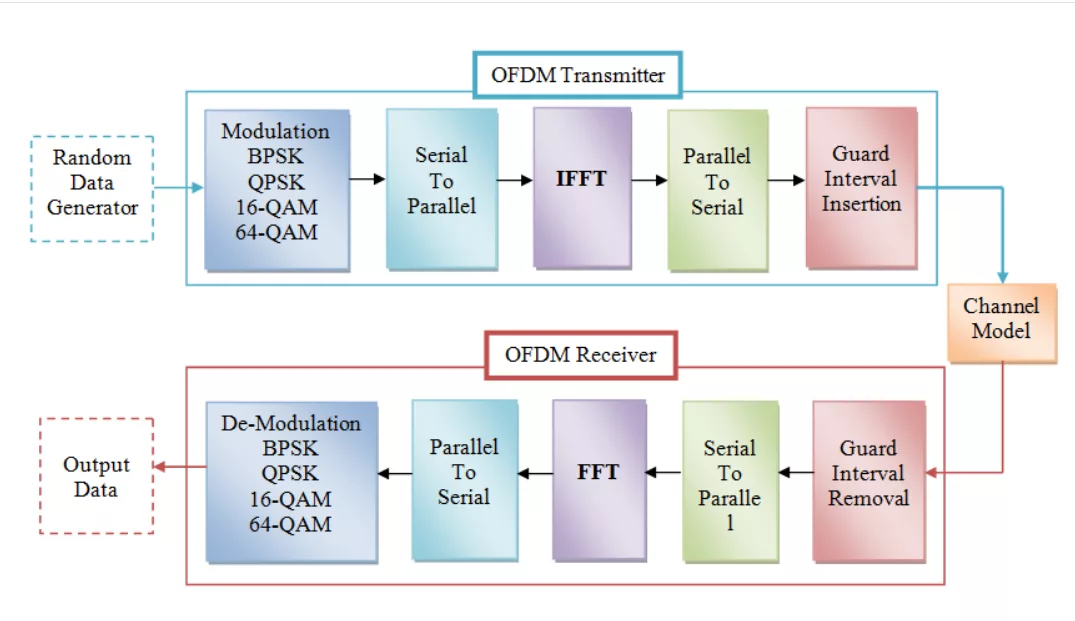
OFDM - Orthogonal Frequency Division Multiplexing

Key features

  •  Configure and create complete multiple OFDM Frames with Preamble, Header, and Payload
  •  Preset for Standard compliant Frames for various wireless standards like Wi-Fi, WiMAX
  •  Define Frame with Preamble, Header, and Payload (selectively) to simulate different OFDM signals
  •  Configure Symbols with Data, Pilot and Guard sub carriers with different base pattern type, amplitude profile and phase offsets
  •  Subcarrier Modulation Formats including BPSK, QPSK, QAM (16, 32, 64, 256, 512, 1024), and 8-PSK
  •  Add Impairments such as Phase Noise and Multipath to simulate realistic propagation scenarios
  •  Define Frequency Hopping and Gated Noise to simulate practical environments for receiver testing
     

Block Diagram

Benefits

  •  Immunity to selective fading:   One of the main advantages of OFDM is that is more resistant to frequency selective fading than single    carrier systems because it divides the overall channel into multiple narrowband signals that are affected individually as flat fading    sub - channels.
  •  Resilience to interference:   Interference appearing on a channel may be bandwidth limited and, in this way, will not affect all the    sub - channels. This means that not all the data is lost.
  •  Spectrum efficiency:   Using close-spaced overlapping sub-carriers, a significant OFDM advantage is that it makes efficient use of the    available spectrum.
  •  Resilient to ISI:   Another advantage of OFDM is that it is very resilient to inter-symbol and inter-frame interference. This results from the    low data rate on each of the sub-channels.
  •  Resilient to narrow-band effects:   Using adequate channel coding and interleaving it is possible to recover symbols lost due to the    frequency selectivity of the channel and narrow band interference. Not all the data is lost.
  •  Simpler channel equalisation:   One of the issues with CDMA systems was the complexity of the channel equalisation which had to be    applied across the whole channel. An advantage of OFDM is that using multiple sub-channels, the channel equalization becomes much    simpler.

Specifications

Identity

Part Number
OFDM
Vendor
Qbit labs
Type
Silicon IP

Files

Note: some files may require an NDA depending on provider policy.

Provider

HQ: USA

Learn more about Filters Transforms IP core

10 FPGA Design Techniques You Should Know

Regardless of whether you are using VHDL, System Verilog, or a different design capture language, there are a number of universal design techniques with which FPGA engineers should be familiar, from the very simple to the most advanced.

Frequently asked questions about Filters and Transforms IP cores

What is OFDM - Orthogonal Frequency Division Multiplexing?

OFDM - Orthogonal Frequency Division Multiplexing is a Filters Transforms IP core from Qbit labs listed on Semi IP Hub.

How should engineers evaluate this Filters Transforms?

Engineers should review the overview, key features, supported foundries and nodes, maturity, deliverables, and provider information before shortlisting this Filters Transforms IP.

Can this semiconductor IP be compared with similar products?

Yes. Buyers can compare this product with similar semiconductor IP cores or IP families based on category, provider, process options, and structured technical specifications.

×
Semiconductor IP