Overview
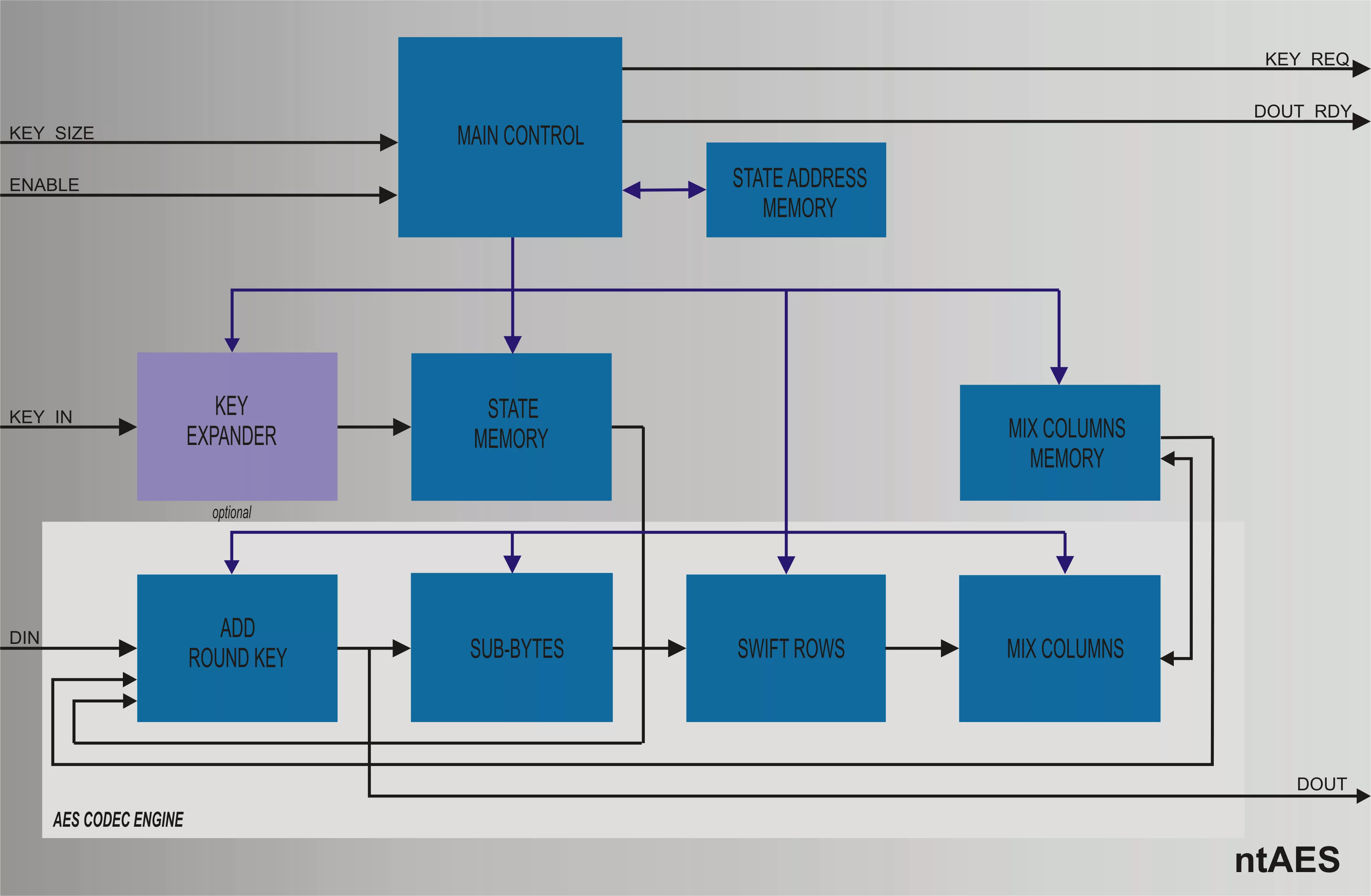
ntAES128 core implements the NIST FIPS-197 Advanced Encryption Standard and can be programmed to either encrypt or decrypt 128-bit blocks of data using a 128-bit, 192-bit or 256-bit key. The ntAES128 has been carefully designed for high throughput applications with optimal logic resources utilization. The encryptor core accepts a 128-bit plaintext input word, and generates a corresponding 128-bit ciphertext output word using a supplied 128, 192, or 256-bit AES key. The decryptor core provides the reverse function, generating plaintext from supplied ciphertext, using the same AES key as was used for encryption. The hardware roundkey expansion logic has been designed as a discrete building block. This allows either to build a complete stand-alone AES solution, or to save logic resources by leaving the key generation process to the user. Alternatively, the roundkey expansion logic can be shared between multiple encryption/decryption cores for optimal silicon area resources utilization. The implementation is very low on latency, high speed with a simple interface for easy integration in SoC applications.
Learn more about Symmetric Crypto IP core
Noesis Technologies has announced today the immediate availability of its ntFFT_UHS IP Core that implements a customized FFT/IFFT programmable fixed point (Decimation in Frequency - DIF) transform processor, supporting low latency, streaming, ultra-parallel complex samples per clock cycle in natural order.
Noesis Technologies has announced today the immediate availability of its ntAES_XTS IP Core, a fully compliant core with AES-XTS algorithm standardized at NIST SP800-38E and IEEE 1619-2007 recommendations targeting disk encryption applications at sector (data unit) addressable level.
Noesis Technologies announced today the immediate availability of its fully configurable FFT/IFFT processor (ntFFT). ntFFT core is a fully configurable solution that performs the FFT and IFFT transform. It is on-the-fly programmable in terms of transform size and type.
Noesis Technologies announced today the immediate availability of its ntOFDM_BBP custom baseband processor, which implements the physical layer of an OFDM, time division duplexing (TDD) system. The baseband processor includes both transmission and reception bit-level and symbol-level processing chains including a sophisticated synchronization unit.
Noesis Technologies announced today the immediate availability of its CVSD voice codec algorithm compliant IP Core.