Overview
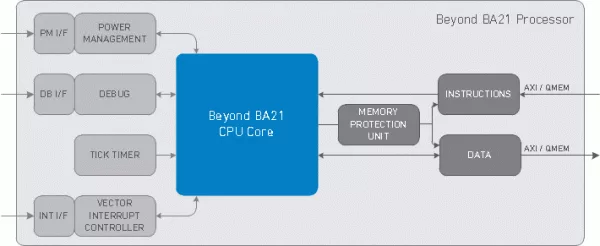
Beyond BA21 implements a 32-bit low-power processor that delivers better performance than most processors of its size. Designed for deeply-embedded systems or as an auxiliary processor in larger systems, it is an especially effective choice for wireless communication, analog peripherals management, or other mixed-signal functions in energy-and cost-sensitive applications.
This royalty-free 32-bit processor core is binary-compatible with other members of the silicon-proven BA2xTM processor family. Its BA2 instruction set is relatively simple and extremely compact, offering system area and energy savings benefits. Programing is facilitated with the included C/C++ tool chain, Eclipse IDE, architectural simulator, and ported C libraries, RTOSs, and OSs.
Learn more about CPU IP core
Beyond Semiconductor today announced a strategic collaboration with Rubicon Labs. Developed over the past three years, the partnership combines Rubicon Labs’ cloud based device identity and security platform with Beyond Semiconductor’s processor and secure system-wide design competence to deliver security and identity for IoT, IIoT and data center ecosystems
NXP Semiconductors today unveiled the new BeyondStudioTM IDE for the JN516x range of wireless microcontrollers for Internet of Things (IoT) applications. The comprehensive software development environment, developed by Beyond Semiconductor, dramatically simplifies the development of software on the JN516x family – improving code density, reducing development time and improving code quality.
Lauterbach TRACE32 software development tools now support the Beyond BA22 Family of microprocessor cores for deeply embedded system controllers through full application processors.
OmniVision Technologies licenses Beyond Semiconductor IP
InSilica Inc. announced that it has taken a license to use BA22 RISC Processor solution from Beyond Semiconductor in its next generation camera processors. The value to InSilica of Beyond Semiconductor's IP solution is to reduce power in its camera processor SoCs while reducing overall silicon area cost.
The Beyond line of products consists of 32 bit processor cores that can be configured to include a Memory Management Unit (MMU), an Instruction and Data Cache, a Power Management Unit, Timer and a Debug Unit. Advanced debug unit enables software developers to debug their software both in ROM and RAM, giving them total control of the processor and its peripherals.