Vendor: Rambus, Inc. Category: Symmetric Crypto

Inline memory encryption engine, for FPGA

IME-IP-340 Inline Memory Encryption (IME) Engine provides just-in-time encryption, decryption and authentication for all memory r…

Overview

IME-IP-340 Inline Memory Encryption (IME) Engine provides just-in-time encryption, decryption and authentication for all memory read and write requests between a host processor and its attached memory. Absent encryption, instruction and data stored in external memory are vulnerable to attack, introspection, or modification as they are loaded and executed.

Historically, inline memory encryption’s performance impact was too great to justify implementation. However, the growing threat environment has raised the stakes for protecting memory data transactions. The Rambus IME-IP-340 Engine mitigates physical attack vectors and does so with high throughput and low latency to make memory encryption viable and practicable.

How the IME-IP-340 Engine Works

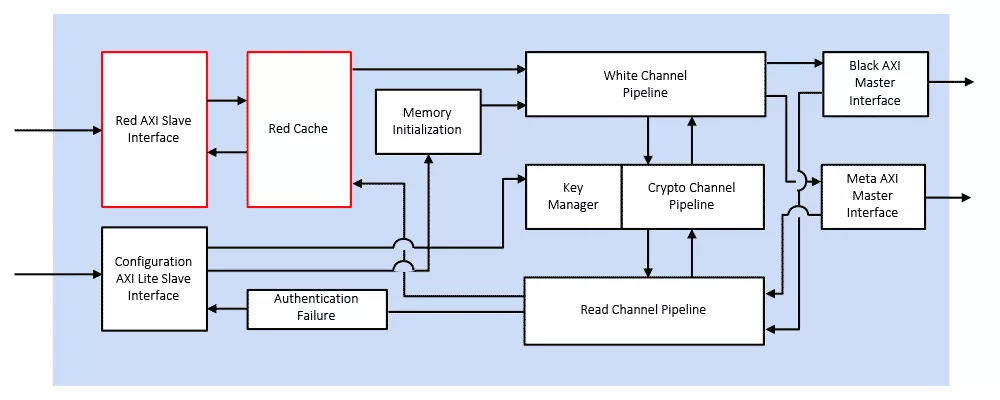
The Rambus IME-IP-340 Engine provides encryption, decryption and authentication for all memory read and write requests between a host processor and its attached memory. The IME-IP-340 Engine is instantiated on the host (SoC or FPGA) between the processor logic and the memory controller. The IME-IP-340 Engine is a high-throughput, low latency, military-grade security solution. Its features can be configured at compile and/or runtime.

Introduction to Side-Channel Attacks

Side-channel attacks, including simple power analysis and differential power analysis, conducted against electronic gear are relatively simple and inexpensive to execute. An attacker does not need to know specific implementation details of the cryptographic device to perform these attacks and extract keys. As all physical electronic systems routinely leak information, effective side-channel countermeasures should be implemented at the design stage to ensure protection of sensitive keys and data.

Deep Anti-Tamper Experience

As the inventor and pioneer of DPA and an acknowledged leader in device security, Rambus is uniquely qualified to provide anti-tamper solutions for the most stringent requirements. Rambus technologies protect more than 9 billion chips per year, and as a US-based, independent company, Rambus has the experience and pedigree to be the solution provider of choice. Rambus has for more than 20 years supplied solutions for government and defense applications, including anti-tamper cores, software libraries, and testing workstations.

Key features

  • Performs encryption, decryption and/or authentication using AES Counter Mode (CTR) or Galois Counter Mode (GCM)
  • Supports AES key sizes 128 or 256
  • Internal key management with NIST-compliant key generation
  • Encrypt memory space into user-defined vaults, each with a unique key
  • Compatible with AMBA AXI4 interface
  • Supports hard or soft memory controllers in Xilinx FPGA and SoC devices
  • Supports multiprocessor systems
  • Supports modern operating systems with and without MMUs
  • Robust Side Channel Attack (SCA), Differential Power Analysis (DPA) countermeasures
  • Implemented in Xilinx ZU, ZU+ and Versal. Ready for implementation in other FPGA platforms
  • FPGA resources used: 25K-120K LUTs depending on configuration
  • Low application performance impact: 1-6% depending on configuration
  • Low memory overhead: ~10-20% of available memory addresses used for overhead; zero system memory overhead is possible using metadata on a separate bus
  • User configurable
  • Error handling via IRQ output and separate AXI interface
  • Driver with API for programming entropy (user defined)
  • Automatic key generation and storage (once entropy is initialized)

Block Diagram

Specifications

Identity

Part Number
IME-IP-340
Vendor
Rambus, Inc.
Type
Silicon IP

Files

Note: some files may require an NDA depending on provider policy.

Provider

HQ: USA

Learn more about Symmetric Crypto IP core

Google, Quantum Attacks, and ECDSA: Why There’s No Need to Panic and Why Preparation Matters Now

Over the past several weeks, we’ve seen growing discussion across the industry about Google’s latest publications on quantum computing and cryptography. In some corners, those discussions have quickly escalated into claims that widely deployed elliptic curve cryptography (ECC), including ECDSA, is on the verge of collapse. Customers are understandably asking questions: Has ECDSA been broken? Are today’s systems suddenly at risk? Do migration timelines need to change?

Frequently asked questions about Symmetric Cryptography IP cores

What is Inline memory encryption engine, for FPGA?

Inline memory encryption engine, for FPGA is a Symmetric Crypto IP core from Rambus, Inc. listed on Semi IP Hub.

How should engineers evaluate this Symmetric Crypto?

Engineers should review the overview, key features, supported foundries and nodes, maturity, deliverables, and provider information before shortlisting this Symmetric Crypto IP.

Can this semiconductor IP be compared with similar products?

Yes. Buyers can compare this product with similar semiconductor IP cores or IP families based on category, provider, process options, and structured technical specifications.

×
Semiconductor IP