Overview
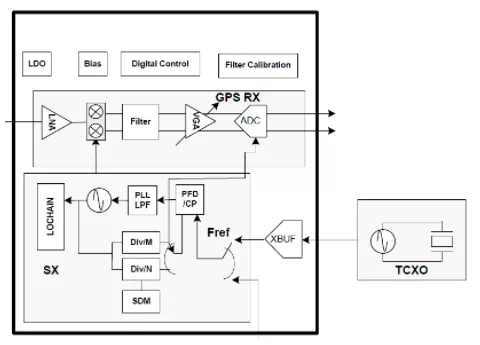
This GNSS RF Receiver IP is silicon-proven in TSMC40nm ULP process node, offers comprehensive support for all current satellite-based navigation systems, encompassing GPS (US), Galileo (EU), GLONASS (Russia), Beidou (China), QZSS (Japan), and SBAS. Tailored for battery-powered IoT and M2M applications, it concurrently accommodates L1/L2 and L5 frequencies.
Integrated within this IP are both integer-N (default) and dual-mode fractional-N frequency synthesizers, facilitating the utilization of a singular reference frequency across multiple modes. Its fully integrated Frequency Synthesizer (SX) features a wide-ranging VCO tuning capability, ensuring coverage across various frequency requirements and process corners. Moreover, it supports both single-system and multi-system operations.
This can be ported to any technology node subject to the availability of the RF front end. It can be supplied with the most stable firmware for accurate highly reliable location tracking along with support and upgrades.
This GNSS RF Receiver IP boasts high-level programmability, allowing optimization of power consumption and functionality across diverse scenarios. It is particularly well-suited for IoT and mobile tracking applications, thanks to its ultra-low power design. Furthermore, the RF IP incorporates an integrated reference clock buffer to ensure a stable reference frequency, thereby enhancing overall performance.
Learn more about GNSS IP core
T2M-IP, the global leader in semiconductor IP cores and technology expertise, is proud to announce the immediate availability of its partner's VESA-compliant DisplayPort v1.4 Rx PHY and Controller IP Cores.
T2M announces the availability of its partner’s Bluetooth V6.0 RF Transceiver IP Core in 22nm ULL and 40nm ULP.
Incorporating BroadR-Reach™ technology for Automotive Excellence, this PHY delivers exceptional performance for automotive and industrial applications, providing a superior alternative to traditional BaseT1 solutions.
Designed to meet the evolving needs of next-generation automotive and industrial applications, the CAN XL Controller IP offers superior performance and flexibility while maintaining backward compatibility with previous CAN standards.
T2MIP, a leading provider of semiconductor IP cores, proudly announces the immediate availability of their partner's H.264 and H.265 HEVC Codec IP cores.
T2M-IP is excited to announce that its state-of-the-art USB 3.0 IP, developed in the 22nm ULP (Ultra Low Power) and ULL (Ultra Low Leakage) process technologies, has been successfully licensed to over 10 customers worldwide in the past two years.