Overview
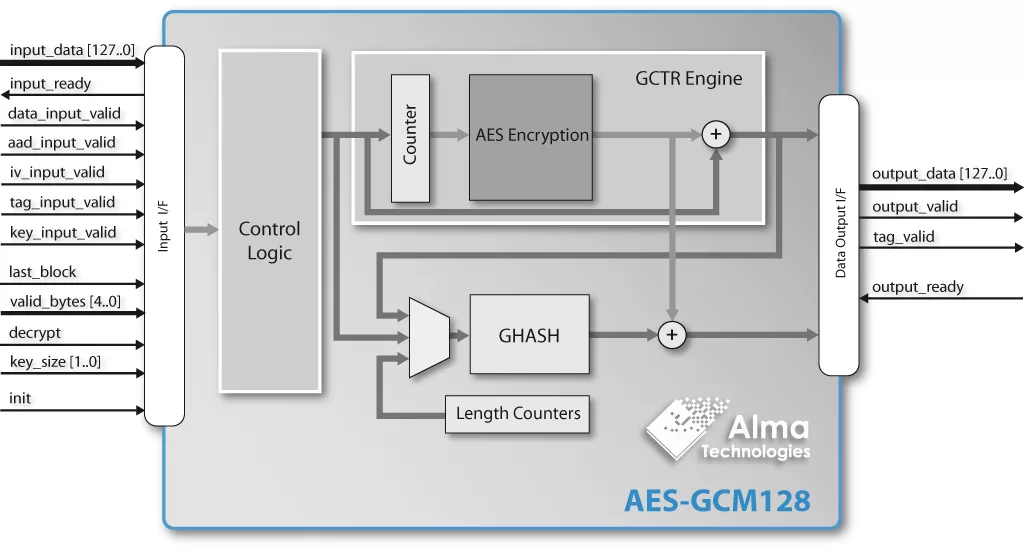
The AES-GCM128 IP core implements the GCM-AES authenticated encryption and decryption, as specified in the NIST SP800-38D recommendation for GCM and GMAC and the FIPS-197 Advanced Encryption Standard. The core can be programmed to encrypt or decrypt 128-bit blocks of data, using 128-, 192-, or 256-bit cipher-key. In addition, using the GHASH algorithm a Hash value - the TAG - is calculated for the encrypted, or the additional plaintext, data. Then, in decryption mode, the calculated TAG is compared with the TAG that accompanies the ciphertext data and a Fail or Pass flag is accordingly generated.
The AES-GCM128 core uses 128-bit datapath, needing 1 clock cycle to load or unload each 128-bit plaintext or ciphertext data block. A Key Expander module is included in the AES-GCM128 and automatically generates the AES Round Key Values. All internal operations are performed on 128-bit words and, for each HASH, only 12/14/16 clock cycles are required per 128-bit block for 128/192/256-bit cipher-key size respectively. The AES-GCM128 core supports 96-bit Initialization Vectors and input/output TAGs of configurable length.
The AES-GCM128 core is equipped with easy-to-use fully stallable interfaces for both input and output. These are designed to permit the user application to pause the produced output data stream when it is not able to receive data, or to pause the input stream towards the core according to data arrival rate.
Learn more about Symmetric Crypto IP core
Alma Technologies S.A. today announced its new UHT-SCALER IP core, a standalone and high-performance image scaler, designed for enabling ultra-high frame rate SD, HD or Ultra HD (4K/8K and beyond) image resizing, even in low-end ASIC or FPGA silicon.
Alma Technologies S.A. today announced its new UHT-JPEGLS-E scalable encoder IP core that enables numerically lossless encoding of ultra-high frame rate SD/HD, and Ultra HD video (4K/8K and beyond), even in highly cost-effective FPGA and ASIC technologies.
Alma Technologies S.A. today announced its new UHT-DSC-E and UHT-DSC-D DSC 1.2b encoder and decoder IP cores that enable the transport of high-definition content with up to 10K resolution, 120Hz refresh rate, high dynamic range and high color depth through existing interfaces, such as VESA DisplayPort, MIPI DSI and HDMI 2.1.
This new scalable UHT JPEG 2000 encoder IP core provides the extreme performance needed by modern video compression applications that have to cope with massive pixel rates and resolutions.
An online tool for back-to-back comparison of the image compression standards implemented by our IP cores is now available on our website. The Bit Accurate Models of the respective image compression cores are used to encode / decode a user supplied test image, in order to evaluate and compare their actual performance.
Alma Technologies S.A., a company that designs, markets, sells and supports innovative semiconductor IP since 2001, today introduced at the Toulouse Space Show 2016 a new encoder IP core which implements the CCSDS 122.0-B-1 lossless and lossy image data compression standard.