eSPI Controller
Enhanced Serial Peripheral Interface – Controller IP with single, dual, and quad eSPI Bus support for Intel CPU’s
Overview
DESPI eSPI Controller IP Core – High-Speed, Fully Configurable eSPI Controller for FPGA and ASIC
The DESPI eSPI Controller IP Core is a fully configurable Enhanced Serial Peripheral Interface (eSPI) Controller, compliant with the eSPI Base Specification Revision 1.6. It is designed for high-performance embedded systems, enabling reliable, low-latency communication between host processors, microcontrollers, and eSPI-enabled peripheral devices, including Embedded Controllers (EC) in Intel-based platforms.
As a modern replacement for the legacy LPC (Low Pin Count) interface, the DESPI Controller IP delivers high-speed serial communication with support for single, dual, and quad SPI modes. With serial clock frequencies up to 66 MHz, it ensures efficient data transfer, reduced pin count, and improved system throughput in advanced SoC designs.
Its modular and scalable architecture allows seamless integration into FPGA and ASIC environments, making it suitable for a wide range of applications requiring robust eSPI host/controller functionality.
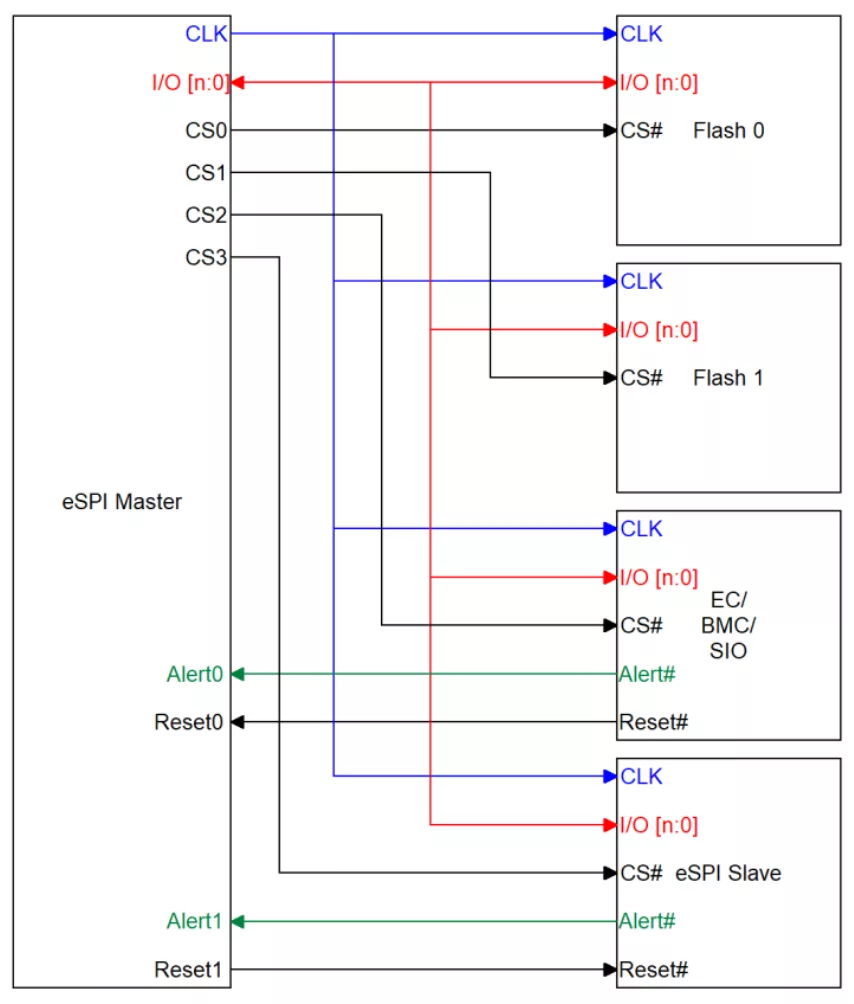
Key features
- eSPI Controller IP compliant with eSPI Base Specification Rev. 1.6
- Configurable Controller mode for integration into complex SoC architectures (looking for an eSPI Target? here it is)
- High-speed SPI interface up to 66 MHz for low-latency communication
- Support for Single, Dual, and Quad SPI transfers to maximize bandwidth and performance
- Large, highly configurable shared memory buffer enables efficient and flexible frame and data storage to fit any needs.
- Customizable peripheral channels, including memory-mapped I/O, Virtual Wire signals, and event signaling
- Technology-agnostic RTL design compatible with all major FPGA and ASIC vendors
- Optimized for Intel-based systems and embedded controller communication
Block Diagram
Benefits
Compliant with eSPI base specification as defined in Enhanced Serial Peripheral Interface (eSPI) Specification rev.1.6
- Supports Master Mode
- Supports Single, Dual and Quad modes
- Supports TX and RX operation as per specs
- Support for
- Command Phase
- Turn-Around Phase
- Response Phase
- Baud Rate selection
- Slave Triggered Transactions
- Power management Event
- Interrupts and Alerts
- In-band reset
- Support for multiple channels
- Peripheral channel
- Virtual wire Channel
- OOB Message (Tunneled SMBus) Channel
- Run-time Flash Access Channel
- Various Master/Slave errors detection
- CRC Checking and generation
- The simple interface allows easy connection to microcontrollers
- Fully synthesizable, static synchronous design with no internal tri-states
Available system interface wrappers:
- AMBA – APB / AHB / AXI Bus
- Altera Avalon Bus
- Xilinx OPB Bus
Applications
- Host interface for Embedded Controllers (EC) in Intel CPU platforms
- FPGA and ASIC-based SoC designs requiring eSPI Master functionality
- High-speed data acquisition systems and industrial embedded platforms
- Multi-slave microcontroller systems with low-latency communication requirements
- Replacement of legacy LPC interfaces in modern hardware architectures
Specifications
Identity
Files
Note: some files may require an NDA depending on provider policy.

Provider
Learn more about SPI / QSPI XSPI IP core
Unleashing the Power of Communication: Exploring the XSPI Protocol and Arasan Chip Systems' XSPI IP Portfolio
Frequently asked questions about SPI / QSPI / xSPI IP cores
What is eSPI Controller?
eSPI Controller is a SPI / QSPI XSPI IP core from Digital Core Design listed on Semi IP Hub.
How should engineers evaluate this SPI / QSPI XSPI?
Engineers should review the overview, key features, supported foundries and nodes, maturity, deliverables, and provider information before shortlisting this SPI / QSPI XSPI IP.
Can this semiconductor IP be compared with similar products?
Yes. Buyers can compare this product with similar semiconductor IP cores or IP families based on category, provider, process options, and structured technical specifications.