ECDSA IP Core
ECDSA IP Cores perform digital signature generation and verification in compliance with the Elliptic Curve Digital Signature Algo…
Overview
ECDSA IP Cores perform digital signature generation and verification in compliance with the Elliptic Curve Digital Signature Algorithm (ECDSA) specifications defined in 'FIPS 186'. This standard specifies methods for digital signature generation and verification using the Elliptic Curve Digital Signature Algorithm (ECDSA).
The curves P-192, P-224, P-256, P-384, and P-521 specified in 'SP 800-186', which includes specifications for the generation of the domain parameters used during the generation and verification of digital signatures, are supported.
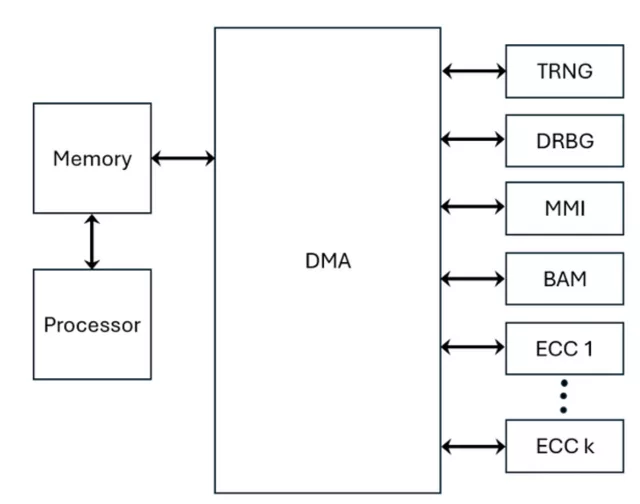
ECDSA IP cores consist of a cluster of IPs. VHDL is used as the Hardware Description Language of the IP Cores. The cluster includes TRNG, DRBG, MMI (Montgomery Modulo Inversion), BAM (Barret Reduction, Addition-Substruction, Multiplication) and ECC (Elliptic Curve Cryptograph) IP Cores. The use of TRNG IP Core and DRBG IP Core is recommended. ECC cores are configurable and their number can be changed.
Key features
- supports signature generation and verify for curves listed below:
- P-192
- P-224
- P-256
- P-384
- P-521
- is compliant with FIPS 186.
- is tested on Z-7015 Z-7020 Z-7045.
- has fully stallable input and output interfaces.
Block Diagram
What’s Included?
- Encrypted Netlist
- Synthesis Scripts
- Comprehensive Documentation
Specifications
Identity
Security
Files
Note: some files may require an NDA depending on provider policy.
Provider
Learn more about Public Key IP core
Securing the IoT: Part 1 - Public key cryptography
Smart Engine for Public Key cryptography
Public key cryptography and security certificates
Securing your apps with Public Key Cryptography & Digital Signature
Secure Boot for embedded systems: Building a complete chain of trust
Frequently asked questions about Public-Key Cryptography IP cores
What is ECDSA IP Core?
ECDSA IP Core is a Public Key IP core from ElectraIC listed on Semi IP Hub.
How should engineers evaluate this Public Key?
Engineers should review the overview, key features, supported foundries and nodes, maturity, deliverables, and provider information before shortlisting this Public Key IP.
Can this semiconductor IP be compared with similar products?
Yes. Buyers can compare this product with similar semiconductor IP cores or IP families based on category, provider, process options, and structured technical specifications.