Vendor: Commsonic Ltd Category: Modulation Demodulation

DVB-Satellite demodulator

The CMS0059 Satellite Demodulator is a high-performance (A)PSK demodulator core intended for DVB-S, DVB-DSNG, DVB-S2 and DVB S2X …

Overview

The CMS0059 Satellite Demodulator is a high-performance (A)PSK demodulator core intended for DVB-S, DVB-DSNG, DVB-S2 and DVB S2X forward link applications.

The DVB-S and DVB-DSNG “plug-in”s provide soft constellation outputs together with recovered QAM information suitable for decoding by the integrated DVB-S/DSNG FEC decoder. The recovered TS output stream is smoothed before being output from the core.

The DVB-S2 and DVB-S2X demodulator “plug-ins” are compatible with the ACM, VCM and CCM configurations of the DVB-S2 and DVB-S2X Standards and is therefore suitable for the reception of DVB broadcast, DSNG, professional and broadband interactive services. The DVB-S2 and DVB-S2X demodulator plug-ins provide soft constellation outputs together with DVB-S2/DVB-S2X physical-layer information suitable for decode by a 3rd party DVB-S2 FEC (BCH/LDPC) decoder.

Optional DVB-S2X Annex-M timeslicing acquisition and header decoding.

Operating symbol rate is programmed from a register and extends from approximately 40% of the master clock frequency down to an arbitrary low rate that is set through synthesis options. The range would normally be dictated by the application and, in particular, the phase noise characteristics of the radio system.

Carrier acquisition is performed in several stages starting with a coarse, stepped search. The search range and step size are programmed through registers and can be set to accommodate an arbitrary offset (within the sample rate bandwidth). Constellation symbols are output as soft decisions after descrambling and the recovery of carrier phase, symbol timing and gain.

The CMS0059 is provided with a baseband I/Q radio interface compatible with zero-IF and near-zero-IF tuner modules. The interface performs automatic compensation of DC offsets and quadrature imbalances (phase and amplitude).

Tuner Rx gain control is provided through PDM or parallel gain value outputs. Further stages of gain control are implemented digitally within the demodulator.

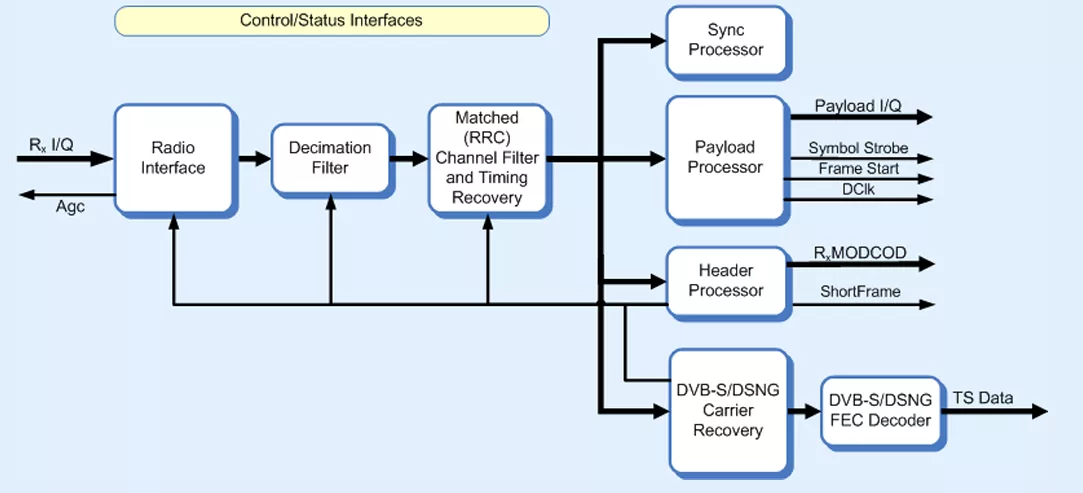
The Decimation Filter stage suppresses wideband interference and restricts the sample rate bandwidth prior to matched (RRC) channel filtering and timing recovery. The combined response of the Decimation and Channel Filters allows the CMS0059 to tolerate up to +10dBc of adjacent channel interference at any supported symbol rate.

DVB-S/DSNG Demodulation

A single processor at the output of the Channel Filter handles the DVB-S/DSNG demodulation functions – primarily carrier and phase recovery.

The carrier-recovery block corrects the phase and frequency offsets for QPSK, 8-PSK or 16-QAM constellations before delivering soft outputs symbols (unsliced constellation samples) for either external decoding, or to the integrated FEC decoder.

DVB-S2 / DVB-S2X Demodulation

Three dedicated processors at the output of the Channel Filter handle the DVB-S2 and DVB-S2X specific demodulation functions:

Sync Processor. This is responsible for the recovery of initial Physical Layer (PL) frame synchronisation from the Start of Frame (SOF) sequence in each PL Header.

Header Processor. This is responsible for configuring the Payload Processor according to the received MODCOD/PLSCODE field. The arrival of a SOF sequence triggers the (BPSK) demodulation and decoding of the PL Header.

The MODCOD/PLSCODE field defines the modulation format, FEC code rate and size of the frame payload.

Payload Processor. This delivers soft output symbols (unsliced constellation samples) to a separate LDPC Decoder after carrier phase correction, gain normalisation and physical layer descrambling.

Register Configuration

Static configuration and status monitoring is performed through a bank of registers. This would typically be driven from a processor interface connected to a CPU that is embedded on the same device or located off-chip.

Parameters accessible through this interface include:

  • Nominal symbol and input carrier frequencies;
  • Window and step sizes for the coarse carrier search;
  • AGC and PLL configuration and status;
  • Estimated signal-to-noise ratio (CNIR).

Important synchronisation events such as the acquisition of symbol timing lock or PL frame sync are signalled through the SyncEvents output. Some or all of these signals would typically be connected to the processor interface as sources of interrupt but might otherwise be polled as status indicators.

The Channel and Decimation Filters use hard-wired FIR filter coefficients that are generated during synthesis. FPGA platforms employing more than one Channel Filter configuration would normally store a different netlist for each filter used.

The option of programmable coefficients is available for ASIC and high-end FPGA platforms that have adequate (multiplier) resources.

Full details of the register interface are provided in the CMS0059 IP Guide document.
Key features

  • Fully compliant with ETSI EN 302 307-1, ETSI EN 302 307-2, ETSI EN 301 210 and ETSI EN 300 421.
  • Optional integrated DVB-S/DSNG channel decoder.
  • Optional DVB-S2X Annex-M support.
  • Optional DVB-DSNG support.
  • Optional DVB-S2 support for CCM, VCM and ACM configurations of ETSI EN 302 307-1.
  • Optional DVB-S2X support for CCM, VCM and ACM configurations of ETSI EN 302 307-2.
  • Automatic DVB-S/DSNG/S2/S2X search acquisition.
  • Support for an arbitrary range of symbol rates up to 40% of the master clock frequency.
  • Digital decimation and channel filters reject up to +10dBc of adjacent channel interference.
  • Fully-digital carrier and clock recovery circuits eliminate the need for an external VCXO.
  • Baseband I/Q radio interface incorporating compensation for DC offset and quadrature imbalances.
  • Integrated, high-performance pi/2-BPSK DVB S2 / -S2X demodulator and Reed Muller FEC decoder for Frame Header processing (PLSCODE).
  • DVB-S2 / -S2X frame-by-frame selection of frame size, FEC code rate and modulation format (QPSK, 8PSK, 16APSK, 32APSK, 64APSK, 128APSK and 256APSK).
  • DVB-S2 / -S2X pilot-assisted carrier tracking ensures robust performance in the presence of high levels of phase noise.
  • DVB-S2 / -S2X physical layer sync acquisition and maintenance at –2dB SNR (Es/N0).
  • DVB-S2 / -S2X compatible with leading LDPC FEC decoder solutions.
  • Supplied as a protected bitstream or netlist (Megacore for Altera FPGA targets).

Block Diagram

Specifications

Identity

Part Number
CMS0059
Vendor
Commsonic Ltd
Type
Silicon IP

Files

Note: some files may require an NDA depending on provider policy.

Provider

Commsonic Ltd
HQ: UK
Commsonic is a design services company specialising in the development of ASIC, FPGA, DSP and board-level sub-systems for applications in wireless and wireline communications.

Our expertise is primarily in the gate- and power-efficient implementation of physical-layer (PHY) functions such as: modulation, demodulation, equalisation and channel coding but our experience encompasses all of the major elements of a modern baseband 'core' including the medium access control (MAC), voiceband DSP, mixed-signal interfaces, and embedded Cpu and software.

Our services are provided on a turnkey basis or as part of a support package attached to our licenced IP or tool products.

Commsonic's customers are typically semiconductor vendors and manufacturers of communications equipment that require leading-edge, Standards-based or proprietary PHY solutions but lack the internal resources or skills necessary to deliver projects against aggressive deadlines.

Learn more about Modulation Demodulation IP core

Three Major Inflection Points for Sourcing Bluetooth Intellectual Property

Synopsys is now shipping support for Bluetooth® 5.4, the latest specification from the Bluetooth SIG (Special Interest Group). The enhancements in Bluetooth 5.4 will open additional markets and use cases. This is one of the many inflection points in the Bluetooth Low Energy market that will be discussed in this paper.

Part 2: Opening the 5G Radio Interface

Carriers are now deploying 5G across the globe driven by the need to keep up with relentless mobile data growth. 5G New Radio (NR) operates at higher frequencies to increase bandwidth, but at the expense of range. There will therefore be a need for a much larger number of 5G RUs to provide the same coverage. The availability of cost-effective, reliable and open 5G radio units is therefore critical.

An Integrated, Tunable RF Filter: an Enabler for Reconfigurable Front-Ends

This paper presents the design and performance of a key RF circuit necessary for the realization of a reconfigurable, integrated RF front-end: a tunable frequency, selectable bandwidth, on-chip, “SAW replacement” filter. The on-die tunable filter presented here has a tunable center frequency up to 1 GHz, a selectable bandwidth up to 40 MHz, and an adjacent channel rejection down to 60 dB.

Design considerations for integrated CMOS receivers

To meet the demands for the multi-band, multi-mode wireless standards in the current market, a highly integrated wireless receiver (RX) is desired. CMOS technology has become the technology of choice for the integrated receiver design.

Silicon IP for Programmable Baseband Processing

An efficient IP reuse strategy relies on IP blocks with wide applicability. That makes generic blocks, such as programmable processors preferable. However, in many applications such as handheld wireless terminals, additional silicon area and power consumption compared to fixed function solutions can not be accepted.

Frequently asked questions about Modulation and Demodulation IP cores

What is DVB-Satellite demodulator?

DVB-Satellite demodulator is a Modulation Demodulation IP core from Commsonic Ltd listed on Semi IP Hub.

How should engineers evaluate this Modulation Demodulation?

Engineers should review the overview, key features, supported foundries and nodes, maturity, deliverables, and provider information before shortlisting this Modulation Demodulation IP.

Can this semiconductor IP be compared with similar products?

Yes. Buyers can compare this product with similar semiconductor IP cores or IP families based on category, provider, process options, and structured technical specifications.

×
Semiconductor IP