Curve25519 Key Exchange and Digital Signature IP Core
XIP4003C is a very compact Intellectual Property (IP) core designed for efficient X25519 key exchange and Ed25519-based Edwards-c…
Overview
XIP4003C is a very compact Intellectual Property (IP) core designed for efficient X25519 key exchange and Ed25519-based Edwards-curve Digital Signature Algorithm (EdDSA). XIP4003C implements arithmetic on Curve25519, and provides a security level of 128 bits. Curve25519 is used in numerous contemporary security protocols and applications, including TLS 1.3.
XIP4003C has been designed for easy integration with FPGA- and ASIC-based designs in a vendor-agnostic design methodology, and the functionality of XIP4003C does not rely on any FPGA manufacturer-specific features.
Key features
- Minimal Resource Requirements: The entire XIP4003C requires less than 800 ALMs (Cyclone® 5) and uses only 1-2 multipliers/DSP Blocks2 and 1-2 internal memory block in a typical FPGA implementation.
- Constant Latency: The execution time of XIP4003C is independent of the key value, and consequently provides protection against timing-based side-channel attacks.
- Performance: Despite its small size, XIP4003C can support more than 100 key exchange or digital signature operations per second.
- Standard Compliance: XIP4003C is compliant with RFC7748, RFC8032, and the draft version of FIPS 186-5. XIP4003C can be used as a part of many public-key protocols including IKEv2 (RFC 8031) and TLS 1.3 (RFC 8446).
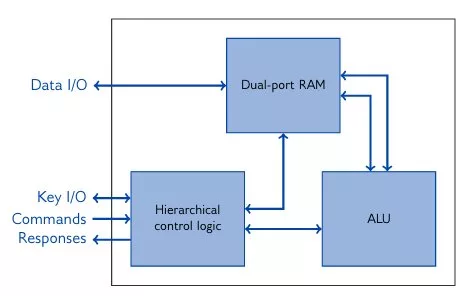
Block Diagram
Benefits
- Fully digital design
- Portable to any ASIC or FPGA technology
- Fully standard compliant
- Easy to integrate
- Several bus interfaces available
- IP core designed in-house at Xiphera
- Technical support by the original designers and cryptographic experts
Applications
- XIP4003C can be used in combination with other Xiphera IP cores to design an FPGA-based security solution. Possible use cases include:
- Using the TRNG IP core XIP8001B to supply the required number of random bits for secret key derivation by the HKDF IP core XIP3322B, whose result will be used by XIP4003C.
- Using XIP4003C to exchange the 128-bit secret key required for the AES-GCM -based communication with Xiphera IP cores XIP1111B, XIP1111H, XIP1113B and XIP1113H.
- Using XIP4003C with XIP3027C in digital signature generation and verification
- XIP4003C can also be used to offload microcontroller / -processor based designs, if a software-based implementation of Curve25519 arithmetic is too slow.
What’s Included?
- XIP4003C can be shipped in a number of formats, including netlist, source code, or encrypted source code.
- Additionally, synthesis scripts, a comprehensive testbench, and a detailed datasheet including an integration guide are included.
Specifications
Identity
Files
Note: some files may require an NDA depending on provider policy.
Provider
Learn more about Public Key IP core
CAVP-Validated Post-Quantum Cryptography
Hybrid models connect the post-quantum with the classical security
Why Post-Quantum Cryptography Doesn’t Replace Classical Cryptography
The Rise of Physical AI and Robotics: Why Hardware-Based Security is Non-Negotiable
Securing the IoT: Part 1 - Public key cryptography
Frequently asked questions about Public-Key Cryptography IP cores
What is Curve25519 Key Exchange and Digital Signature IP Core?
Curve25519 Key Exchange and Digital Signature IP Core is a Public Key IP core from Xiphera Ltd listed on Semi IP Hub.
How should engineers evaluate this Public Key?
Engineers should review the overview, key features, supported foundries and nodes, maturity, deliverables, and provider information before shortlisting this Public Key IP.
Can this semiconductor IP be compared with similar products?
Yes. Buyers can compare this product with similar semiconductor IP cores or IP families based on category, provider, process options, and structured technical specifications.