Overview
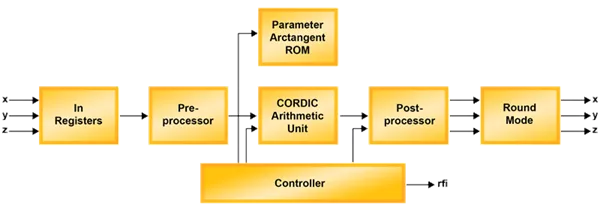
CORDIC (COordinate Rotation DIgital Computer) is a simple and efficient algorithm to calculate hyperbolic and trigonometric functions and convert polar co-ordinates to artesian and vice versa. It is an iterative method that requires simple arithmetic operations such as addition, subtraction, bit shift and table look up. This frees up any available multipliers in the device for use in more complex tasks.
The Lattice CORDIC IP is configurable and several functions can be implemented in the IP core: Rotation, Translation, Sin and Cos, Arctan. Two architecture configurations are available for the arithmetic unit: Parallel, with single cycle data throughput, and Word-serial, with multiple cycles throughput. The input data, output data widths and iterative number are configurable over a wide range. The IP core uses full internal precision while allowing variable output precision with several choices for rounding.
Learn more about Arithmetic Units IP core
Combining Arm® AGI CPU server platforms with Lattice FPGAs and AMI firmware creates a solution that provides advanced security, manageability, connectivity, and flexibility for next-generation AI data center infrastructure.
Lattice Prompt pairs with AI agentic tools developers already use, combining them with Lattice design tools, knowledge base, and documentation to turn natural language inputs into validated responses, dramatically accelerating FPGA development while optimizing design performance and capability.
First announced on May 4, 2026, the acquisition creates the industry's most complete secure management and control platform.
The acquisition brings together Lattice’s industry-leading low power FPGAs with AMI’s industry‑leading platform firmware and infrastructure manageability solutions for cloud and AI to create a complete portfolio of secure management and control solutions.
The collaboration demonstrates a real-time AI sensor fusion architecture that integrates TI mmWave radar and camera sensors using NVIDIA Holoscan Sensor Bridge running on Lattice’s low power FPGA. The FPGA acts as a companion chip delivering synchronized sensor data directly into GPU-accessible memory to enable low-latency and robust perception for robotics and industrial edge AI applications.
Sets new standard for secure control FPGAs with full CNSA 2.0-compliant post-quantum cryptography, crypto-agility, and hardware Root of Trust for next-generation infrastructure