Vendor: Lattice Semiconductor Corp. Category: CPRI

Common Public Radio Interface - IP Core

This document provides technical information about the Lattice Common Public Radio Interface (CPRI) IP core.

Overview

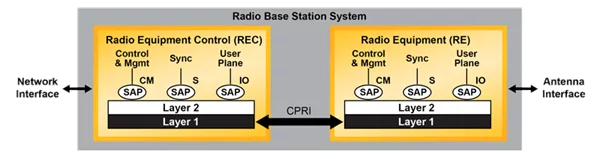
This document provides technical information about the Lattice Common Public Radio Interface (CPRI) IP core. This IP core together with SERDES and Physical Coding Sublayer (PCS) functionality integrated in the LatticeECP3™ and ECP5™ LFE5UM FPGAs implements the physical layer of the CPRI specification and interleaves IQ data with synchronization, control and management information. It can be used to connect Radio Equipment Control (REC) and Radio Equipment (RE) modules.

The CPRI IP core implements not only all of the capabilities required to support the physical layer of the CPRI specification (basic function), but also specific requirements related to link delay accuracy (low latency character).

One CPRI core configuration for 5G version (4.9152 Gbps) is also supported. It is similar to the "low latency" one for 3G version except the data rate.

Key features

  • Supports the physical link layer (Layer 1) of the CPRI specification
  • Supports three standard bit rates of the CPRI specification
    • 614.4 Mbps
    • 1228.8 Mbps
    • 2457.6 Mbps
    • 3072 Mbps
  • Supports 8b/10b encoding/decoding performed in the PCS/SERDES
  • Supports code-violation detection performed in the PCS/SERDES
  • Performs CPRI Hyperframe Framing
    • Performs interleaving of IQ data, sync, C&M data, and vendor specific information
    • Provides an 8-, 16-, or 32-bit parallel interface for IQ data
  • Performs subchannel mapping:
    • Supports a slow C&M channel based on a serial HDLC interface at standard bit rates (240 Kbps, 480 Kbps,960 Kbps, and 1920 Kbps). The HDLC framer, if needed, must be provided as a separate IP core.
    • Supports a fast C&M channel based on a serial Ethernet interface (84.48 Mbps max.) to the user logic, anon-standard rate MII Ethernet interface to a MAC, or a 100 Mbps MII interface to a PHY device. Accepts a user-selected pointer to the CPRI subchannel where the Ethernet link starts. The Ethernet MAC function isprovided as a separate IP core.

Block Diagram

Specifications

Identity

Part Number
CPRI
Vendor
Lattice Semiconductor Corp.
Type
Silicon IP

Files

Note: some files may require an NDA depending on provider policy.

Provider

Learn more about CPRI IP core

Powering Scale Up and Scale Out with 224G SerDes for UALink and Ultra Ethernet

At the recent ECOC 2025 conference in Copenhagen, Cadence showcased its key role in enabling the future of AI infrastructure with live silicon demonstrations of several essential IP technologies for emerging 800G and 1.6T networks. Powered by Cadence's 224G SerDes IP, Cadence's Ultra Accelerator Link (UALink 1.0) scale-up and Ultra Ethernet scale-out networking solutions deliver the performance, flexibility, and interoperability needed for next-generation AI factories and hyperscale data centers.

O-RAN Fronthaul Security using MACsec

With 5G being deployed for time-sensitive applications, security is becoming an important consideration. At the same time, Open Radio Access Networks (RAN) are gaining more interest from mobile carriers and governments. Yet, Open RAN networks have serious security challenges, especially in the RAN fronthaul where there are strict timing requirements. This paper proposes MACsec as an efficient data link layer security solution that can assist in meeting these challenges.

Seize the Ethernet TSN Opportunity

The following sections will take a look at the major Ethernet performance issues and how the extensions address those shortcomings. This will be followed by an overview of the applications of TSN for 5G, industrial automation, automotive invehicle communications and avionics. The paper will conclude with a description of Ethernet TSN solutions offered by Comcores.

Part 2: Opening the 5G Radio Interface

Carriers are now deploying 5G across the globe driven by the need to keep up with relentless mobile data growth. 5G New Radio (NR) operates at higher frequencies to increase bandwidth, but at the expense of range. There will therefore be a need for a much larger number of 5G RUs to provide the same coverage. The availability of cost-effective, reliable and open 5G radio units is therefore critical.

Accelerating 5G virtual RAN deployment

This whitepaper provides an overview of the O-RAN Alliance and the value provided by O-RAN to the carrier industry along with a brief introduction to Comcores, our O-RAN solutions and our role in the O-RAN eco-system.

Frequently asked questions about CPRI IP cores

What is Common Public Radio Interface - IP Core?

Common Public Radio Interface - IP Core is a CPRI IP core from Lattice Semiconductor Corp. listed on Semi IP Hub.

How should engineers evaluate this CPRI?

Engineers should review the overview, key features, supported foundries and nodes, maturity, deliverables, and provider information before shortlisting this CPRI IP.

Can this semiconductor IP be compared with similar products?

Yes. Buyers can compare this product with similar semiconductor IP cores or IP families based on category, provider, process options, and structured technical specifications.

×
Semiconductor IP