Overview
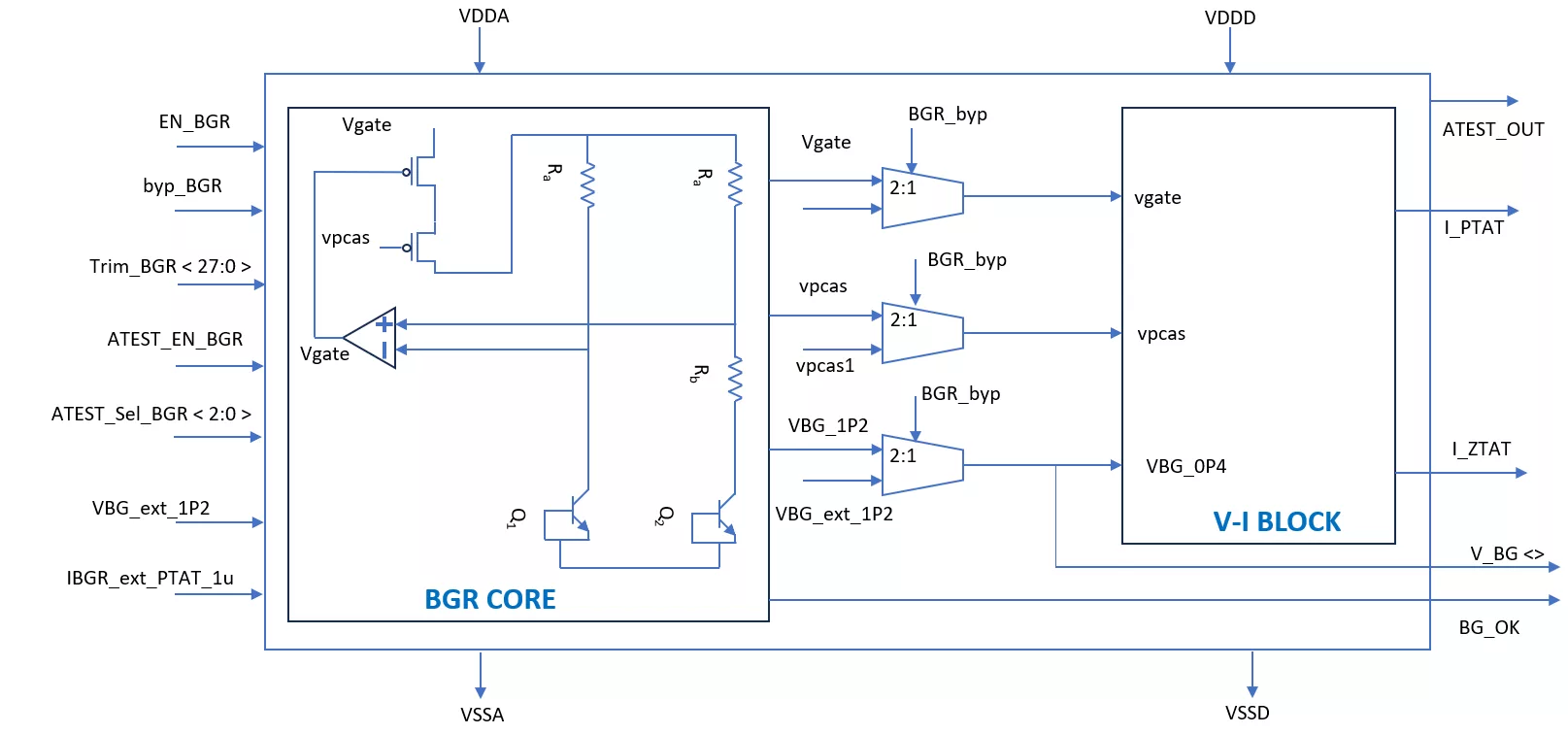
HCLTech offers IP Bandgap (BGR) bgr_1p2_t40_v1 generates precision reference voltage (0.4V ~ 1.2V) and current reference (1.005µA ~ 8.07µA) with variation of 103 ppm/°C over a temperature range of (-40°C - 125°C). hcl_bgr_1p2_t40_v1 is programmable for voltage and current as per requirements. It includes features along with stable voltage, ZTAT current.
hcl_bgr_1p2_t40_v1 offers low voltage dropout reference, low power, small size and its compact size and low power consumption (50.85 µA), make the perfect for battery-powered and portable devices. Furthermore, the total occupied area is a relatively small 0.0722 mm2.
Learn more about Voltage Reference IP core
HCLTech, a leading global technology company, has been selected as a Design Solution Partner (DSP) under the Samsung Advanced Foundry Ecosystem (SAFE™) program.
In this paper, we explain how we adopted the post processing method to make sure we check for signatures that are expected are present in the log files. This acted as a safety net when engineers made inadvertent mistakes and introduced issues in the code base.
HCLTech, a leading global technology company, and Arm, a leading technology provider of processor IP, announced their collaboration to augment custom silicon chips that support AI-driven business operations.
HCLTech, a leading global technology company, and Arm, a leading technology provider of processor IP, announced their collaboration to augment custom silicon chips that support AI-driven business operations.
This paper deals with the implementation of UPF for low power SoC design that can encompass several vendor IPs and custom IPs UPF constraints.
This paper discusses about the low power IP components from ARM can help one to realize the low power features in the SoC. It should be noted that this paper does not discuss about the low power concepts or design techniques. Rather, it focuses on the implementation approaches using ARM low power IP.