Overview
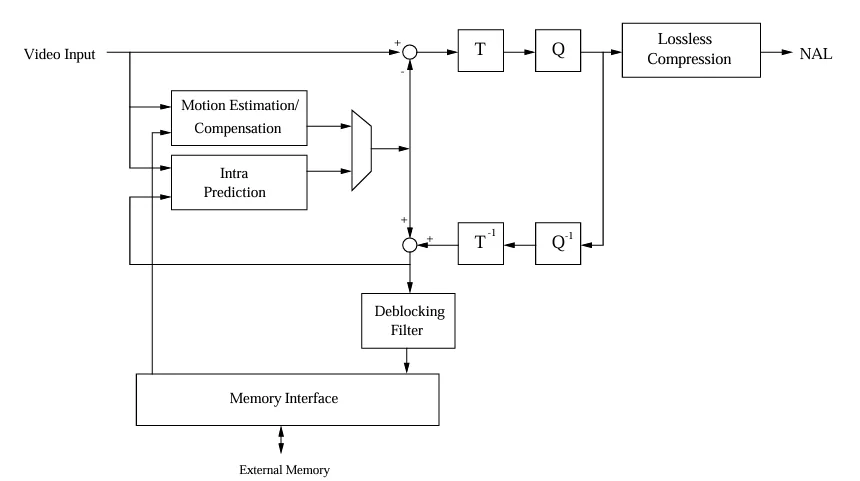
The OL_H264e core is a hardware implementation of the H.264 baseline video compression algorithm.
The core accepts up to the highest resolution HDTV video stream as input and outputs the encoded bitstream.
Simple, fully synchronous design with low gate count.
The OL_H264e core is a hardware implementation of the H.264 baseline video compression algorithm designed to process HDTV progressive video up to 1920x1080 at 30 fps.
Each block of 16x16 pixels is processed in just 1024 cycles. This means that each pixel is processed in just 4 cycles. Consequently, given an uncompressed video stream of resolution X by Y, and frame rate fps, the minimum clock frequency to process a such video stream is :
F = 4*X*Y*fps
This allows the core to process the video stream at relatively low clock frequencies. For example, HDTV video of 1920x1080 @ 30 fps requires ~250 MHz, whereas VGA video of 640x480 @ 30 fps requires ~37 MHz.
Learn more about Video Processing IP core
This paper discusses a simple and effective method for the summation of long sequences of floating point numbers. The method comprises two phases: an accumulation phase where the mantissas of the floating point numbers are added to accumulators indexed by the exponents and a reconstruction phase where the actual summation result is finalised.
This paper attempts to address and reconcile two different issues: the existence of multiple numerical data formats (such as int8, bfloat16, fp8, etc., often non optimal for the application and not directly compatible with one another) and the necessity to reduce their bandwidth requirements, especially in the case of power hungry and slow DRAM.
Bit Layer Multiplier Accumulator (BLMAC) is an efficient method to perform dot products without multiplications that exploits the bit level sparsity of the weights. A total of 1,980,000 low, high, band pass and band stop type I FIR filters were generated by systematically sweeping through the cut off frequencies and by varying the number of taps from 55 to 255.
This paper discusses the hardware implementation of an encoder and a decoder for the QOI lossless RGB image format. Some results are given for the AMD/Xilinx architecture, reaching over 800 Mpixels/s in Ultrascale+ and more than 4K@30 in Artix-7. A compression improvement up to ~15% is also observed when natural images are scanned along a Hilbert curve instead of the normal raster order.
This paper introduces two architectures for the inference of convolutional neural networks (CNNs). Both architectures exploit weight sparsity and compression to reduce computational complexity and bandwidth.
This paper discusses three basic blocks for the inference of convolutional neural networks (CNNs). Pyramid Vector Quantization (PVQ) is discussed as an effective quantizer for CNNs weights resulting in highly sparse and compressible networks. Properties of PVQ are exploited for the elimination of multipliers during inference while maintaining high performance. The result is then extended to any other quantized weights. The Tiny Yolo v3 CNN is used to compare such basic blocks.