Vendor: MEMS Vision Category: Analog Front End

8-Channel Ultra-Low Power Capacitive Touch Interface

The MVCTCH01 ASIC is an ultra-low power and high-sensitivity 8-channel capacitive touch interface that is designed to be easily i…

TSMC 180nm BCDG2 View all specifications

Overview

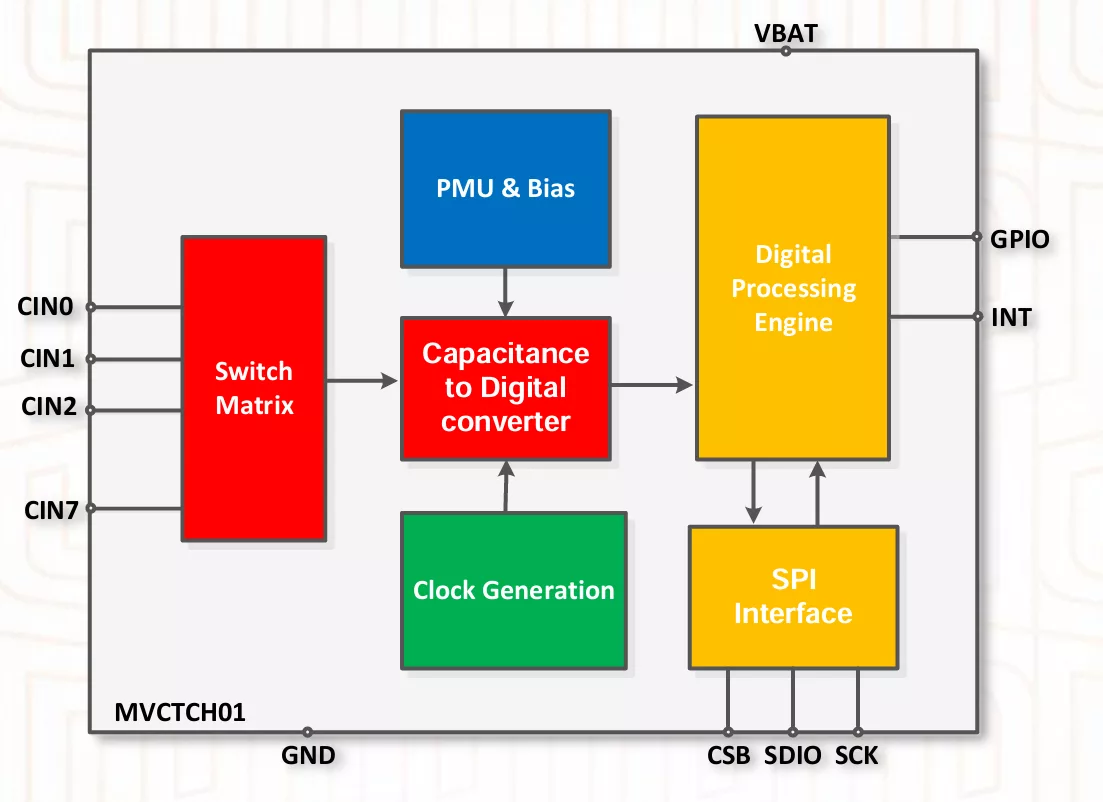
The MVCTCH01 ASIC is an ultra-low power and high-sensitivity 8-channel capacitive touch interface that is designed to be easily integrated with capacitive touch pads. Ultra-low power operation is achieved by using a novel capacitive-to-digital converter, making it suitable for battery powered and portable devices.

The chip supports a low-power sleep mode, a scanning mode where the chip periodically scans the input channels for touch events at programmable intervals, and an active mode where the chip always scans the input channels.

Temperature Range -40 to 85°C
Power Supply Voltage 1.8 to 3.6V
Low Capacitance Noise <16fF for 40pF input
RC Oscillator Trimming Error <0.4%
Low Sleep Current <10nA
Scanning Time (8-channels) 12.5ms
Small Footprint 1.24 x 0.83mm2
Chip Communication 3-wire SPI interface

Key features

  • 8-channel input switch matrix
  • Wide input capacitance range from 5 to 45pF
  • Low measurement current: 40µA
  • Low average current for one measurement/second: 0.5µA
  • Programmable alarm feature to signal touch events
  • Trimmable RC oscillator for accurate clocking
  • Small form factor Die size: 1.24 x 0.83mm2

Block Diagram

Applications

  • Smart-home Devices
  • Wearables
  • Remote Controls
  • Printers
  • Whitegoods
  • Medical Devices
  • Industrial
  • IoT

Silicon Options

Foundry Node Process Maturity
TSMC 180nm BCDG2

Specifications

Identity

Part Number
MVCTCH01
Vendor
MEMS Vision
Type
Silicon IP

Files

Note: some files may require an NDA depending on provider policy.

Provider

HQ: Canada

Learn more about Analog Front End IP core

How to specify and integrate successfully a measurement analog front-end including its power computation engine in an energy metering IC

Based on the system specification of a typical smart meter, this article demonstrates the importance of carefully selecting the power metering IP solution so that its specification matches the standard requirements and copes with the application challenges. This article then pinpoints thoroughly the various issues that must be taken into account for the selection of the Silicon IP and helps identify the possible trade-offs between the performance of the Mixed-signal Front-end (MFE) and that of the Power and energy Computation Engine (PCE).

Modeling and Verification of Mixed Signal IP using SystemVerilog in Virtuoso and NCsim

In this paper we present a methodology to model and verify a mixed-signal IP using SystemVerilog in Virtuoso and NCsim. We take our 12.5Gbps transmitter (TX) design as an example to explain the method we propose. This TX is designed to operate at programmable data rates from 1.25Gbps – 12.5Gbps and to support requirements of multiple serial protocols like USB, PCIe, and SATA. Interaction between AFE and Digital is key towards proper implementation of features like Feed Forward Equalization (FFE), programmable output swing and power management states.

Is there a "one-size fits all" SOC PLL?

Like most types of circuits, there is no such thing as a "one size fits all" PLL. This article will explore the trade-offs in PLL performance and design and look for a solution to most SOC PLL needs.

Frequently asked questions about Analog Front End IP cores

What is 8-Channel Ultra-Low Power Capacitive Touch Interface?

8-Channel Ultra-Low Power Capacitive Touch Interface is a Analog Front End IP core from MEMS Vision listed on Semi IP Hub. It is listed with support for tsmc.

How should engineers evaluate this Analog Front End?

Engineers should review the overview, key features, supported foundries and nodes, maturity, deliverables, and provider information before shortlisting this Analog Front End IP.

Can this semiconductor IP be compared with similar products?

Yes. Buyers can compare this product with similar semiconductor IP cores or IP families based on category, provider, process options, and structured technical specifications.

×
Semiconductor IP