Vendor: Synopsys, Inc. Category: CPRI

12G CPRI PHY - TSMC N5 x4 1.2V North/South (vertical) poly orientation

The multi-lane Multi-Protocol 16G PHY IP is part of a high-performance multi-rate transceiver portfolio, meeting the growing need…

Overview

The multi-lane Multi-Protocol 16G PHY IP is part of a high-performance multi-rate transceiver portfolio, meeting the growing needs for high bandwidth and low latency in enterprise applications. Using leading-edge design, analysis, simulation, and measurement techniques, the multi-protocol 16G PHY delivers exceptional signal integrity and jitter performance that exceeds the standards electrical specifications. The PHY is small in area and provides a low active and standby power solution that supports multiple electrical standards including PCI Express, SATA, Ethernet, OBSI/CPRI, JESD204, Serial Rapid I/O and other industry-standard interconnect protocols. The Synopsys Multi-Protocol 16G PHY IP is optimized to meet the needs of applications with high-speed port side, chip-to-chip, and backplane interfaces.

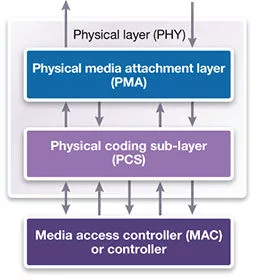
The configurable transmitter and receiver equalizers enable customers to control and optimize signal integrity and at-speed performance. Continuous Calibration and Adaptation (CCA) provides a robust performance across voltage and temperature variations during normal mode of operation. The PHY supports low standby power with advanced L1 substates and low active power with I/O supply under drive, decision feedback equalization (DFE) bypass and V-Boost off. The embedded bit error rate (BER) tester and internal eye monitor provide on-chip testability and visibility into channel performance. The PHY integrates seamlessly with the Synopsys Physical Sublayers and digital controllers/media access controllers (MACs) to reduce design time and to help designers achieve first-pass silicon success. These features reduce both product development cycles and accelerate time-to-market.

Key features

  • Supports 1.25 to 16 Gbps data rates
  • Supports
    • PCI Express 4.0/3.1/2.1/1.1, with lane margining
    • IEEE 802.3 1G to 40G backplane (KX, KX4/XAUI, KR & KR4), port side (XFI, SFF-8431/SFI and CR4)
    • SGMII and QSGMII (1.25 to 5G)
    • SATA 6G/3G/1.5G
    • CEI-6G and CEI-11G
    • Serial Rapid IO (SRIO)
    • CPRI, OBSAI, JESD204B
    • Other industry-standards
  • Supports x1 to x16 macro configurations
  • Superior signal integrity across lossy backplanes enabled by a high-performance analog front-end that includes adaptive continuous time linear equalizer (CTLE), decision feedback equalization (DFE) and feed forward equalization (FFE)
  • PCI Express L1 substate power management
  • PCI Express aggregation and bifurcation
  • Spread Spectrum Clock (SSC)
  • PCIe Separate Refclk Independent SSC (SRIS)
  • Reference clock sharing for aggregated macro configurations
  • Embedded bit error rate (BER) tester and internal eye monitor
  • IEEE 802.3az Electrical Energy Efficient (EEE)
  • Supports IEEE 1149.6 AC Boundary Scan
  • Supports -40°C to 125°C Tj

Block Diagram

Specifications

Identity

Part Number
dwc_12g_cpri_phy_tsmc5ff12_x4ns
Vendor
Synopsys, Inc.
Type
Silicon IP

Files

Note: some files may require an NDA depending on provider policy.

Provider

Learn more about CPRI IP core

Powering Scale Up and Scale Out with 224G SerDes for UALink and Ultra Ethernet

At the recent ECOC 2025 conference in Copenhagen, Cadence showcased its key role in enabling the future of AI infrastructure with live silicon demonstrations of several essential IP technologies for emerging 800G and 1.6T networks. Powered by Cadence's 224G SerDes IP, Cadence's Ultra Accelerator Link (UALink 1.0) scale-up and Ultra Ethernet scale-out networking solutions deliver the performance, flexibility, and interoperability needed for next-generation AI factories and hyperscale data centers.

O-RAN Fronthaul Security using MACsec

With 5G being deployed for time-sensitive applications, security is becoming an important consideration. At the same time, Open Radio Access Networks (RAN) are gaining more interest from mobile carriers and governments. Yet, Open RAN networks have serious security challenges, especially in the RAN fronthaul where there are strict timing requirements. This paper proposes MACsec as an efficient data link layer security solution that can assist in meeting these challenges.

Seize the Ethernet TSN Opportunity

The following sections will take a look at the major Ethernet performance issues and how the extensions address those shortcomings. This will be followed by an overview of the applications of TSN for 5G, industrial automation, automotive invehicle communications and avionics. The paper will conclude with a description of Ethernet TSN solutions offered by Comcores.

Part 2: Opening the 5G Radio Interface

Carriers are now deploying 5G across the globe driven by the need to keep up with relentless mobile data growth. 5G New Radio (NR) operates at higher frequencies to increase bandwidth, but at the expense of range. There will therefore be a need for a much larger number of 5G RUs to provide the same coverage. The availability of cost-effective, reliable and open 5G radio units is therefore critical.

Accelerating 5G virtual RAN deployment

This whitepaper provides an overview of the O-RAN Alliance and the value provided by O-RAN to the carrier industry along with a brief introduction to Comcores, our O-RAN solutions and our role in the O-RAN eco-system.

Frequently asked questions about CPRI IP cores

What is 12G CPRI PHY - TSMC N5 x4 1.2V North/South (vertical) poly orientation?

12G CPRI PHY - TSMC N5 x4 1.2V North/South (vertical) poly orientation is a CPRI IP core from Synopsys, Inc. listed on Semi IP Hub.

How should engineers evaluate this CPRI?

Engineers should review the overview, key features, supported foundries and nodes, maturity, deliverables, and provider information before shortlisting this CPRI IP.

Can this semiconductor IP be compared with similar products?

Yes. Buyers can compare this product with similar semiconductor IP cores or IP families based on category, provider, process options, and structured technical specifications.

×
Semiconductor IP