Cellular IoT and LPWAN - addressing the industry FUD
Chet Babla, ARM
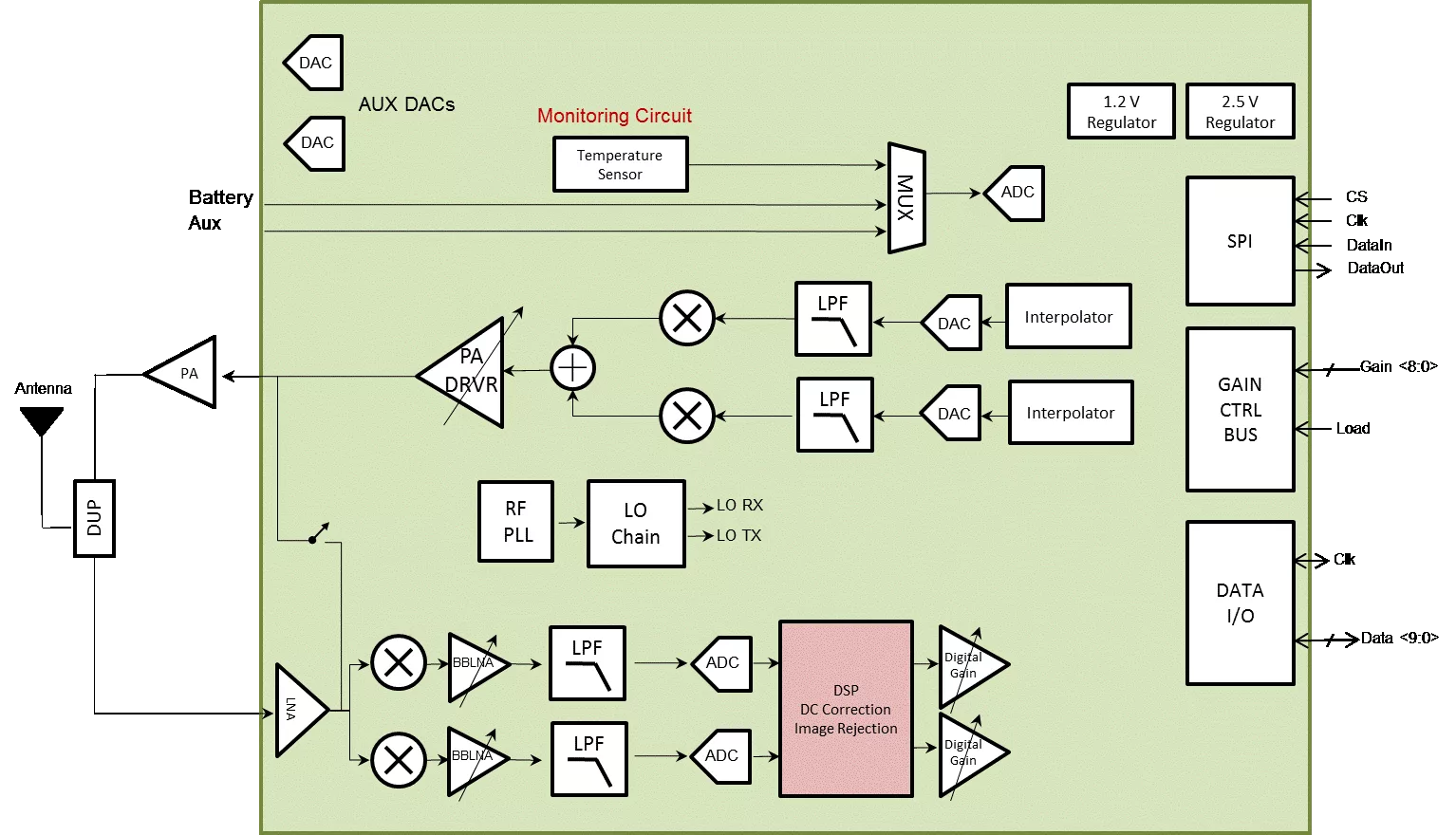
The NB-IoT (LTE Cat NB1) Transceiver is built to comply with the Release 13 standard from 3GPP.
The NB-IoT (LTE Cat NB1) Transceiver is built to comply with the Release 13 standard from 3GPP. It can also operate in a Release-14-compliant mode.
Both the transmitter and the receiver offer performances that meets or exceeds the 3GPP specifications with comfortable margin.
The NB-IoT (LTE Cat NB1) Transceiver operates in the cellular band consistent with LTE Advanced Release 13. It offers analog input and output for ease of testing on FPGA and with silicon baseband modules. It is extremely programmable with an easy SPI interface.
The receiver has internal calibration schemes for DC offset correction and provides the necessary control knobs for IQ mismatch correction
Specifications
| Operating Frequency | 699 MHz to 960 MHz/1695 MHz to 2200 MHz |
| Supported Bandwidth | 200 kHz |
| NF | < 3 dB |
| IIp3 | > -17 dBm |
| Max Input Signal | -10 dBm |
| Supported Interfaces | SPI/SDIO, JTAG, UART, I2C, GPIO, I2S |
The transceiver offers a low-power profile, including the radio, and can be upgraded to meet Release 14 using an external power amplifier that offers +23 dBm output power. Offers 15 dB margin to ACS GSM testing and 8 dB margin for ACS E-UTRA testing.
Easy Integration, Robust Design
Designed to interface with the baseband and MAC layers on a system-level chip. Comprehensive documentation and support make platform integration easy. Built to the highest standards using state-of-the-art RF design methods. Silicon-proven design by Palma Ceia customers worldwide.
Receiver
Transmitter
Note: some files may require an NDA depending on provider policy.
| Foundry | Node | Process | Maturity |
|---|---|---|---|
| TSMC | 40nm | LP | — |

NB-IoT (LTE Cat NB1) Transceiver is a Cellular IP core from Palma Ceia SemiDesign, Inc. listed on Semi IP Hub. It is listed with support for tsmc.
Engineers should review the overview, key features, supported foundries and nodes, maturity, deliverables, and provider information before shortlisting this Cellular IP.
Yes. Buyers can compare this product with similar semiconductor IP cores or IP families based on category, provider, process options, and structured technical specifications.