SATCOM Adopting 3GPP Standards: From Proprietary Silos to Global Scale
SATCOM is adopting 3GPP 5G NTN standards to scale beyond proprietary silos, enabling interoperable satellite networks and global direct‑to‑cell services.
Ceva’s third-generation PentaG platform is a production-ready 5G- modem IP architecture that integrates baseband hardware, L1 PHY…
Ceva’s third-generation PentaG platform is a production-ready 5G-Advanced modem IP architecture that integrates baseband hardware, L1 PHY software, and comprehensive verification assets into a single reusable subsystem.
Compared with the previous generation, the third-generation PentaG platform delivers substantial improvements in performance, scalability, and integration efficiency across both satellite and terrestrial deployments.
Built on a unified architecture, the platform scales seamlessly across SATCOM, IoT, and infrastructure-class applications.
With a silicon-proven, pre-validated modem subsystem, the third-generation PentaG platform accelerates time-to-silicon and significantly reduces development risk.
The Solution
The third-generation PentaG platform delivers a fully integrated modem IP solution combining optimized hardware accelerators, 5G baseband software, and a comprehensive verification environment.
Delivered as a validated modem subsystem rather than discrete IP blocks, it simplifies SoC integration while preserving programmability and extensibility.
Leveraging silicon-proven IP and a unified architecture, the platform reduces integration complexity, accelerates time-to-silicon, and mitigates development risk across satellite, IoT, and infrastructure-class products.
| PentaG-NTN™ | PentaG-Edge™ |
|
|
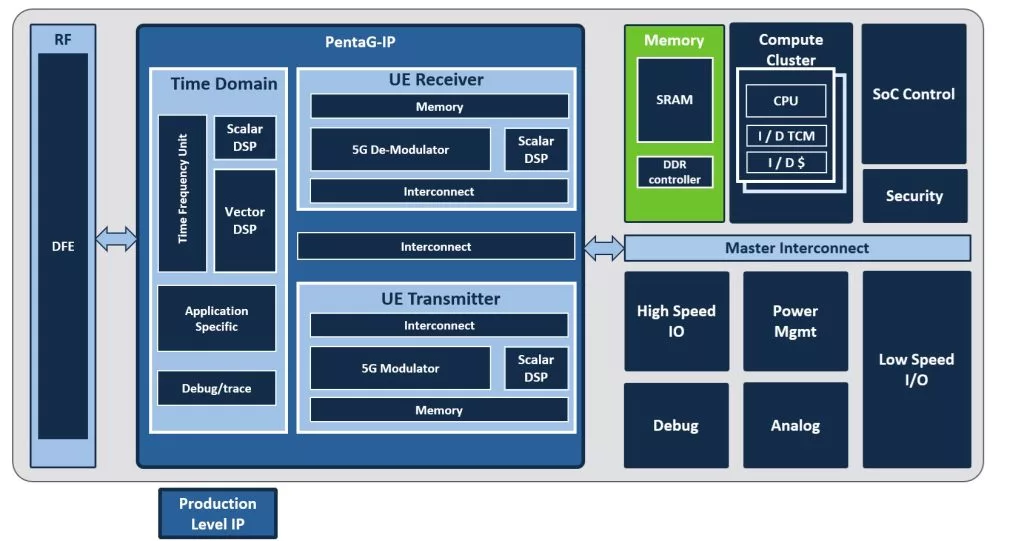
Production-Ready Baseband Processing Subsystem
Optimized Performance and Efficiency
Reduced Technical Risk
Faster Time-to-Market
Note: some files may require an NDA depending on provider policy.

Third-Generation 5G-Advanced Modem IP Platform is a Cellular IP core from Ceva, Inc. listed on Semi IP Hub.
Engineers should review the overview, key features, supported foundries and nodes, maturity, deliverables, and provider information before shortlisting this Cellular IP.
Yes. Buyers can compare this product with similar semiconductor IP cores or IP families based on category, provider, process options, and structured technical specifications.