Overview
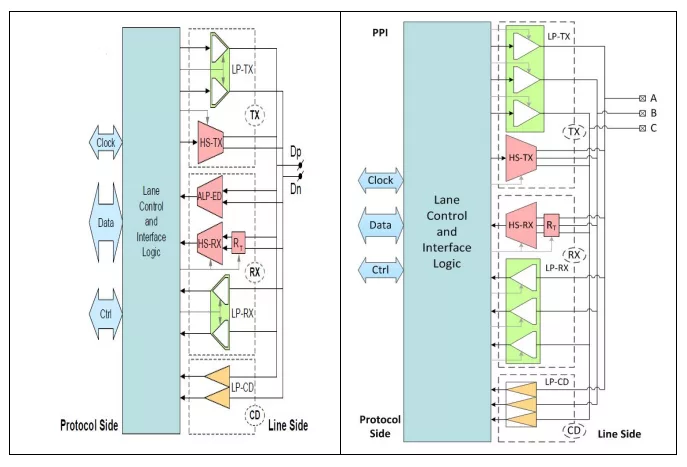
This Tx/Rx transceiver complies with the MIPI Alliance C-PHY℠ v2.0 and D-PHY℠ v2.5 specifications, with world-class area and power dissipation, and is available for a range of foundry processes. This IP delivers 6 Gbps per lane for a max throughput of 24 Gbps in D-PHY℠ mode, and 6 Gsps per trio for a max throughput of 41.04 Gbps in C-PHY℠ mode. The C/D-PHY IP interfaces seamlessly to both D-PHY℠ and C-PHY℠ based sensors over its MIPI CSI-2® IP Core and MIPI Displays are increasingly adopting C-PHY over our MIPI DSI-2℠ IP core.
This combo PHY provides a low-power and high-performance interface for platforms ranging from processors to peripheral devices for mobile, automotive, AI, and IoT applications. It inter-operates seamlessly with Arasan Chip Systems CSI-2® and DSI-2℠, and offers built-in test capabilities including PRBS generator and internal loopback to support cost-effective tests for high volume manufacturing.
This combo PHY may be configured as either a D-PHY℠ with one clock and up to four data lanes, or a C-PHY℠ with up to 3 trio lanes. Area overhead to support both modes is minimized by reusing the D-PHY℠ blocks and high-speed IO’s.
Learn more about MIPI PHY IP core
In the race to build smaller, smarter, and more efficient devices, audio system-on-chips (SoCs) must meet increasingly demanding requirements: high fidelity, low latency, low power, and seamless integration. The SoundWire PHY from Arasan Chip Systems is engineered to meet these challenges and elevate your next audio SoC design from standard to standout.
The emerging MIPI standards are designed to ensure interoperability among devices and software that are used in products for the exploding hand-held market. The standards facilitate the interconnection of multiple, mixed-signal integrated circuit devices on a single hand-held product. Use of the standards ensures low power, low pin count and interoperability of all the devices in the system and easy integration.
This blog breaks the silence to explain what SoundWire‑I3S is, why it matters, and how it’s shaping the future of embedded audio.
UniversalFlash Storage (UFS) was created for mobile applications and computer systems requiring high performance and low power consumption. These systems typically use embedded Flash based on the JEDEC standard eMMC. UFS was defined by JEDEC as the evolutionary replacement for eMMC offering significantly higher memory bandwidth. The standard builds on existing standards such as the SCSI command set, the MIPI Alliance M-PHY and UniPro as well as eMMC form factors to simplify adoption and development.
Universal Flash Storage (UFS) was created for mobile applications and computer systems requiring high performance and low power consumption. These systems typically use embedded Flash based on the JEDEC standard eMMC. UFS was defined by JEDEC as the evolutionary replacement for eMMC offering significantly higher memory bandwidth. The standard builds on existing standards such as the SCSI command set, the MIPI Alliance M-PHY and UniProSM as well as eMMC form factors to simplify adoption and development.
Imagine a camera subsystem that responds in microseconds, consumes less power, and offers a more straightforward route to time-to-market. For SoC architects and IP integration teams, that vision is increasingly possible with MIPI Camera Control Interface (CCI) over I3C.