IP Accelerated (Bye Bye EDA 360)
Eric Esteve
The MIPI C/D-PHY combo IP is a high-frequency low-power, low cost, physical layer compliant with the MIPI® Alliance Standard for …
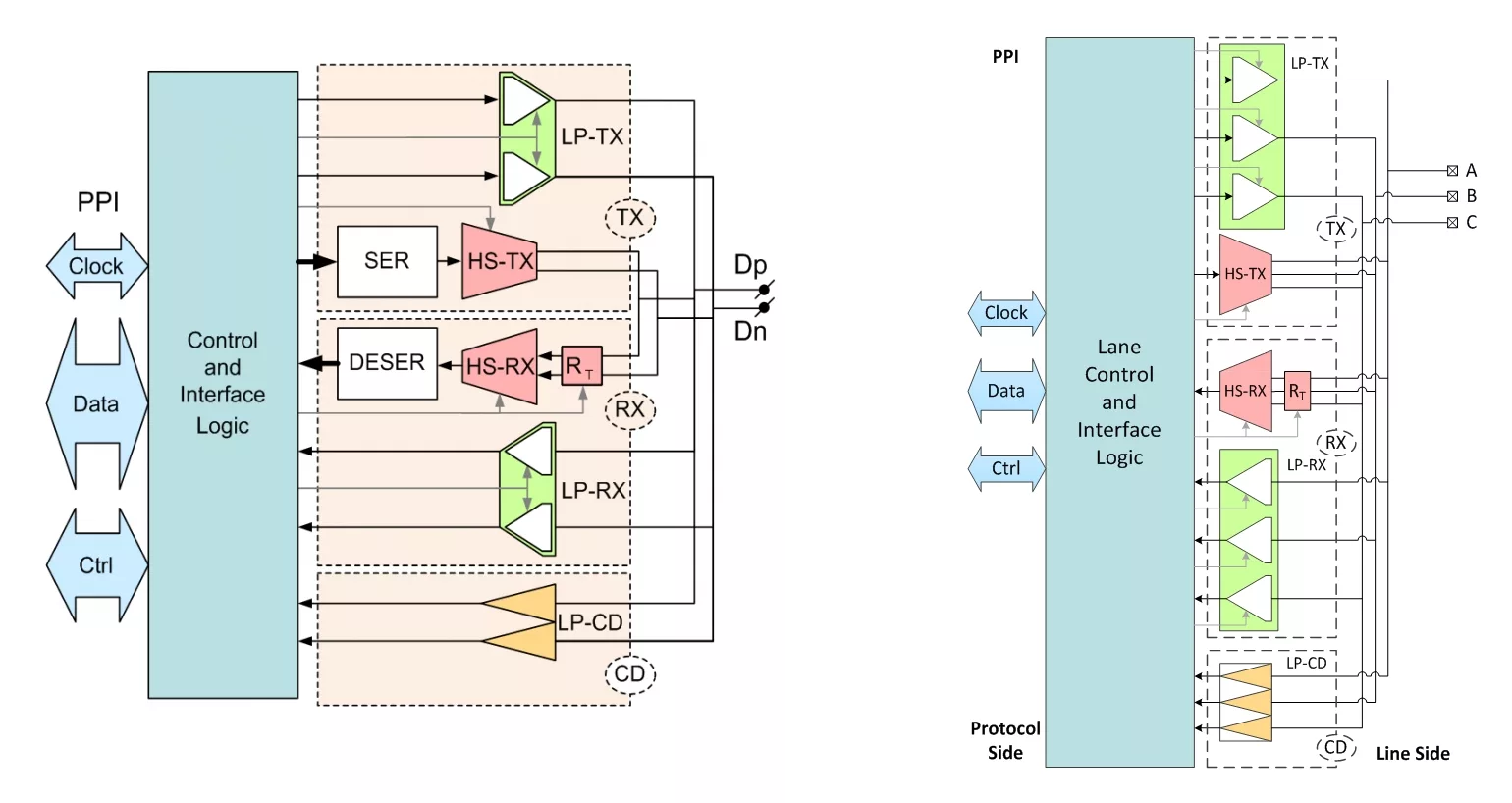
The MIPI C/D-PHY combo IP is a high-frequency low-power, low cost, physical layer compliant with the MIPI® Alliance Standard for C-PHY and D-PHY.
The PHY can be configured as a MIPI Master or MIPI Slave, supporting camera interface CSI-2 v1.2 or display interface DSI v1.3 applications in the D-PHY mode. It also supports camera interface CSI-2 v1.3 and display interface DSI-2 v1.0 applications in the C-PHY mode. The high-speed signals have a low voltage swing, while low-power signals have large swing. High-Speed functions are used for high-speed data traffic while low-power functions are mostly used for control.
The C-PHY is based on 3-Phase symbol encoding technology, delivering 2.28 bits per symbol over three-wire trios, operating with a symbol rate range of 80 to 4500 Msps per lane, which is the equivalent of about 182.8 to 10260 Mbps per lane.
The D-PHY supports a bit rate range of 80 to 1500 Mbps per Lane without deskew calibration, and up to 4500 Mbps with deskew calibration.
The low-power mode and escape mode are the same in both the D-PHY and C-PHY modes. To minimize EMI, the drivers for low-power mode are slew-rate controlled and current limited. The data rate in low-power mode is 10 Mbps. For a fixed clock frequency, the available data capacity of a PHY configuration can be increased by using more lanes. Effective data throughput can be reduced by employing burst mode communication.
The C-PHY/D-PHY combo is a complete PHY, silicon-proven at multiple foundries and multiple nodes. The C/D-PHY is fully integrated and has analog circuitry, digital, and synthesizable logic.
Note: some files may require an NDA depending on provider policy.

MIPI C-PHY/D-PHY Combo IP is a MIPI PHY IP core from Mixel, Inc. listed on Semi IP Hub.
Engineers should review the overview, key features, supported foundries and nodes, maturity, deliverables, and provider information before shortlisting this MIPI PHY IP.
Yes. Buyers can compare this product with similar semiconductor IP cores or IP families based on category, provider, process options, and structured technical specifications.