Overview
The DB-I3C-BASIC-MS-APB Controller IP Core interfaces a microprocessor via the AMBA APB Bus to an I3C Bus, compliant to the MIPI I3C – BASIC v1.0 Improved Inter Integrated Circuit specification. The I3C Basic serves as an upgrade path to the I2C standard.
The I3C is a two-wire bidirectional interface standard (SCL is Clock, SDA is Data) for transfer of bytes of information between two or more compliant I3C devices as well as legacy I2C Slave devices.
The DB-I3C-BASIC-MS-APB is a I3C Controller supporting I3C SDR Broadcast & Direct Messages, and Legacy I2C Messages.
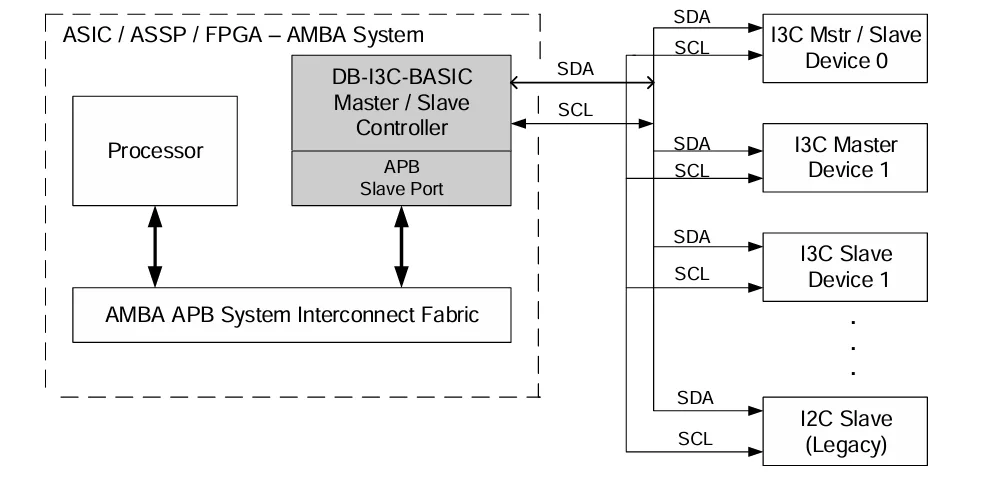
In an ASIC / ASSP / FPGA integrated circuit, typically, the microprocessor is an ARM or RISC-V processor, but can be any embedded processor. Figure 1 depicts the system view of the DB-I3C-BASIC-MS-APB Controller IP Core embedded within an integrated circuit device with its Microprocessor Configuration.
Learn more about I2C / I3C IP core
The I2C (Inter-Integrated Circuit) Bus invented in 1980 by Philips Semiconductors (NXP Semiconductors today) was a massive step forward in simplifying communications in embedded systems. It is a simple two-wire interface for synchronous, multi-master/multi-slave, single ended serial communication. Fast forward 45 years to today and it is still widely used for attaching low speed peripheral Integrated Circuits (ICs), processors and microcontrollers. But silicon today has changed...
Early in my career selling chips for Motorola Semiconductor, the ability to spin derivative microcontroller chips for a customer’s specific requirement was relatively straightforward. If the volume looked reasonable, we would tape-out a new chip with a few added features because mask costs and wafers were relatively inexpensive at the larger process nodes. The customer won by getting an MCU tailored to their specific need, and Motorola won by gaining a more committed customer plus another SKU that could be sold to other customers – boosting ROI. With the migration to higher cost FinFET nodes, those times are long gone as the economics no longer work.
Sharmion Kerley, MIPI Director of Marketing and Membership
Imagine a camera subsystem that responds in microseconds, consumes less power, and offers a more straightforward route to time-to-market. For SoC architects and IP integration teams, that vision is increasingly possible with MIPI Camera Control Interface (CCI) over I3C.