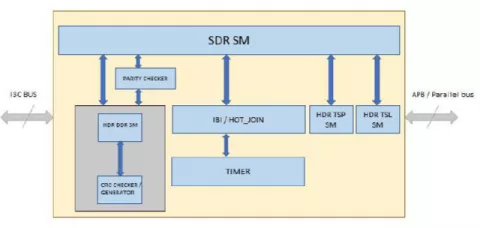
Overview
As Sensor data rate increases, there is a necessity to have control information flowing to and from sensors at an efficient data rate. Also, to bridge the gap of digital interface fragmentation of various interfaces like I2C/SPI/UART, MIPI has come up with a solution of MIPI I3C interface. Also, the traditional interfaces like I2C/SPI/UART would require additional sideband signals like interrupts/chip select/enable/sleep signals. These additional signals increase the pin counts. MIPI I3C interface presents a fast, low cost, low power, two wire digital interfaces for sensors. Apart from increased data rate, I3C also has support for legacy devices operating in FM and FM+ modes. I2C-like communication with SCL clock speed up to 12.5 MHz MIPI-defined transmissions allowing the master to communicate with one or all slaves on the bus HDR mode using ternary number symbols to achieve two data transmissions per equivalent clock cycle. A subset of I2C communication to legacy I2C slaves, if present on the bus Slave initiated request to master, e.g. in-band interrupt, address request.
Provider
T2M GmbH is the leading Global Technology Company supplying state of the art complex semiconductor connectivity IPs and KGDs, enabling the creation of complex connected devices for Mobile, IoT and Wearable markets.
T2M's unique SoC White Box IPs are the design database of mass production RF connectivity chips supporting standards including Wifi, BT, BLE, Zigbee, NFC, LTE, GSM, GNS. They are available in source code as well as KGD for SIP / modules.
With offices in USA, Europe, China, Taiwan, South Korea, Japan, Singapore and India, T2M’s highly experienced team provides local support, accelerating product development and Time 2 Market.
Learn more about I2C / I3C IP core
The I2C (Inter-Integrated Circuit) Bus invented in 1980 by Philips Semiconductors (NXP Semiconductors today) was a massive step forward in simplifying communications in embedded systems. It is a simple two-wire interface for synchronous, multi-master/multi-slave, single ended serial communication. Fast forward 45 years to today and it is still widely used for attaching low speed peripheral Integrated Circuits (ICs), processors and microcontrollers. But silicon today has changed...
Early in my career selling chips for Motorola Semiconductor, the ability to spin derivative microcontroller chips for a customer’s specific requirement was relatively straightforward. If the volume looked reasonable, we would tape-out a new chip with a few added features because mask costs and wafers were relatively inexpensive at the larger process nodes. The customer won by getting an MCU tailored to their specific need, and Motorola won by gaining a more committed customer plus another SKU that could be sold to other customers – boosting ROI. With the migration to higher cost FinFET nodes, those times are long gone as the economics no longer work.
Sharmion Kerley, MIPI Director of Marketing and Membership
Imagine a camera subsystem that responds in microseconds, consumes less power, and offers a more straightforward route to time-to-market. For SoC architects and IP integration teams, that vision is increasingly possible with MIPI Camera Control Interface (CCI) over I3C.