Vendor: Perceptia Devices Category: PLL

Low Power All Digital Fractional-N PLL in GlobalFoundries 12LPP/14LPP

Perceptia’s DeepSub™ pPLL05 is a low power, low voltage all digital PLL featuring low-jitter and compact area.

GlobalFoundries 22nm FDX View all specifications

Overview

Perceptia’s DeepSub™ pPLL05 is a low power, low voltage all digital PLL featuring low-jitter and compact area. It is suitable for IoT and embedded clocking applications in systems running below the nominal core voltage at frequencies up to 1.5GHz. It is suitable as a clock source for moderate speed microprocessor blocks and other logic.


To give IoT designers the maximum flexibility in managing power, pPLL05 is very small (< 0.008 sq mm) and low power (< 0.6mW). It is well suited to applications with a single low voltage power supply that the PLL shares with the blocks that use its output clock. Better jitter performance can be achieved if the pPLL05 has its own analog power supply.

pPLL05 integrates easily into any SoC design and includes all the views and models required by back end flows.

The pPLL05 is built using Perceptia’s second generation all digital PLL technology. This robust technology delivers identical performance across many processes, regardless of PVT conditions. It consumes a small fraction of the area of an analog PLL whilst maintaining comparable performance.

pPLL05 can be used as an integer-N PLL or as a fractional-N PLL. The fractional-N mode provides a high flexibility to choose the best combination of input and output clock frequencies at the system level.

Perceptia further provides integration support and offers customization and migration services.

Key features

  • Low power, suitable for IoT applications
  • Good jitter, suitable for clocking digital logic.
  • Extremely small die area (< 0.005 sq mm), using a ring oscillator
  • Output frequency can be from 1 to 400 times the input reference, up to 1.5GHz
  • Reference clock from 5MHz to 200MHz
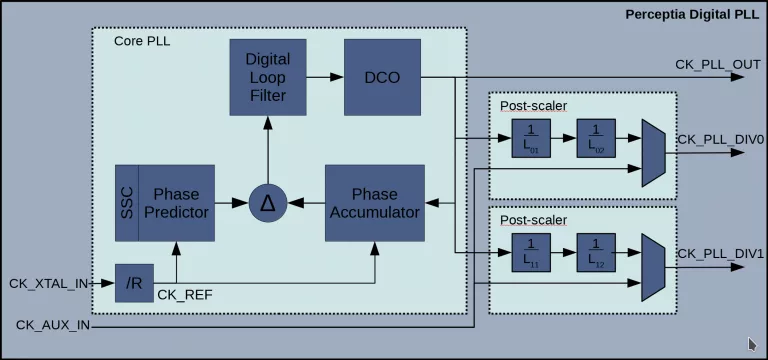
  • Second-generation digital PLL architecture, providing integer and fractional multiplication
  • Primary PLL output running at the main DCO frequency for lowest noise clocking
  • Two further PLL outputs via separate postscalers
    • Post-scalers programmable from 1 to 2,040
  • Lock-detect output
  • Can generate a spread-spectrum clock from a clean reference
  • Oscillator output duty cycle better than 48 / 52%
  • Highly testable using industry standard flows
    •   ATPG vectors provided
    •   Specification of functional tests to supplement ATPG testing

Block Diagram

Benefits

  • Small size  (< 0.008 sq mm)
  • Low Power (< 0.6 mW)
  • Easy integration
  • Fractional Multiplication

Applications

  • IoT
  • Embedded
  • Moderate speed digital systems

What’s Included?

  • Datasheet
  • Detailed Verilog behavioral model
  • Timing models
  • LEF5.6 abstract for floor planning/chip assembly
  • Integration Guide
  • DFT Guide
  • Integration support
  • Characterization report
  • GDSII layout macrocell
  • CDL netlist for LVS
  • DRC, LVS and SI verification reports
  • Netlist model with accompanying documentation allowing integration of the module in scan chains

Files

Note: some files may require an NDA depending on provider policy.

Silicon Options

Foundry Node Process Maturity
GlobalFoundries 22nm FDX

Specifications

Identity

Part Number
pPLL05-GF12LPP
Vendor
Perceptia Devices

Provider

Perceptia Devices
HQ: Australia
Perceptia Devices is an IP and design services provider, based in Sydney, Australia and Silicon Valley. It is focused on high-speed and ultra-low-power mixed-signal semiconductor designs. Its specialization and innovation in all-digital PLLs, a distinction from its competitors, allows it to steadily build a portfolio of proprietary and patented architectures and circuits that bring value to demanding applications. Perceptia is privately owned and self-funded.

Learn more about PLL IP core

Creating a Frequency Plan for a System using a PLL

How do you ensure that every part of a system receives the clock it needs—without wasting power or sacrificing performance? The answer lies in creating a well-structured frequency plan built around a PLL.

Specifying a PLL Part 3: Jitter Budgeting for Synthesis

This white paper is aimed at system architects and physical implementation leaders working on the design of SoCs. It can be confusing to understand the impact of different jitter sources and how to calculate a jitter budget when specifying a digital system. This white paper explains how jitter changes the period of a clock and how to ensure that jitter has correctly been accounted for in the calculations for timing closure.

Specifying a PLL Part 2: Jitter Basics

This article explains a some of the key terminology and parameters commonly used to describe jitter. It will also help clarify the most important parameters for a some PLL applications, allowing the designer to better understand what is required from a PLL.

Specifying a PLL Part 1: Calculating PLL Clock Spur Requirements from ADC or DAC SFDR

In high end RF systems, such as 5G radios, the requirements are so stringent that the source of this strongest unwanted tone can be the PLL. This article outlines how spurs in the input clock to the ADC or DAC may limit the SFDR. This in turn will set the requirements for the spurs for the input clock (from a PLL), in order to achieve a specific SFDR.

Achieving Groundbreaking Performance with a Digital PLL

This article compares analog, first-generation digital, and second-generation digital PLLs. It evaluates which type of PLL may be best in which situation. It further discloses a roadmap into other application areas, including general purpose / logic clocking, and regular low-jitter PLLs.

Frequently asked questions about PLL IP cores

What is Low Power All Digital Fractional-N PLL in GlobalFoundries 12LPP/14LPP?

Low Power All Digital Fractional-N PLL in GlobalFoundries 12LPP/14LPP is a PLL IP core from Perceptia Devices listed on Semi IP Hub. It is listed with support for globalfoundries.

How should engineers evaluate this PLL?

Engineers should review the overview, key features, supported foundries and nodes, maturity, deliverables, and provider information before shortlisting this PLL IP.

Can this semiconductor IP be compared with similar products?

Yes. Buyers can compare this product with similar semiconductor IP cores or IP families based on category, provider, process options, and structured technical specifications.

×
Semiconductor IP