Vendor: Kamaten Technology Incorporated Category: PLL

General use, integer-N 4GHz Hybrid Phase Locked Loop on TSMC 28HPC

This Integer-N Hybrid (Digitally Aided Analog) PLL generates clock signals within broad frequency range.

TSMC 28nm HPC View all specifications

Overview

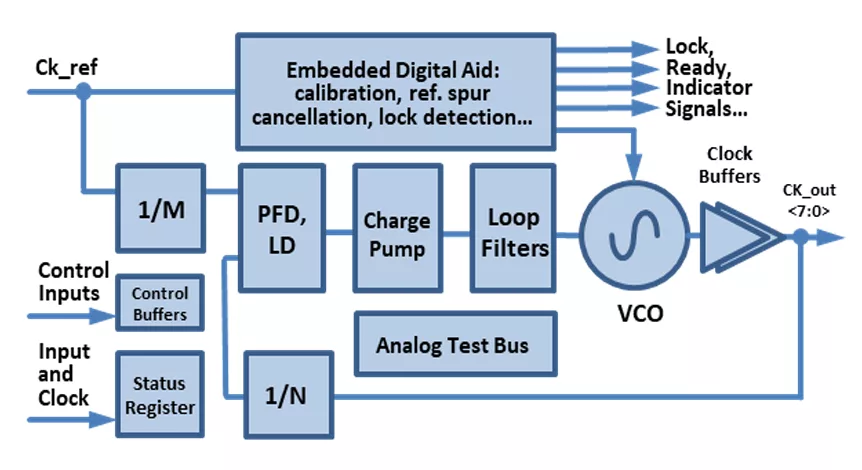
This Integer-N Hybrid (Digitally Aided Analog) PLL generates clock signals within broad frequency range. Division coefficients of the embedded input and feedback dividers can be set to any integer between 1 and 64 or may be bypassed to save power. Higher order dividers and/or pre-scalers are optional. Output clock may be 8- or 4-phase set by the user. Disabling 4 out of 8 output buffers also saves power. With use of external frequency multipliers, the output clock frequency may be doubled or quadrupled. User controlled embedded control register allows setting frequency division, loop bandwidth, phase margin, peaking. PLL has reference spur reduction functions also controlled by the control register. The control register has serial and parallel interfaces. This PLL has very short lock time, lock indicator signal and power-up sequence support signals. Footprint is compact and no off-chip components are needed. This PLL has Analog Test Bus (ATB) as a Design for Test (DFT) feature.

Key features

  • Output frequency range: 500MHz ÷ 2GHz 
  • Reference clock frequency range: 8MHz ÷ 2GHz 
  • User-set 4 or 8 output clock phases 
  • Loop bandwidth 60kHz - 180MHz, with phase margin >50° 
  • Output clock duty cycle 50 +5% 
  • Typically locks within 150 reference clock cycles 
  • Simple power-up sequence facilitated by indicator output signals 
  • All digital aid functions are embedded, minimum external control is required 
  • Embedded control register with serial and parallel interfaces 
  • Input for external ROM storing multiple pre-set states 
  • Typical supply voltage 900mV 
  • All input and output signals are CMOS 
  • Typical power consumption: 2.6mA at 1GHz, scales with VCO frequency 
  • Low leakage power down mode 
  • Operational temperature:  -40°C to +110°C 
  • Footprint: 150 x 200 µm 
  • Does not require any off-chip components 
  • Design For Test (DFT) enabled by embedded Analog Test Bus (ATB)  
  • Process:  TSMC 28nm HPC/HPC+, design can be ported to other nodes

Block Diagram

Applications

  • This general purpose PLL generates and synthetizes clock signals for a broad range of applications, such as telecommunication, consumer, automotive, industrial etc., where compact footprint, low power, very fast locking and high functional flexibility are needed while use of external components should be avoided.

Files

Note: some files may require an NDA depending on provider policy.

Silicon Options

Foundry Node Process Maturity
TSMC 28nm HPC

Specifications

Identity

Part Number
PLL-INTN8G-T28HPC
Vendor
Kamaten Technology Incorporated

Provider

Kamaten Technology Incorporated
HQ: Canada
Primarily analog and mixed signal IP development for telecommunication, automotive, consumer. Secondary activity: design services provider, full custom analog and mixed signal.

Learn more about PLL IP core

Creating a Frequency Plan for a System using a PLL

How do you ensure that every part of a system receives the clock it needs—without wasting power or sacrificing performance? The answer lies in creating a well-structured frequency plan built around a PLL.

Specifying a PLL Part 3: Jitter Budgeting for Synthesis

This white paper is aimed at system architects and physical implementation leaders working on the design of SoCs. It can be confusing to understand the impact of different jitter sources and how to calculate a jitter budget when specifying a digital system. This white paper explains how jitter changes the period of a clock and how to ensure that jitter has correctly been accounted for in the calculations for timing closure.

Specifying a PLL Part 2: Jitter Basics

This article explains a some of the key terminology and parameters commonly used to describe jitter. It will also help clarify the most important parameters for a some PLL applications, allowing the designer to better understand what is required from a PLL.

Specifying a PLL Part 1: Calculating PLL Clock Spur Requirements from ADC or DAC SFDR

In high end RF systems, such as 5G radios, the requirements are so stringent that the source of this strongest unwanted tone can be the PLL. This article outlines how spurs in the input clock to the ADC or DAC may limit the SFDR. This in turn will set the requirements for the spurs for the input clock (from a PLL), in order to achieve a specific SFDR.

Achieving Groundbreaking Performance with a Digital PLL

This article compares analog, first-generation digital, and second-generation digital PLLs. It evaluates which type of PLL may be best in which situation. It further discloses a roadmap into other application areas, including general purpose / logic clocking, and regular low-jitter PLLs.

Frequently asked questions about PLL IP cores

What is General use, integer-N 4GHz Hybrid Phase Locked Loop on TSMC 28HPC?

General use, integer-N 4GHz Hybrid Phase Locked Loop on TSMC 28HPC is a PLL IP core from Kamaten Technology Incorporated listed on Semi IP Hub. It is listed with support for tsmc.

How should engineers evaluate this PLL?

Engineers should review the overview, key features, supported foundries and nodes, maturity, deliverables, and provider information before shortlisting this PLL IP.

Can this semiconductor IP be compared with similar products?

Yes. Buyers can compare this product with similar semiconductor IP cores or IP families based on category, provider, process options, and structured technical specifications.

×
Semiconductor IP