Overview
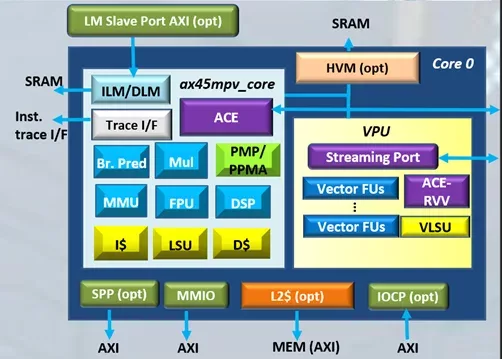
AndesCore™ AX45MPV 64-bit multicore CPU IP is an 8-stage superscalar processor with Vector Processing Unit (VPU) based on AndeStar™ V5 architecture. It supports RISC-V standard “G (IMA-FD)”, “C” 16-bit compression, “B” bit manipulation, DSP/SIMD ‘P’ (draft), “V” (vector) extensions, and Andes performance enhancements, plus Andes Custom Extension™ (ACE) for user-defined instructions. It features MMU for Linux based applications, dynamic branch prediction for efficient branch execution, dual-issue of common instruction pairs, level-1 instruction/data caches and local memories for low-latency accesses. The AX45MPV symmetric multiprocessor supports up to eight cores and a level-2 cache controller with instruction and data prefetch. Coherence Manger ensures data coherence among CPU accesses and IO transactions from cacheless bus masters. The AX45MPV contains a powerful VPU with up to 1024-bit VLEN and DLEN, and is excellent for computations involving large arrays of data such as computer vision, digital signal processing, image processing, machine/deep learning, and scientific computing. Other features include ECC for level-1/2 memory soft error protection, Platform-Level Interrupt Controller (PLIC) with enhancements for vectored dispatch and priority-based preemption, CoDense™ and StackSafe™, and PowerBrake and WFI for power management.
AndeStar™ V5 Architecture
| Key Features |
Benefits |
| RISC-V RV64 GCBPV |
- State-of-the art ISA from latest developments in computer architecture
- Industry standard and open architecture
|
| Andes Extended Instructions |
Andes exclusive performance and functionality enhancements |
| MMU and Sv39/Sv48 virtual memory translation |
For Linux and advanced operating systems with protection between kernel and user program |
| 64-bit CPU architecture |
Enabling software to utilize the memory spaces far beyond the 4G byte limit of 32-bit CPUs |
| Machine (M), optional User (U) and Supervisor (S) Privilege levels |
Embedded systems with privilege protections |
CPU Core
| Key Features |
Benefits |
| 5.86 CoreMark/MHz, 3.39 DMIPS/MHz |
Superior performance-per-MHz |
| 8-stage dual issue in-order superscalar pipeline |
Superior performance-efficiency, while allowing for high speeds |
|
Extensive branch predication features
- Branch Target Buffer (BTB)
- Branch History Table (BHT)
- Return Address Stack (RAS)
|
- Branch Target Buffer and Branch History Table to speed up control codes
- Return Address Stack to speeds up procedure returns
|
- MMU (Memory Management Unit)
- Sv39, Sv48 virtual-memory systems
- 4/8-entry fully associative ITLB/DTLB
- 32-512-entry 4-way set-associative shared TLB
- Hardware page table walker
|
- Virtual memory support for full address space and easy code/data sharing
- Support for full-featured OS such as Linux
- Protection of supervisor and user privilege
- Hardware for fast address translation
|
| Physical Memory Protection (PMP), configurable up to 32 regions |
Basic read/write/execute memory protection with minimum cost |
| Programmable Physical Memory Attribute (PMA), configurable up to 16 regions |
Configurable memory attributes:
- Memory, I/O, None
- Cacheable/Non-cacheable
- Write-back/Write-through
- Read/write/read & write allocate, no allocate
- Access fault for non-existent regions
|
| Performance monitors |
Program code performance tuning |
| StackSafe™ hardware stack protection |
- Easy identification of stack size threshold during development
- Hardware error detection of stack overflow and underflow at runtime
|
| PowerBrake technology |
Performance throttling to digitally reduce power consumption |
| QuickNap™ technology |
Fast power-down/wake-up support for cache |
Memory Subsystems
| Key Features |
Benefits |
|
Level-1 I-Cache & D-Cache
- Size: 8KB to 64KB
- Cache line size: 64 bytes
- Set associativity: 2-way or 4-way
|
- Accelerating accesses to slow memories
- Flexible cache configurations
|
|
Level-2 I/D Unified Cache
- Configurable from 128KB to 8MB
- 64-byte cache line size
- 16-way, pseudo random replacement
- 2 or 4 banks
|
- Accelerate performance with larger 2nd level cache
- Flexible selections to meet performance and timing requirements
|
|
ILM & DLM
- Size: 4KB to 16MB
- Scalar core access only
- SRAM interface support
- Bus masters accessed by AXI slave port
|
- For deterministic and efficient program execution
- Flexible size selection to fit diversified needs
|
|
HVM
- Size: 32KB to 4GB
- Accessible by VPU and scalar core, can also be shared by multiple cores
- Fast vector access with DLEN data width
- Slave port for external DMA
- When MMU is presented, HVM is addressed by MMU translated physical memory, therefore it can also work under Linux
|
- Local memory for vector data, especially for AI model, can work with external DMA to hide the latency.
- High speed direct access
|
|
MemBoost
- Data Cache Write-Around
- Instruction and Data Prefetch
- Multiple Outstanding Mem. Req
|
- Smart cache line allocation policy, for better cache utilization and reduce number of memory accesses
- Conditionally fill instruction and data caches in advance, for minimum memory access latency
- Issue multiple transactions to data memory sub-system for higher bus utilization, also support out-of-order completion
|
| Optional ECC error protection with SRAM interface |
Code and data integrity protection |
| Bus master port: AXI with 128/256/512-bit data, I/D joint or separate bus |
High throughput with wide data path |
| BUS Slave Port: AXI with 128/256/512-bit data, for ILM/DLM accesses |
Efficient data transfer between CPU and SoC masters |
| Core/bus clock ratio of N:1 |
Simplified SoC integration |
Multicore Cache Coherence
| Key Features |
Benefits |
- Support up to 8 cores
- MESI cache coherence protocol
- 128/256/512-bit I/O coherence port for cacheless bus masters
|
- Symmetric multicore and L2 cache controller with cache coherence between level-1 (L1) caches and I/O coherence for bus masters without caches
- Convenient and efficient interface for SoCs with rich I/O transactions
|
Vector Processing Unit (VPU)
| Key Features |
Benefits |
- RISC-V V-extension (RVV) 1.0 spec
- Custom RVV instructions based on ACE-RVV
- LMUL supporting 1, 2, 4, 8, 1/2, 1/4, 1/8
|
- Standard and Custom RISC-V vector support
|
- Vector dual issue
- Available 2nd multiply-add unit
|
- Two vector instructions can be issued at same cycle
- Up to 2 MAC units for maximum performance
|
- Configurable VLEN/DLEN from 128 to 1024 bits with 1:1 or 2:1 ratio
- Multiple independent vector execution units for parallel execution
- Dual Independent memory access paths with RVV load/store and Andes Streaming Port (ASP) load/store
|
- Addressing a wide range of compute requirements with different area/performance trade-off
- High Speed memory accesses to CoProcessor memory in addition to the standard memory hierarchy with DLEN data width
|
Platform-Level Interrupt Controller (PLIC)
| Key Features |
Benefits |
|
Implements RISC-V PLIC specification
- Up to 1023 interrupt sources
- Up to 255 interrupt priority levels
|
Interrupt handling for SoC with multiple processors |
|
Enhanced interrupt features
- Priority-based preemption
- Selectable edge trigger or level trigger
|
Complete hardware preemption support |
Debug Support
| Key Features |
Benefits |
| Implements RISC-V debug specification v1.0 |
Supported by industry debug tool suppliers |
| JTAG Debug Port |
Industry-standard support |
| Embedded Debug Module with up to 8 triggers |
Flexible configurations to tradeoff between gate count and debugging capabilities |
| Exception redirection support |
Entering debugger upon selected exceptions without using breakpoints |
| RISC-V Trace 1.0 Instruction Trace interface |
Supported by Andes tools |
*MMU and HVM features are available in 2023 Q4
Learn more about CPU IP core
For the first time in our more than 35-year history, Arm is delivering its own silicon products – extending the Arm Neoverse platform beyond IP and Arm Compute Subsystems (CSS) to give customers greater choice in how they deploy Arm compute – from building custom silicon to integrating platform-level solutions or deploying Arm-designed processors.
The ChiPy DSL is Quadric's Python framework for building complete on-chip pipelines. Using YOLOX-M as a case study, we show how backbone inference, box decoding, and NMS run entirely on the Chimera GPNPU — no host CPU intervention, no DDR round-trips, just Python compiled to silicon.
As part of the new Arm Lumex compute subsystem (CSS) platform, the Arm C1 CPU cluster – the first built on the Armv9.3 architecture – is the next evolution of our highest performing CPU cluster for consumer devices, designed to unleash the full potential of on-device AI and elevate the user experience.
Hardware fuzzing has recently gained momentum with many discovered bugs in open-source RISC-V CPU designs. Comparing the effectiveness of different hardware fuzzers, however, remains a challenge: each fuzzer optimizes for a different metric and is demonstrated on different CPU designs.
Unlock ultra-efficient performance, advanced AI processing, and robust security with the Cortex-A320—designed to power the future of IoT and edge AI innovation.
Pie maintains low computation latency, high throughput, and high elasticity. Our experimental evaluation demonstrates that Pie achieves optimal swapping policy during cache warmup and effectively balances increased memory capacity with negligible impact on computation. With its extended capacity, Pie outperforms vLLM by up to 1.9X in throughput and 2X in latency. Additionally, Pie can reduce GPU memory usage by up to 1.67X while maintaining the same performance. Compared to FlexGen, an offline profiling-based swapping solution, Pie achieves magnitudes lower latency and 9.4X higher throughput.