Rambus Delivers Quantum Safe IP Solutions with Next-Generation Root of Trust for Data Center Security
SAN JOSE, Calif. – July 13, 2023 – Rambus Inc. (NASDAQ: RMBS), a premier chip and silicon IP provider making data faster and safer, today announced the first in a family of Quantum Safe security IP products with its next-generation Root of Trust for data center and communications security. Quantum computers will be able to rapidly break current asymmetric encryption, placing important data and assets at risk. The Rambus Root of Trust IP offers customers a complete Post Quantum Cryptography (PQC) hardware security solution that protects valuable data center and AI/ML assets and systems.
“To ensure today’s data remains protected into the future, we must implement now security solutions that safeguard against quantum attacks,” said Neeraj Paliwal, general manager of Security IP at Rambus. “This new generation of the Rambus Root of Trust is a flagship product in our Quantum Safe IP portfolio that offers customers complete security solutions for the data center and advanced workloads like generative AI.”
“Since 2016, NIST has done pioneering efforts to identify post-quantum cryptographic algorithms which will be better suited for protecting critical government and public infrastructure from entities looking to steal data now to decrypt later using quantum computing,” said Heather West, PhD, research manager of Quantum Computing Research at IDC. “Now that NIST has announced its first four post-quantum computing recommendations, it is important that system designers begin implementing quantum-resistant cryptography to ensure that data and hardware remain secure in the quantum computing era.”
Rambus Root of Trust IP with Quantum Safe Cryptography uses the quantum-compute resistant cryptographic algorithms selected by the National Institute of Standards and Technology (NIST): CRYSTALS-Kyber for key-encapsulation and CRYSTALS-Dilithium for digital signatures. In addition, Rambus Root of Trust IP supports the Commercial National Security Algorithm Suite (CNSA) algorithms for software and firmware updates including XMSS/LMS stateful hash firmware signatures, CNSA symmetric-key algorithms, and CNSA quantum-resistant public-key algorithms.
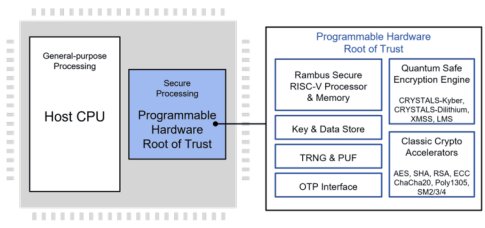
Rambus Quantum Safe Root of Trust Features:
- Programmable 32-bit secure processor
- Quantum Safe Encryption engine
- Open Compute Project (OCP) Caliptra Root of Trust for Measurement with DICE and X.509 support
- True Random Number Generator (TRNG) and Physical Unclonable Function (PUF) entropy source
- Secure data store
- FIPS 140-3 CAVP and CMVP compliant
- SDK for user development of secure and trusted applications
More Information:
Learn more about the Rambus Root of Trust IP at www.rambus.com/security/root-of-trust/.
Related Semiconductor IP
- Root of Trust
- CryptoManager Root of Trust for Use with the Caliptra Specification
- Embedded Hardware Security Module (Root of Trust) - Automotive Grade ISO 26262 ASIL-B
- tRoot Fx Hardware Secure Modules: Programmable Root of Trust
- Embedded HSM Family (Root of Trust) - Automotive Grade ISO 26262 ASIL-B
Related News
- Rambus Enhances Enterprise-Grade Security for Data Center and AI SoCs with CryptoManager™ Root of Trust Supporting the Caliptra™ Specification
- Rambus Protects Data Center Infrastructure with Quantum Safe Engine IP
- PUFsecurity and Himax Prioritize User Security and Data Protection in Endpoint AI with PUF-based Root of Trust
- Rambus Enhances Data Center and AI Protection with Next-Gen CryptoManager Security IP Solutions
Latest News
- GF unveils roadmap to deliver the world’s most advanced FD-SOI platform for Physical AI
- GlobalFoundries marks Dresden expansion milestone, announces next-generation platform for Physical AI
- TSMC September 2026 Revenue Report
- Lattice Collaborates with Arm to Advance Secure, Adaptable AI Data Center Infrastructure
- ZLG Selects CAST CAN XL and TSN IP for Next-Generation Vehicle-Network Development and Test Tools