Vendor:
Arasan Chip Systems Inc.
Category:
SPI / QSPI XSPI
QSPI Master IP
The QSPI master core is easy to use, simple to work with, quick to operate, and reliable under all conditions.
Overview
The QSPI master core is easy to use, simple to work with, quick to operate, and reliable under all conditions. It supports the majority of QSPI devices standard from a standard AXI4 slave interface. It also features support for Octal SPI, Dual SPI (DSPI), and SPI interface. The core is designed so that a user design may immediately access memory from the QSPI device in SPI mode, or alternatively issue a command to switch to any other mode. Additionally, a DMA command may be issued to copy memory from the QSPI device to anywhere else on the bus.
Key features
- Compliant with AMBA AXI3/4 and AXI4-lite protocols. An APB control port interface is available if desired instead of the AXI4-lite control port interface.
- User configurable clock frequency support
- Designed to support all leading NOR FLASH devices.
- Configurable bus width, Full & Narrow AXI burst support
- DMA for maximum bus throughput
- Supports 24 or 32b addressing and User selectable commands.
- Supports Execute in Place flash access protocols
- Backwards compatible with SPI and Dual SPI devices
Block Diagram
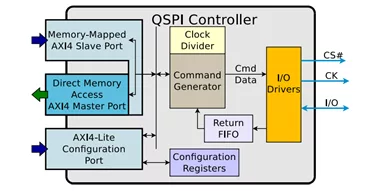
QSPI Master IP block diagram
Files
Note: some files may require an NDA depending on provider policy.
Specifications
Identity
Part Number
QSPI Master IP
Vendor
Arasan Chip Systems Inc.
Type
Silicon IP
Provider

Arasan Chip Systems Inc.
HQ:
USA
Arasan Chip Systems, is a leading provider of IP for mobile storage and mobile connectivity interfaces with over a billion chips shipped with our IP. Arasan’s high-quality, silicon-proven, Total IP Solutions include digital IP, Analog Mixed Signal PHY IP, Verification IP, HDK, and Software. Arasan has a focused product portfolio targeting mobile SoCs. The term Mobile has evolved over our two-decade history to include all things mobile – starting with PDA’s in the mid 90’s to smartphones to today’s Automobiles, Drones, and IoT. Arasan is at the forefront of this evolution of “Mobile” with its standards-based IP at the heart of Mobile SoCs.
Learn more about SPI / QSPI XSPI IP core
Unleashing the Power of Communication: Exploring the XSPI Protocol and Arasan Chip Systems' XSPI IP Portfolio
Frequently asked questions about SPI / QSPI / xSPI IP cores
What is QSPI Master IP?
QSPI Master IP is a SPI / QSPI XSPI IP core from Arasan Chip Systems Inc. listed on Semi IP Hub.
How should engineers evaluate this SPI / QSPI XSPI?
Engineers should review the overview, key features, supported foundries and nodes, maturity, deliverables, and provider information before shortlisting this SPI / QSPI XSPI IP.
Can this semiconductor IP be compared with similar products?
Yes. Buyers can compare this product with similar semiconductor IP cores or IP families based on category, provider, process options, and structured technical specifications.