Overview
The USB-C 3.0 and USB 3.0 PHY IP provide designers with the industry's best combination of low area and low power with support for the leading process technologies from 65-nm to 14/16-nm FinFET. Both the USB-C and USB 3.0 PHYs offer a single efficient GDSII design that supports all four USB 3.0 speed modes (SuperSpeed, High-Speed, Full-Speed, and Low-Speed). To maximize battery life in mobile applications, the USB-C/USB 3.0 PHYs are designed to minimize power consumption and standby current. In addition, the USB-C 3.0 femtoPHY is optimized to support the USB Type-C connectivity specification.
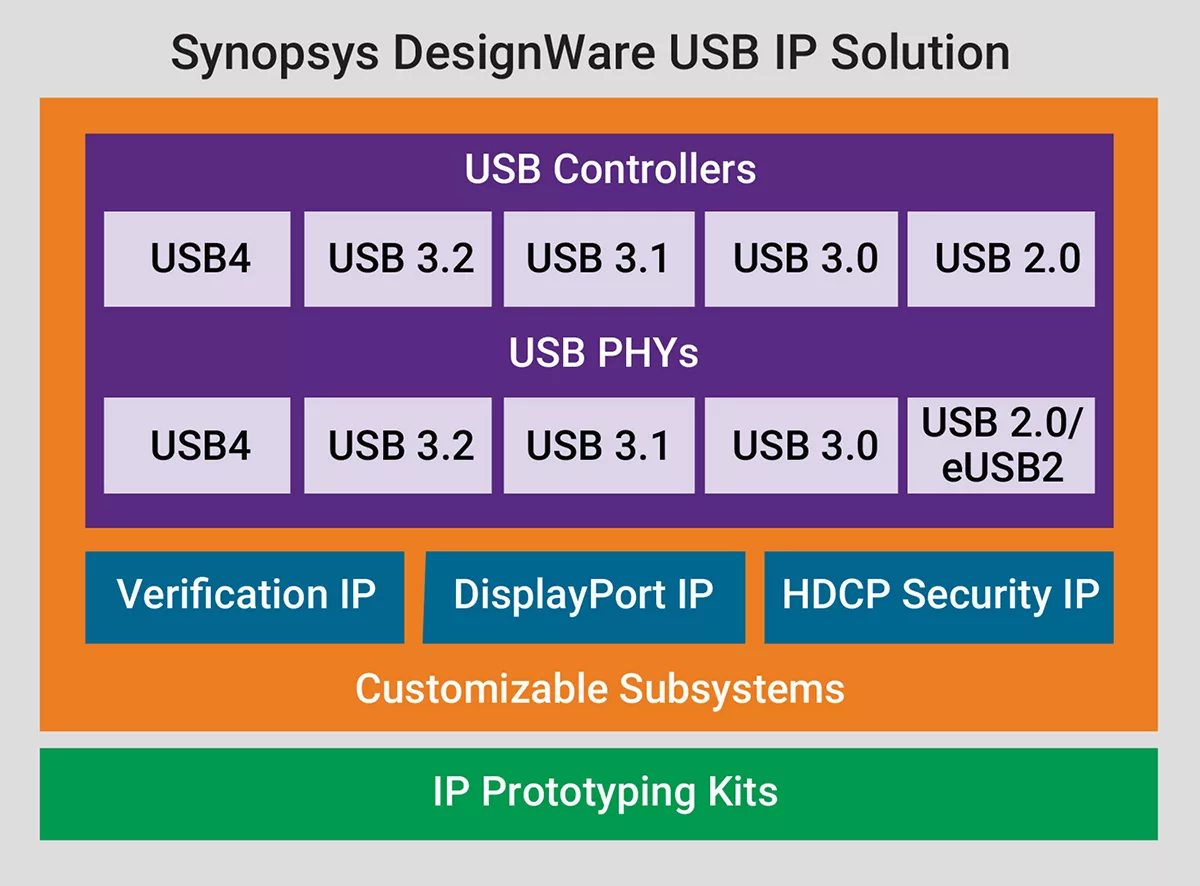
The USB IP is the most certified USB IP solution in the industry. With over 3,000 design wins and approximately three billion silicon-proven units shipped, the vendor complete USB IP solution, consisting of digital controllers, PHYs, verification IP, IP Prototyping Kits and IP software development kits, enables designers to lower integration risk and speed time-to-market.
Learn more about Single-Protocol PHY IP core
UniversalFlash Storage (UFS) was created for mobile applications and computer systems requiring high performance and low power consumption. These systems typically use embedded Flash based on the JEDEC standard eMMC. UFS was defined by JEDEC as the evolutionary replacement for eMMC offering significantly higher memory bandwidth. The standard builds on existing standards such as the SCSI command set, the MIPI Alliance M-PHY and UniPro as well as eMMC form factors to simplify adoption and development.
In this paper, we introduce a new high-level, dataflow programming language called C~ (“C flow”) that further increases productivity by raising the level of abstraction from behavioral descriptions, while overcoming the limitations of C for hardware design. We present the syntax and semantics of this language, and the framework that provides hardware and software code generation. This paper illustrates the benefits of using C~ for hardware design of a IEEE 802.3 MAC, synthesized for FPGA and for 90nm CMOS technology.
Universal Flash Storage (UFS) was created for mobile applications and computer systems requiring high performance and low power consumption. These systems typically use embedded Flash based on the JEDEC standard eMMC. UFS was defined by JEDEC as the evolutionary replacement for eMMC offering significantly higher memory bandwidth. The standard builds on existing standards such as the SCSI command set, the MIPI Alliance M-PHY and UniProSM as well as eMMC form factors to simplify adoption and development.
Since MIPI and MDDI standards both target interfaces to cameras and displays on mobile devices, are two separate standards really needed?
Enter the Inner Sanctum of RapidIO: Part 1
Networking software key to PICMG 2.16 optimization