Overview
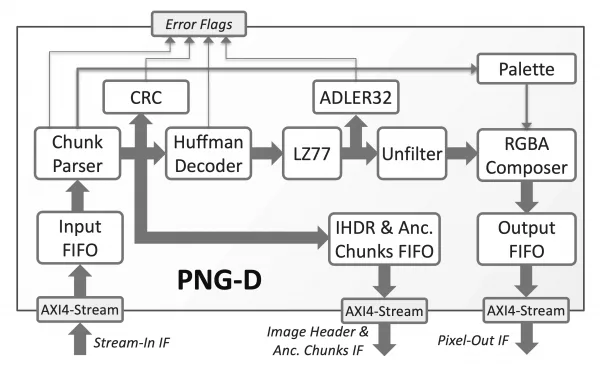
The PNG-D core implements a lossless image decompression engine compliant with the Portable Network Graphics (PNG) file format specified in the ISO/IEC 15948 and RFC 2083 standards.
The decoder core can decompress greyscale, truecolor, and palette-based PNG images with 8 and 16 bits per color. The core supports alpha channel transparency and all the filters and DEFLATE compression options specified by the PNG standard. The core does not currently support interlaced mode and images with under 8 bits per color, but these can be added on request.
The easy-to-use PNG-D core operates on a standalone basis, parsing the image header and decompressing image data without a host processor's assistance. PNG-D accepts compressed data and outputs pixel data via AXI4-Stream interfaces. A separate dedicated interface provides the system with the image header and any ancillary chunks to prepare the decoded images for further processing and/or display. Moreover, the core detects, reports, and automatically recovers from various errors in the input files.
The core is designed with industry best practices, and its reliability has been proven through rigorous verification. The deliverables include a complete verification environment and a bit-accurate software model.
Learn more about Image Conversion IP core
Computer vision has made tremendous advances in the last several years due to the proliferation of AI technology. The intersection of big data and massive parallel computing changed the way in which machines are programmed to understand unstructured 2D and 3D data, such as video feeds from cameras.
Traditional IC design options that embedded system designers have had to choose from include fixed hardware devices such as standalone microprocessors, microcontrollers and ASSPs or configurable hardware devices such as FPGAs and cell-based ASICs. In this paper we present a new design option called Nextreme Structured ASICs which provide embedded system designers with a compelling alternative to custom embedded system design.
By Hantro
Configurable Processors for Video Processing SOCs
In this article, we show how fast video streams conforming to MIPI CSI2 rev2.0 over MIPI DPHY rev1.2 can be generated, using VLSI Plus’ SVTPlus-CSI2-F IP core, with simple off-FPGA analog front-end. The high bit rates can be achieved with a relatively slow FPGA clock frequency, trading off FPGA resources for simple timing closure.
Beyond pure process scaling which is necessary to meet today's price, power, and performance goals, chip designers have to grapple with tighter integration and product performance specialities in areas such as integrated power management, image sensing, application-specific data conversion, and enhanced display drivers.