LPDDR5/4x/4 PHY IP for Samsung 14LPU
OPENEDGES, the memory system IP provider, including DDR memory controller, DDR PHY, on-chip interconnect, and NPU IP together as …
Overview
OPENEDGES, the memory system IP provider, including DDR memory controller, DDR PHY, on-chip interconnect, and NPU IP together as an integrated solution or independent IP. They are tightly combined to bring synergy for high performance and low latency. OPENEDGES' integrated IP solutions are market and silicon-proven, featuring advanced architectures and proprietary technologies that enable customers to shorten their design and verification processes.
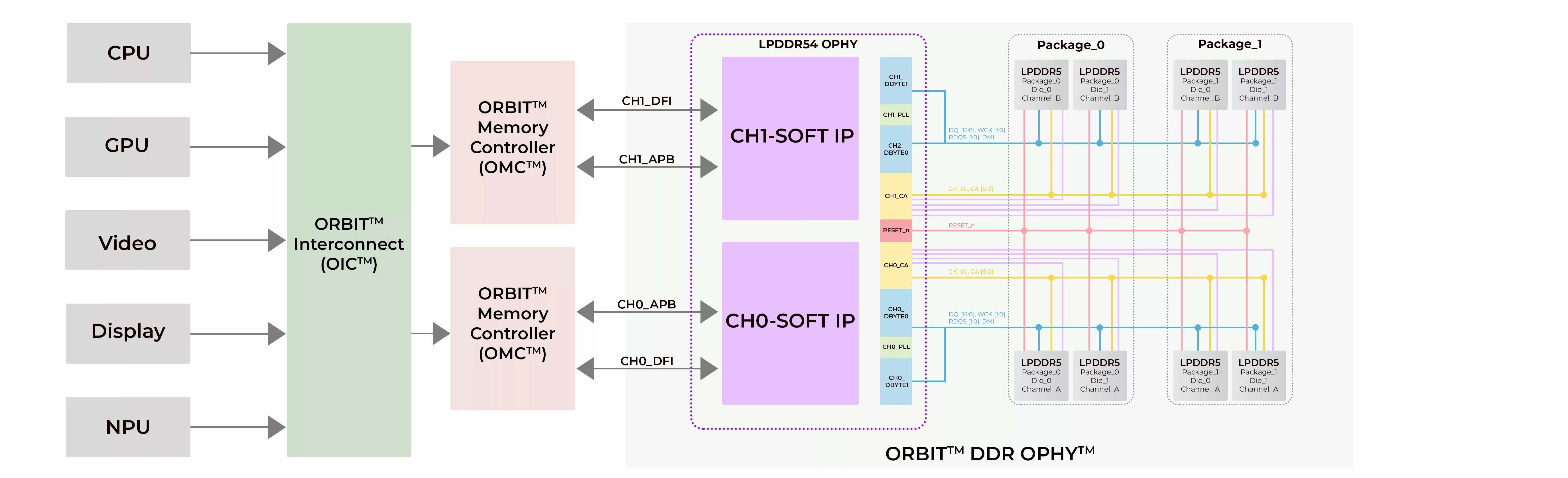
The ORBIT Memory system consists of interconnect, memory controller, and PHY IPs that work in unison to create maximum system synergies. The ORBIT DDR PHY (OPHY) features a state-of-art mixed-signal architecture that addresses the challenges of DRAm integration in high-performance and low-power environments. This architecture enables OPHYs to overcome issues with long-term impedance drift and clock phase drift, allowing impedance and clock phase updates without interruption of data traffic. Programmable timing at the OPHY boundary combines flexibility with analog precision, resulting in low read/write latency between the ORBIT Memory Controller (OMC) and the DRAM.
OPHYs are designed with subsystem and system-level considerations in mind. Built-in power management logic and advanced PLL design allow aggressive power state management and optimal system power usage. Tight integration with the ORBIT Memory System enables ActiveQoS bandwidth and latency control for maximum performance of the SoC memory subsystem. At the system level, OPHYs have been designed to minimize package substrate layer and PCB layer requirements, enabling usage in cost-sensitive applications and application processors.
Key features
- Compliant with JEDEC standards for LPDDR5/4x/4 with PHY standards
- DFI 5.0 Interface Compliant
- Supports 1,2, or 4 ranks
- Multiple frequency states
- PHY independent training and calibration
- Firmware based training
- Hardware or Firmware based retraining
- Proprietary microcontroller with custom ISA
- Multiple DFICLK: CK ratios and DFICLK:CK: WCK ratio
- Tx and Rx channel equalization
- Voltage and temperature tracking of timing and impedance control circuit
- Flexible floor planning/bump mapping
Block Diagram
Benefits
- Configurability with Flexible Applications
- Cost-effective with minimal package substrate/PCB layer requirements
- High Performance
- Firmware-based training / ultra-fast fractional training
- Fast switching between FSPs
- Programmable PHY boundary timing providing low read/write latency
- Maximize capacity with channel equalization at the multi rank
- Low Power scheme using power-saving mode and multiple voltage domains
Applications
- Consumer edge devices
- Digital set-top-boxes
- TVs
- SSD controllers
- Application processors
What’s Included?
- Hard & Soft IP
- GDSII, LEF, LVS, timing models, etc.
- Verilog behavior models and encrypted RTL
- Synthesis and STA constraints
- Example test benches
- Documentation
- PHY Technical Reference Manual
- Implementation, package, and PCB design guidelines
- Test and characterization guidelines
- Physical verification reports
Files
Note: some files may require an NDA depending on provider policy.
Silicon Options
| Foundry | Node | Process | Maturity |
|---|---|---|---|
| Samsung | 14nm | 14nm 140 nm | Silicon Proven |
Specifications
Identity
Provider
Learn more about Single-Protocol PHY IP core
Design IP Faster: Introducing the C~ High-Level Language
Universal Flash Storage: Mobilize Your Data
Can MIPI and MDDI Co-Exist?
Enter the Inner Sanctum of RapidIO: Part 1
Networking software key to PICMG 2.16 optimization
Frequently asked questions about Single-Protocol PHY IP
What is LPDDR5/4x/4 PHY IP for Samsung 14LPU?
LPDDR5/4x/4 PHY IP for Samsung 14LPU is a Single-Protocol PHY IP core from OPENEDGES Technology, Inc. listed on Semi IP Hub. It is listed with support for samsung Silicon Proven.
How should engineers evaluate this Single-Protocol PHY?
Engineers should review the overview, key features, supported foundries and nodes, maturity, deliverables, and provider information before shortlisting this Single-Protocol PHY IP.
Can this semiconductor IP be compared with similar products?
Yes. Buyers can compare this product with similar semiconductor IP cores or IP families based on category, provider, process options, and structured technical specifications.