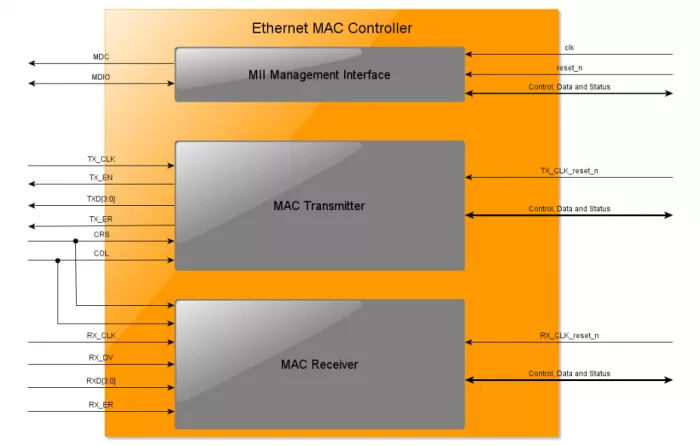
The 10/100/1000 Ethernet MAC Controller DO-254 IP Core implements the Media Access Control as specified in the IEEE 802.3-2008 specification.
It can be configured to interface with the PHY through MII, RMII, GMII or SGMII, giving a wide choice to the user for the selection of the chip to connect to the physical layer. It can be configured to operate at 10 Mbps, 100 Mbps or 1000 Mbps, allowing the user to select the speed in base of their needs such as power, size, latency, etc.
The Ethernet MAC Controller has been developed to DAL A according to the DO-254 / ED-80 and is accompanied by a Certification Kit.
A radiation-hardened version with Triple Modular Redundancy (TMR) is also available.
Implementation Details
The figures below are indicative only, they may vary depending on the selected device, used tools, IP Core configuration and user added logic.
Unless otherwise specified all the runs have been performed with the default options of the respective tool. Register placement on the IO has been disabled.
Constraints were added for a GMII implementation or MII implementation. The results listed under the column “Maximum frequency of operation” are the worst case scenario (no multicycle, false paths, etc. defined).
The results are provided for an Ethernet MAC Core with ‘g_MDC_DIVIDER’ = 10, ‘g_MII_DATA_LENGTH’ = 8 for GMII, ‘g_MII_DATA_LENGTH’ = 4 for MII and without TMR (Triple Module Redundancy), if TMR is used the number of registers will be triplicated, the combinatorial logic will also increase and there might be a penalty on the maximum ‘clk’ frequency. The reported frequency is that needed for GMII (125 MHz), MII (25 MHz at 100 Mpbs).
Note: The results provided below are for some arbitrarily selected devices. If a device does not appear in a table below it does not mean that it is not supported. The Ethernet MAC Core can be implemented in any technology.
ACTEL/MICROSEMI
| FPGA Type |
Maximum ‘clk‘ Frequency |
Logic Modules (CORE) |
| ProASIC3
(A3P400 144FBGA I Std)
|
50 MHz (MII; RMII) |
1947 |
| IGLOO
(AGL400V5 144FBGA I Std)
|
50 MHz (MII; RMII) |
2019 |
| IGLOO2
(M2GL010T 484FBGA I Std)
|
125 MHz (GMII) |
SEQUENTIAL (R-cells): 583
COMB (C-cells): 995
|
| Fusion
(AFS600 484FBGA I -1)
|
50 MHz (MII; RMII) |
2040 |
| Axcelerator
(RTAX250S 208CQFP Mil Std)
|
50 MHz (MII; RMII) |
SEQUENTIAL (R-cells): 685
COMB (C-cells): 1163
|
Note: The number of used logic modules is an approximation, since the tools do not provide detailed information of the resources used in a “per module” basis.
ALTERA
| FPGA Type |
Maximum ‘clk’ Frequency |
Flip-Flops |
ALUTs |
ALMs |
Logic Cells |
| MAX II
(EPM2210FF324I5)
|
50 MHz (MII; RMII) |
512 |
– |
– |
982 |
| Cyclone III
(EP3C5E144I7)
|
125 MHz (GMII) |
514 |
– |
– |
1091 |
| Cyclone IV
(EP4CE22F17I7)
|
125 MHz (GMII) |
513 |
– |
– |
1066 |
| Stratix II
(EP2S60F484I4)
|
125 MHz (GMII) |
512 |
591 |
563 |
– |
Note: MAX II compiled with MII options (‘g_MDC_DIVIDER’ = 10, ‘g_MII_DATA_LENGTH’ = 4)
XILINX
| FPGA Type |
Maximum ‘clk‘ Frequency |
Flip-Flops |
4-LUTs |
Slices |
Macrocells |
| CoolRunnerII
(XC2C128-6-TQ144)
|
NA |
NA |
– |
– |
NA |
| Spartan3
(XC3S1000-5FG320)
|
TX*: 100 MHz (MII)
RX: 125 MHz (GMII) |
527 |
1007 |
677 |
– |
| Spartan6
(XC6SLX45-3FGG484)
|
125 MHz (GMII) |
527 |
619 |
271 |
– |
| Virtex4
(XC4VLX15-12SF363)
|
125 MHz (GMII) |
526 |
940 |
643 |
– |
| Zync
(XC7Z010-3CLG400)
|
125 MHz (GMII) |
516 |
502 |
303 |
– |
Note *: The Transmitter needs further optimizations during synthesis and P&R.