Vendor: Tetrivis Category: Modulation Demodulation

1.8V low-power 32MHz single-bit switched-capacitor Sigma-Delta Modulator

The TRV107TSM180BCD IP is a 1.8V low-power 32MHz single-bit switched-capacitor Sigma Delta Modulator (7.8125kHz-to-62.5kHz-Nyquis…

TSMC 180nm BCDG2 View all specifications

Overview

The TRV107TSM180BCD IP is a 1.8V low-power 32MHz single-bit switched-capacitor Sigma Delta Modulator (7.8125kHz-to-62.5kHz-Nyquist-rate) implemented in TSMC Low-Power 180nm CMOS process technology. Its 13-bit performance makes it suitable for use in high-performance wireless/wireline sensor interface, fine-line Instrumentation and Internet-of-Things integrated circuit subsystems (WSN, BAN, IoT).

Key features

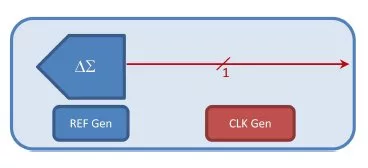
  • Integrated Single-Channel Sigma Delta Modulator
  • Integrated Common-Mode Reference Generator
  • Integrated Feedback DAC Positive and Negative Reference Generator

Block Diagram

Benefits

  • Low-Power 32MHz single-bit switched-capacitor Sigma Delta Modulator
  • capable of 13-bit performance.

Applications

  • Suitable for use in high-performance wireless/wireline sensor interface, fine-line Instrumentation and Internet-of-Things integrated circuit subsystems (WSN, BAN, IoT).

What’s Included?

  • Behavioural Models
  • Layout Abstract View
  • Timing Models
  • GDSII Layout Database
  • Netlist for LVS verification
  • Usage and Integration Guidelines
  • Databook

Files

Note: some files may require an NDA depending on provider policy.

Silicon Options

Foundry Node Process Maturity
TSMC 180nm BCDG2

Specifications

Identity

Part Number
TRV107TSM180BCD
Vendor
Tetrivis

Provider

Tetrivis
HQ: United Kingdom
Tetrivis provides Analogue, Mixed-Signal, RF and mm-Wave Integrated Circuit design/consulting services and develops ASICs and IP subsystems ranging from DC to 35GHz in Bipolar, BiCMOS and CMOS process technologies (0.5um to 22nm nodes). Tetrivis has put together an IP portfolio in a variety of nanometer-CMOS process nodes encompassing high-performance and low-power data converter, clock synthesis, RF, baseband and power management functions. Tetrivis has been expending research and development effort in providing innovative smart antenna chipset design architectures for use in the emerging LEOSAT market. With extensive experience in the latest IC tear-down and debug methodologies including Focused-Ion-Beam (FIB) debugging, Tetrivis can help you track down and repair problems on your designs. With a plethora of customers and collaborators across the semiconductor industry, we are well positioned to meet your various high-performance integrated circuit design needs.

Learn more about Modulation Demodulation IP core

Three Major Inflection Points for Sourcing Bluetooth Intellectual Property

Synopsys is now shipping support for Bluetooth® 5.4, the latest specification from the Bluetooth SIG (Special Interest Group). The enhancements in Bluetooth 5.4 will open additional markets and use cases. This is one of the many inflection points in the Bluetooth Low Energy market that will be discussed in this paper.

Part 2: Opening the 5G Radio Interface

Carriers are now deploying 5G across the globe driven by the need to keep up with relentless mobile data growth. 5G New Radio (NR) operates at higher frequencies to increase bandwidth, but at the expense of range. There will therefore be a need for a much larger number of 5G RUs to provide the same coverage. The availability of cost-effective, reliable and open 5G radio units is therefore critical.

An Integrated, Tunable RF Filter: an Enabler for Reconfigurable Front-Ends

This paper presents the design and performance of a key RF circuit necessary for the realization of a reconfigurable, integrated RF front-end: a tunable frequency, selectable bandwidth, on-chip, “SAW replacement” filter. The on-die tunable filter presented here has a tunable center frequency up to 1 GHz, a selectable bandwidth up to 40 MHz, and an adjacent channel rejection down to 60 dB.

Design considerations for integrated CMOS receivers

To meet the demands for the multi-band, multi-mode wireless standards in the current market, a highly integrated wireless receiver (RX) is desired. CMOS technology has become the technology of choice for the integrated receiver design.

Silicon IP for Programmable Baseband Processing

An efficient IP reuse strategy relies on IP blocks with wide applicability. That makes generic blocks, such as programmable processors preferable. However, in many applications such as handheld wireless terminals, additional silicon area and power consumption compared to fixed function solutions can not be accepted.

Frequently asked questions about Modulation and Demodulation IP cores

What is 1.8V low-power 32MHz single-bit switched-capacitor Sigma-Delta Modulator?

1.8V low-power 32MHz single-bit switched-capacitor Sigma-Delta Modulator is a Modulation Demodulation IP core from Tetrivis listed on Semi IP Hub. It is listed with support for tsmc.

How should engineers evaluate this Modulation Demodulation?

Engineers should review the overview, key features, supported foundries and nodes, maturity, deliverables, and provider information before shortlisting this Modulation Demodulation IP.

Can this semiconductor IP be compared with similar products?

Yes. Buyers can compare this product with similar semiconductor IP cores or IP families based on category, provider, process options, and structured technical specifications.

×
Semiconductor IP