Vendor: Rambus, Inc. Category: PCI Express

PCIe 5.0 Controller with AXI

The PCIe 5.0 Controller is designed to achieve maximum PCI Express® (PCIe®) 5.0 performance with great design flexibility and eas…

Overview

The PCIe 5.0 Controller is designed to achieve maximum PCI Express® (PCIe®) 5.0 performance with great design flexibility and ease of integration. It is fully backward compatible with PCIe 4.0 and 3.1/3.0. A PCIe 5.0 Controller with AXI  is also available. The controller delivers high-bandwidth and low-latency connectivity for next-generation applications in artificial intelligence/machine learning (AI/ML), data center, edge, 5G infrastructure and graphics.

How the PCIe 5.0 Controller Works

The PCIe 5.0 Controller is configurable and scalable IP designed for ASIC and FPGA implementation. It supports the PCIe 5.0, 4.0 and 3.1/3.0 specifications, as well as the version 5.x of the PHY Interface for PCI Express (PIPE) specification. The IP can be configured to support endpoint, root port, switch port, and dual-mode topologies, allowing for a variety of use models.

The vendor integrates and validates the PCIe 5.0 Controller with the customer’s choice of 3rd-party PCIe 5.0 PHY.

Key features

  • PCI Express layer
    • Comprises complete PCIe 5.0 interface subsystem with Rambus PCIe 5.0 PHY
    • Supports the PCI Express 5.0 rev. 1.0 (32 GT/s), 4.0 (16 GT/s), 3.1/3.0 (8 GT/s) and PIPE (8, 16, 32 and 64-bit) specifications
    • Supports the PCI-SIG Single-Root I/O Virtualization (SR-IOV) Specification
    • Supports Endpoint, Root-Port, Dual-mode configurations
    • Supports x16, x8, x4, x2, x1 at Gen5, Gen4, Gen3, Gen2, Gen1 speeds
    • Supports up to 64 Physical Functions (PF), 512 Virtual Functions (VF)
    • Supports AER, ECRC, ECC, MSI, MSI-X, Multi-function, crosslink, DOE, CMA over DOE, and other optional features and ECNs
    • Additional optional features include LTR, L1 PM substates, etc.
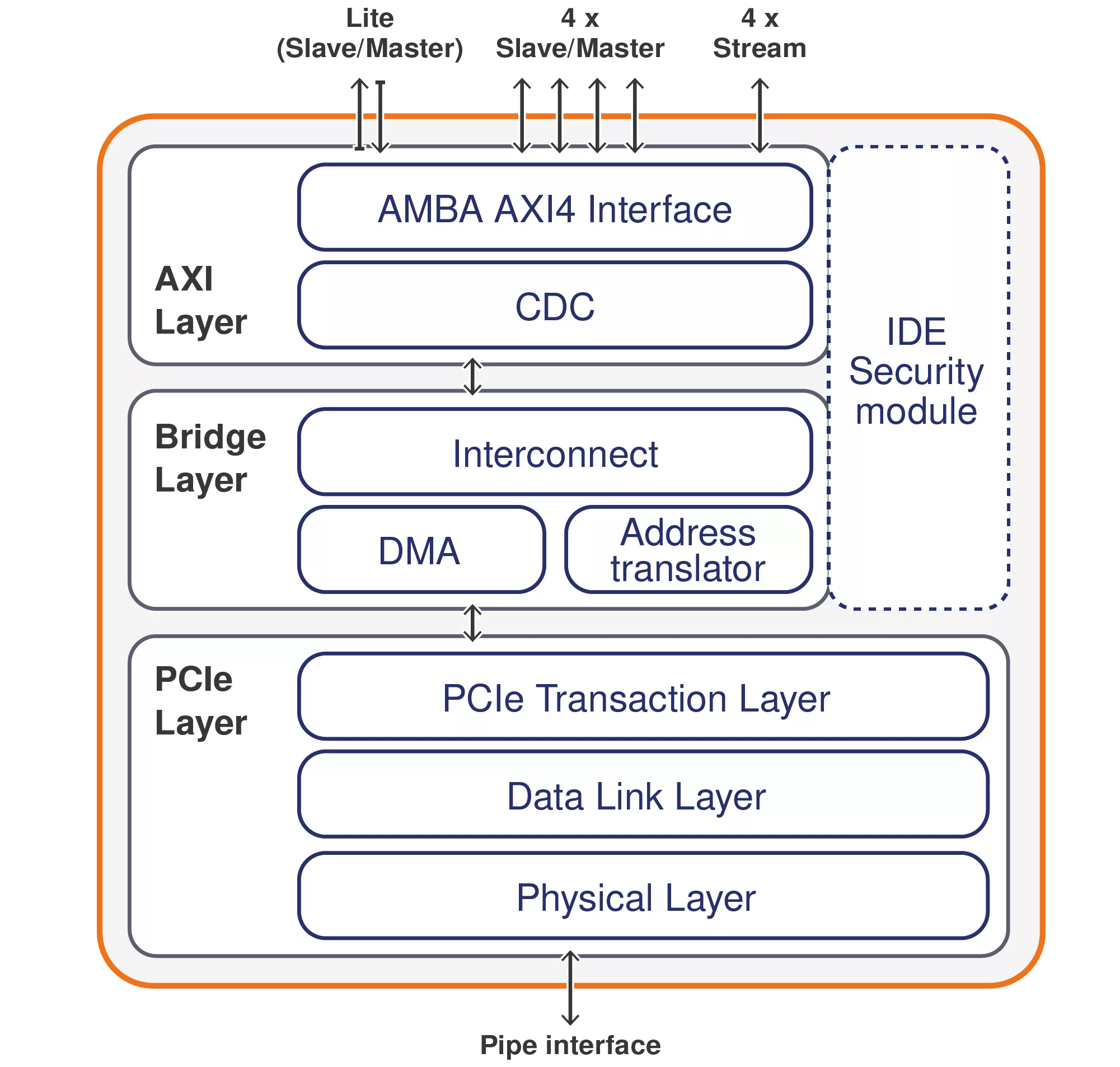
  • AMBA AXI layer
    • Compliant with the AMBA® AXI™ Protocol Specification (AXI3, AXI4 and AXI4-Lite) and AMBA® 4 AXI4-Stream Protocol Specification
    • Supports multiple, user-selectable AXI interfaces including AXI Master, AXI Slave, AXI Stream
    • Each AXI interface data width independently configurable in 512-, 256-, 128-, and 64-bit
    • Each AXI interface can operate in a separate clock domain
    • Supported Burst types include INCR, FIXED, WRAP
    • Narrow transfers supported
  • Integrity and Data Encryption (IDE)
    • Implements the PCI Express IDE ECN
    • Configurable IDE engine
    • Supports x1 to x16 lanes
    • 256-bit or 512-bit data bus for PCIe IDE
    • Configurable pipeline stages for difference process nodes for best cost and performance balance
    • Supports containment and skid modes
    • Supports multi-stream
    • Utilizes high-performance AES-GCM for encryption, decryption, authentication
    • PCIe IDE TLP aggregation for 1, 2, 4, 8 TLPs
    • PCIe IDE automatic IDE prefix insertion and detection
    • PCIe IDE automatic IDE sync/fail message generation
    • PCRC calculation & validation
    • Efficient key control/refresh
    • Bypass mode
  • Data engines
    • Optional built-in Legacy DMA engine
      • Up to 8 DMA channels, Scatter-Gather, descriptor prefetch
      • Completion reordering, interrupt and descriptor reporting
    • Optional Address Translation tables for direct PCIe to AXI and AXI to PCIe communication

Block Diagram

Benefits

  • Internal data path size automatically scales up or down (64-, 256-, 512- bits) based on link max. speed and width for reduced gate count and optimal throughput
  • Configurable pipelining enables full speed operation on Intel and Xilinx FPGA, full support for production FPGA designs up to Gen4 x8/Gen3 x16 with same RTL code - Gen5 support pending
  • Stringent implementation of PCIe to AXI Ordering Rules and AXI to PCIe Ordering Rules guarantees AXI deadlock prevention
  • Carefully engineered AXI bridge & AXI interconnect allows full performance on AXI interfaces
  • Availability of multiple AXI Master interfaces, a key benefit for high end SSD to maximize throughput
  • Optional QuickBoot mode allows for up to 4x faster link training, cutting system-level simulation time by 20%

Applications

  • HPC,
  • Cloud Computing,
  • AI,
  • Machine Learning,
  • Enterprise,
  • Networking,
  • Automotive,
  • AR/VR,
  • Test and Measurement

What’s Included?

  • Verilog RTL,
  • Supporting Documentation

Files

Note: some files may require an NDA depending on provider policy.

Specifications

Identity

Part Number
PCIe 5.0 Controller with AXI
Vendor
Rambus, Inc.

Provider

Rambus, Inc.
HQ: USA
Rambus delivers industry-leading chips and silicon IP for the data center and AI infrastructure. With over three decades of advanced semiconductor experience, our products and technologies address the critical bottlenecks between memory and processing to accelerate data-intensive workloads. By enabling greater bandwidth, efficiency and security across next-generation computing platforms, we make data faster and safer.

Learn more about PCI Express IP core

Challenges in PCI Express IP Implementation

IP selection, verification and integration are key aspects to the success of an IP-based design. This paper describes some of the challenges imposed by an IP based implementation of the technology and discusses about possible solutions to address them.

Realizing the Performance Potential of a PCI-Express IP

This paper describes challenges involved in realizing the maximum performance of a configurable interconnect IP (GPEX - Rambus PCI Express Digital Controller). The following sections describe how various performance metrics such as roundtrip latency and bandwidth can be used to characterize a PCI Express IP performance and its impact on the system. The ideas presented can also be applied to other high speed interconnect architectures like RapidIO and Hypertransport

Frequently asked questions about PCIe IP cores

What is PCIe 5.0 Controller with AXI?

PCIe 5.0 Controller with AXI is a PCI Express IP core from Rambus, Inc. listed on Semi IP Hub.

How should engineers evaluate this PCI Express?

Engineers should review the overview, key features, supported foundries and nodes, maturity, deliverables, and provider information before shortlisting this PCI Express IP.

Can this semiconductor IP be compared with similar products?

Yes. Buyers can compare this product with similar semiconductor IP cores or IP families based on category, provider, process options, and structured technical specifications.

×
Semiconductor IP